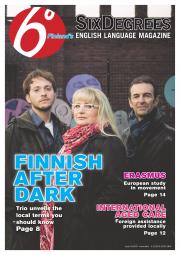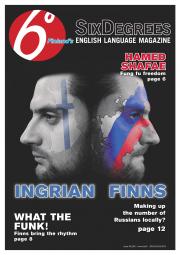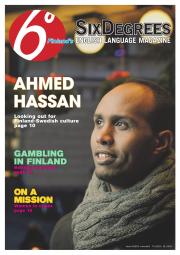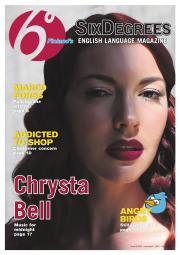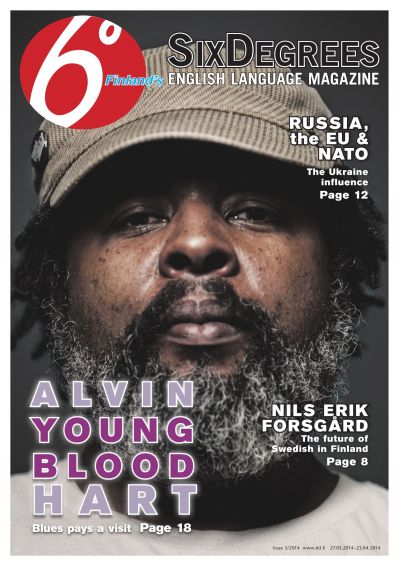


• Finland?s SixDegrees english language magazine Russia , the eu & nato The Ukraine influence Page 12 a lv i n Yo u n g blood nils erik forsgÅrd The future of Swedish in Finland Page 8 h a r t Blues pays a visit Page 18 Issue 3/2014 www.6d.fi 27.03.2014?23.04.2014
  • Stay connected with your loved ones for less Send money with MoneyGram * from only ?5 moneygram.fi Available at: CS7742 And anywhere you see the MoneyGram sign * Fees mentioned are for sends up to ?30. In addition to the transfer fees applicable to a transaction, a currency exchange rate set by MoneyGram or its agent will be applied. For a full list transfer fees please visit www.moneygram.fi. Change Group is an agent of MoneyGram International Limited in the provision of money transfer services.MoneyGram and the Globe and MoneyGram Brings You Closer are trademarks of MoneyGram. All other marks are the property of their respective owners. MoneyGram International Limited is authorized and regulated in the United Kingdom by the Financial Conduct Authority. © 2014 MoneyGram. All rights reserved.
  • s to group starting with cardio was longer. The researchers hence the researchers set a limit for the combine exercise regimen: position between the two training orders?? Start your weekend with news in English. Why not add Helsinki Times to your morning coffee? Spring collection near you IMAGES: HSY / Jenni-Justiina Niemi Stay informed about news and current affairs in Finland by subscribing to the weekly Helsinki Times. To subscribe: e-mail subscribe@helsinkitimes.fi Visit www.helsinkitimes.fi for a daily Finnish news update in English. Koulutuksia maahanmuuttajille. Perusopetus ? nuorille ja aikuisille, joilla ei ole peruskoulun päättötodistusta ? hakuaika 20.4. saakka ? täytä hakulomake www.hdo.fi > Hakijalle Valmentavat ja kuntouttavat koulutukset ? suomen kielen opiskelua ? erityistä tukea opiskeluun, jatko-opintojen suunnitteluun tai työelämään siirtymiseen ? myös luku- ja kirjoitustaidottomille ? hakuaika 20.4. saakka ? täytä hakulomake www.hdo.fi > Hakijalle Valmistava koulutus, MAVA ? suomen kielen opiskelua ? tietoa erilaisista ammateista ja koulutuksista ? tutustumista suomalaiseen työelämään ? kesto yksi vuosi ? hakuaika 16.6.?25.7., opintopolku.fi Koulutukset alkavat elokuussa 2014. Opetuskieli on suomi. SPRING is almost here, and many residents of Helsinki are setting to work with the annual springcleaning of their homes and apartments. However, what to do with certain items that cannot be thrown away in the regular bins each week? A free service from 31 March until 26 May, touring collection vehicles are scheduled to arrive at a location near you. ?Touring collection vehicles collect hazardous waste, scrap metal and electric and electronic equipment,? explains Leif Bergström, Head of Hazardous Waste services at HSY. ?The service is intended for small lots from private households. It is not a free transportation service for companies.? Tailored for people who don?t own a car, this convenient and easy service enables you to dispose of your waste in an environmentally sound manner that?s easy on the wallet. Items which are collected: 1. Hazardous waste from households. Energy-saving bulbs, paint, solvents, cleaning chemicals, batteries and medicine. (not impregnated wood, explosives). 2. Scrap metal. (Small lots ? full trailers to HSY?s Sortti-stations) Bicycles, wood-burning stoves, hot-water tanks and metal containers and cans. 3. Electric and electronic equipment (max. three pcs. of the same item). Refrigerators, freezers, TV sets, coffee makers, washing machines, computers and food mixers, among other things. The spring collection service is provided by HSY (Helsinki Region Environmental Services Authority). HSY provides water services and waste management services for Espoo, Kauniainen, Helsinki, Vantaa and Kirkkonummi and also produces information about the Helsinki Metropolitan Area and the environment. Find out when and where you can deposit your hard waste (in Finnish): www.hsy.fi/keraysautot www.hdo.fi www.hel.fi
  • HELSINKI TIMES 27 MARCH ? 2 APRIL Customer service points Rautatientori Metro Station (by Central Railway Station) Itäkeskus Metro Station Pasila, Opastinsilta 6A Monthly review 3 HSL Customer service tel. 09 4766 4000 (Mon-Fri 7am-7pm, Sat-Sun 9am-5pm) Advice on public transport routes, timetables and tickets, Travel Card assistance and lost Travel Cards HSL Helsinki Region Transport PO BOX 100, 00077 HSL www.hsl.fi My HSL provides information about your preferred routes LaUri erikSSon The HSL.fi online service expands with a new My HSL section, which provides all of the information you wish to get in one place. Up to 49 per cent of visits to HSL.fi in February were made from mobile phones or other hand-held devices. Fare dodging decreased In 2013, about 2.7 per cent of public transport passengers were caught fare dodging, while in 2012 the figure was about 3.2 per cent. The highest number of fare dodgers were found on commuter trains, trams and the Metro. HSL is responsible for ticket inspections on the HSL area public transport services and on longdistance trains across the country. In 2013, HSL?s goal was to increase the number of tickets inspected and target the inspections in a certain way to reduce fare dodging. HSL not only reached the goal but exceeded it, as last year HSL inspected the tickets of some 4 million passengers compared to 3.4 million in 2012. New technology has played a key role in making the inspections more effective. In spring 2012, HSL replaced the old devices with new ones. The new devices clearly speeded up ticket inspectors? work: in 2012, a ticket inspector inspected the tickets of 232 passengers per day on average, last year the figure was about 260 per day. As HSL lost nearly 8 million euros due to fare dodging last year, fare evasion still makes a significant dent in the public transport finances. The My HSL service is built around the routes you use regularly. You can register for the service at HSL.fi. Once you have registered, you can select the routes for which you want to receive traffic bulletins, news and disruptions alerts. You can get the news and alerts via My HSL or you can have them sent to your email. My HSL comprises upgraded versions of Disruption Info (www.poikkeusinfo.fi) and My Departures (www.omatlahdot. fi), which will be closed as separate services in early 2014 but you will be able to use the familiar services by registering for My HSL. On the new website, Disruption Info and My Departures will work without any hitches regardless of the device used, so they are suited to mobile use. This is particularly important for passengers using public transport because up to 49 per cent of visits to HSL.fi in February were made from mobile phones or other hand-held devices. Park your bike with a Travel Card In My HSL you can also register to use a new bike parking service, which works with a Travel Card. The service is run by HSL and HKL and it is first being trialed at Vuosaari Metro Station. There are both sheltered bicycle racks with a frame locking system and lockers which work with a Travel Card. HSL is collecting feedback on the pilot with a view to expanding the service to other Metro stations at a later stage. My HSL is first released as a beta version and the service is further developed on the basis of user experiences and feedback. Myllypuro station to be renovated Public transport gaining popularity The Myllypuro Metro station will undergo an overhaul in August. The station will become even more accessible, as after the work there will be more lifts to the platforms along with a new escalator access to the ticket hall in the Myllyaukio square. Besides the paving, seating and lighting, the roof above the platforms will be replaced and glass walls added to protect passengers from the wind and rain. The surroundings of the station will be improved by redoing some of the surfaces, planted areas and ramps. Existing areas for bicycles will also be improved and new ones added. The work will be completed in summer 2016. The station will be in use throughout the renovations. According to a study conducted by HSL, residents of Helsinki spend 73 minutes a day travelling, making 3.4 journeys on average on weekdays. For the first time in five decades, public transport is gaining popularity faster than private motoring in the metropolitan area. The share of public transport of all journeys has increased in all municipalities in the area, on both commuter and leisure journeys, among men and women and in most age groups. Around 80 per cent of residents in the metropolitan area use a Travel Card or a similar public transport ticket, while the corresponding figure for the entire HSL region is 30 per cent. In Helsinki, 77 per cent of people have a driving license, compared with 91 per cent in Nurmijärvi, Tuusula, Sipoo, Mäntsälä and Kauniainen.
  • Contents 5 SixDegrees in this issue April 8 Nils Erik Forsgård It?s time to fling open Finland?s doors to immigration and create more of a welcoming atmosphere for newcomers, according to this author and leader of the think tank Magma. 10 All-a-board 12 Ukraine & more 17 Blues for three Even though the gaming market is saturated with the bells and whistles of computer games, boardgames still have a place in many homes. Amidst the fears and speculation regarding the situation in Crimea, what does all of this mean for Ukraine, Russia, the EU and the US? The SixDegrees Team Editor-in-chief Alexis Kouros Subeditor James O?Sullivan Advertising & Marketing Aiman Kaddoura, Bob Graham, Ethan Shadabi, Kenneth Martin +358 9?689 67 422 Emails in the form: firstname@6d.fi Events for Out & See: james@6d.fi Writers and contributors in this issue Anski Auramo, Nick Barlow, David Brown, Johannes Hautavirta, Teemu Henrikkson, Lia Lezama Sarrah Kassem, Andy Kruse, Kai Kuusisto, Anna-Maija Lappi, Tania Nathan, James O?Sullivan, Mika Oksanen, Leonard Pearl, Eva Peltonen, Thomas Poole, Mari Storpellinen Mimmu Takalo, Jutta Vetter, Tomas Whitehouse Proofreading James O?Sullivan Image: C. Kola & Mischa Scherrer 6 Starters 15 Society Immigrant bus drivers, David Brown, Legal Immigrants and Minority Report. 16 Tastebuds We grab some Jamaican in Helsinki, explore Asian grocery stores and discover a fun Finn food fact. 18 Cultitude Spring Night Visions Festival, Alvin Youngblood Hart, Alfredo Jaar, Tove Jansson, Funky Elephant Festival, European Film Weeks. Also, find out what?s on at the cinema and in the gaming world over the next month. 20 Out & See Where to go and what to see in Helsinki, Tampere, Turku, Jyväskylä and Oulu. A Scotsman, a Finn and an American walk into a bar. Not just any bar, mind you ? this is where Robbie Hill & The Blue 62?s first met. Layout & Graphic Design Kirby Wilson Print house I-Print Seinäjoki Circulation 50,000 pieces Publisher Dream Catcher Productions www.dreamcatcher.fi 6° DreamCatcher Vilhonvuorenkatu 11B 00500 Helsinki tel. +358 9?689 67 420 fax. +358 9?689 67?421 info@6d.fi www.6d.fi ISSN 1459-5680 All articles, pictures and graphics are subject to copyright. No reproduction or reprinting is allowed without permission from Dream Catcher Inc.© Dream Catcher Next issue is out on 24 April SixDegrees can also be read at www.lehtiluukku.fi
  • Starters 6 Issue 3 2014 Top 5 things on our mind this month... On Ukraine and the ripple effect Anyone who has lived in Finland long enough knows that political unrest experienced anywhere in Russia will always cause concern here as well. After centuries of mutual raiding and plundering in the border regions, some 70 years of peaceful co-existence is not enough to obliterate the bad memories. The aesthetic of ugly random things In addition to creating interesting patterns running down the Tarmac, the melting snow reveals a display of contemporary urban art in the landscape: cans, bottles, wrappings and other stuff that are fascinating in a quaint way. Amateur stages at the backbone of Finnish culture Even though you may find it difficult to pick up the dialogue in a play where the language is Finnish, you will have a good time at your local amateur theatre. What deficiencies they may have in resources and lack of cool professionalism they are largely able to compensate for with the burning desire to reach out and entertain. Traditions and style councils The recently retired Finnish alpinist Tanja Poutiainen inadvertently prodded some termites? nest by publicly donning a combination of Sami apparel and other clothing items; Sami handicraft specialists went out to strongly criticise her for this. But isn?t it OK for you to look the way you feel, as long as you?re decent? The ability to set the tone is a big thing in life As fast as our top-flight ice hockey has become, what a privilege it felt to watch a player in the Finnish league pick up the puck at his team?s zone and, instead of firing a ?wish you well? loop pass somewhere, slowly circle forward in gyro fashion for a better passing angle. And that?s the thing ? many times the speed at which we do things can be as uncomfortable or comfortable as we make it to be. Mika Oksanen Word on the street What is the best way to get into shape for summer? Elina By working out. Just by doing something simple on a daily basis, like jogging. And you don?t have to go long distances and super fast, light exercise is a good way to start. Mari Juntunen First of all, clean up your diet and start eating healthily. After that it?s easier to get going. Get your bike back out after the winter. I also find it a great combination to do yoga and jogging. Kati Blomqvist Just get active, by walking and jogging. It?s not about having a gym membership at the best gym in town, a workout at home will do just as well. Oona Ahonen I?d say by mental exercises to start with, as it?s so hard to stick to an exercise regime! After you get into the routine, it gets easier. I don?t think it really matters what you do, as long as you make sure you do a little bit every day. I go on dance classes and I?d recommend that to anyone as it?s so much fun, you don?t even realise doing your hated exercise. Compiled by Mari Storpellinen. Cycling season is upon us. (hopefully!) James O?Sullivan W HILE the arrival of takatalvi has predictably come along to take the wind out of the sails of springtime celebrations, nonetheless it?s soon time to dust off your neglected bike from your basement storage and gets to enjoying the multitude of bike tracks that weave their way around the country. Finns love to cycle, and in the Capital Region alone there are around 1,000 kilometres of well-maintained cycling paths intersecting the city. In fact, when entering even the most remote of cities, towns and villages around the country one can find a well maintained path for two-wheelers alongside the road leading in and out of town. However, the joy of taking your bike out of storage this time of year is often met with the disappointment of having forgotten you still have to take it to huolto (maintenance). Now, although it may seem to be too much of a financial hit to shell out around 80 euros for someone to merely tighten brakes, oil your chain and align up your gears, you?ll be grateful later in the summer when your bike is still rolling smoothly. But brace yourself for another whopping disappointment after being slugged for maintaining your two-wheeler: getting a flat tyre. Now, with all of the rubbish that has been accumulated under the seasonal snow, it?s only a matter of luck if your path is not met by a stray piece of glass or nail. Also watch out for the well-preserved thawing dog turds that abound this time of year, lest you have the misfortune of riding through the middle of a deposit and have it sprayed across your back by your rear tyre. Actually, speaking of which, a Swedish company has developed the appropriately named Ass Saver, which works a treat in this context. A small piece of plastic that can be easily attached underneath your seat, here all matter of springtime junk is prevented from decorating your tail in spectacular fashion, acting as a cheap and easy alternative to arriving at your chosen destination looking like you have soiled yourself. Otherwise, before you head off, be on alert for the unfortunate prevalence of mopeds when you cycle, typically driven at breakneck speed by teenagers who have been given the legal green light to use the bike paths for their vehicles. And finally, be aware that around 4,000 bikes are stolen each year in Helsinki alone, so be sure to carry a securely lock up your steed! Phew, after all of this, you are ready to go?well, almost. One final thing to keep in mind is using a helmet. Sure, it looks a heck of a lot less siistii to cover your scone and deny the summer breeze blowing in your hair as you pedal, but take a moment to consider the devastating damage caused by relying on your skull to take the brunt of impact should you fall off your bike. BTW, what?s up with the usually sensible people of Finland have not enforcing helmet use as a law? For those short of cash but still seeking to keep the insides of their head on the inside in the Capital Region, helmet hire has previously been available from Virka Info inside Helsinki?s City Hall. Finnish After Dark Learning the Finnish they don?t teach in school Suomeksi: Kärähtää A BL E AVAIL ATED W O N TR ILLUS AS AN ERBACK. tores ooks PAP ajor b .fi/fad rom m .6d Buy f line: www or on English translation: To get burned. Having your food burned is one thing, getting burned yourself another entirely. In this sense, the getting burned refers to the court system and punishments handed down from the bench. As you might guess, this is almost always a very bad thing, so try and avoid both getting burnt, and telling your mates you?ve been burned ? at least if you only mean the toast. ? ? Kuulittekste? Milla käräti ratista? Sen ajokortti joutu hyllylle. Eihä? No, onneks ei kärähtäny mistään pahemmasta! Mä oon kuullu, et sillä on kaikkia hämärähommia meneillään. ? ? Did you hear? About her getting burnt for drink driving? Lost her licence for it. Really? Well, lucky shea wasn?t burnt for anything worse! I hear she has all kinds of shady deals going on! David Brown and Mimmu Takalo
  • SixDegrees Starters 7 SixDegrees Tell me about your city... To fee or not to fee ? Constantine Will Finland pay the cost of charging international students for tuition? Tijana Stolic F inland is currently the only country in the EU that does not charge tuition fees, but this may change as Helsingin Sanomat recently reported that the Ministry of Education and Culture is preparing a report to be discussed in budget talks. The report proposes that tuition fees be charged to students from outside the EU/EEA who undertake courses in languages other than Finnish or Swedish. A disclosure ? as an international master?s student, my opinion may be slightly biased, but here are some points to consider when discussing the implementation of tuition fees. Should tuition fees be implemented, it can be expected that the number of international applications, and therefore the number of international students accepted to Finnish universities, would drop. The same has happened in other Nordic countries. According to a study commissioned by the Nordic Council of Ministers and conducted in 2013 by Oxford Research, the number of international students significantly dropped in Sweden since it implemented tuition fees for undergraduate and master?s students Tomasz Sienicki Beer glass soon half empty in 2011, as well as in Denmark, which started charging tuition in 2006. Both countries have since increased marketing campaigns and scholarship initiatives to boost the numbers. If the number of international students drops here in future, what kinds of consequences would this have on the internationality of Finnish universities? The University of Helsinki, for example, is continually on a mission to increase its world ranking, but if it can?t boast a high number of international students, will this help its goal? Moreover, should the number of international applications drop, the pool of quality applications would diminish accordingly. The rationale for introducing tuition fees is, of course, saving money, but what saves money in the immediate future, may not do the same in the long run. Investing in a bunch of young, smart, ambitious, culturally diverse people might certainly be financially beneficial for Finland in the future. Let us not forget that Finland is currently experiencing difficulties with economic growth and needs all the taxpayers and job providers it can get. And although many international students come to Finland for the free education, many decide to stay. After all, Finland is a great place to live with an equal society, a welfare system, and free education for all. James O?Sullivan T HE sale of alcohol in Finland continues to be a delicate matter for both sides of the argument of moderation. While wine lovers have to plan their consumption in light of Alkos being closed around the country on Sundays, Helsingin Sanomat reports that mid-strength beer may next on the list of restrictions in order to curb the enthusiastic consumption of alcohol around the country. Amongst a number of proposed new measures, the Ministry of Social Affairs and Health is pushing for beer sales at grocery shops, kiosks and service stations be outlawed after 6 pm on Fridays and Saturdays, as well as on Sunday mornings. Aside from the cut in hours of availability on shelves, it has also been proposed that beer?s alcohol content be diluted from 4.7 to 3.5 per cent by volume. Furthermore, a gradual tax hike is proposed in the coming years, as is the restriction of late-night sales of alcohol in pubs and restaurants. How this all advances, it remains to be seen. However, with vehement opposition already gathering voice, the debate will continue to rage on for some time. HOW WELL DO YOU KNOW Easter IN FINNISH? 1 2 3 4 1. Bunny 6. Basket 2. Yellow 7. Colourful 3. Good Friday 8. Decorate 4. Chocolate 9. Daffodil 5. Egg 10. Tulip 5 6 7 8 9 Test your knowledge of Finnish vocabulary by using the local equivalent. Puzzle by Eva Peltonen. Solutions on page 21. Raouf Sifour I n Finland you have this saying: a beloved child has many names. That is Constantine, the City of Knowledge, the City of Bridges, and the City of Warriors. It is one of the biggest and wealthiest cities of Algeria, as well as the commercial centre of the region, and therefore a place where many people come in their search for a better life. The official number of people living there is around one million. During daytime, however, the population doubles as people come to the city for work and study. Poor people around the area gather there to try and earn some money. Constantine has a very distinctive geographical position. The city was originally built on top of a stone mountain. Later, an earthquake split the mountain in two. Therefore, Constantine is now divided in two separate parts that are connected by bridges. Between the two parts runs a river down in the gulley. There is also an airport, considered as one of the most dangerous in the world as the plane needs to go round along the mountainside to get to the airport in the relatively narrow gulley. In Constantine, you are never far away from an incredible view. It is not a place for someone with fear of heights. The suspended bridges over the gulley are hundreds of metres long and not supported by any pillars. Constantine is the Arabic capital of culture, known as the City of Knowledge. Most of the rulers and thinkers, the highest educated people of Algeria come from there. On 16 April the whole of Algeria celebrates the Day of Knowledge. Constantine is the centre of that. There is no nightlife in Constantine, no bars and clubs, and people eat out mainly in the daytime. Taxi is a common way of transportation as it?s very cheap. There are also cable cars and an elevator for transporting people from the bottom of the mountain to the top. The weather conditions in Constantine are quite extreme. Winters are very cold, and summers very hot. Normally, there is always snow in the wintertime. In the summertime, the temperature might go up to 50 degrees Celsius. It is often windy in Constantine but even that doesn?t help in the summer temperatures because it feels like a hair dryer directed at your face. Springtime is best for visiting. In the autumn, there are often thunderstorms coming from the Sahara. After the storms the city is red-coloured because of the sand brought over from the desert. With the heat and the post-storm humidity there is steam everywhere. You feel like you were in a sauna. Currently, Constantine is going through big changes. The city is overcrowded and because of its geographical situation it is impossible to expand the borders. That is why they have started building a new city next to the mountain. Currently, there are a lot of Brazilian workers. Constantine has always been a bit of a melting pot of different cultures. In the ?70s, it attracted a lot of immigrants, among others Finnish fishermen. At the time, Algeria was doing very well economically and it was easy to make money there. During the terrorism time in the ?90s many industries suffered, tourism being one of them. Now tourists have found the city again, and the hotels are fully booked all year round. Contact james@6d.fi if you want to share the inside word on your town.
  • 8 We Met Issue 3 2014 Tomas Whitehouse An opportunity in Swedish Nils Erik Forsgård believes it?s time for the Finland-Swede community to stop acting like a hedgehog and open their culture to change. James O?Sullivan S ITUATED near the corner of Helsinki?s Annankatu and Boulevardi, the interior of the Swedish-language think tank Magma offers some remarkable contrasts. A large window frames the office of Magma?s director Nils Erik Forsgård, overlooking the graves scattered around Ruttopuisto (aka Plague Park). A glance into an adjacent room reveals a wall adorned with a disturbing photo of a woman, completely submerged by water. Spending a few moments studying the complexities of the image as I wait for Forsgård to join me, I wonder if this is a bold statement reflecting the state of the Swedish language here in Finland: perceived by some as drowning in a Finnishlanguage bath that is filling at a rapid rate, coupled with an influx of immigrants arriving here choosing to integrate in Finland. Given the presence of other, less confronting images hung on walls throughout the office space, it remains to be discovered exactly what is meant by this provocative image. Is this a deeply symbolic representation of the current status of the author and historian?s culture in Finland, as it drowns and gasps for air? Or is it, to put it simply, art for art?s sake? Having just returned from Berlin earlier this afternoon, a city where he lived between 2001 and 2008, Forsgård is catching up on emails and paperwork in the few minutes before our agreed interview time. Apologising for keeping me waiting, he takes a seat across the table. The elephant in the room ? the photo that looms behind me ? is the first thing on the tip of my tongue. I couldn?t help but wonder about this photo. So do I, still. Every time I look up from my computer I see a drowning woman. I?m not sure what to do about it. There is an art institution called Pro Artibus, which, among other things buys art and sculptures from young artists. They also have a system where you can borrow these paintings from them for a year or so, to cover your white walls. These motives and photos were brought here without my knowledge. More or less. I?m the boss, so it tells a lot about me being in charge. [laughs] You have been working here at Magma since returning from Berlin in 2008. What were you doing in Germany? I was a guest professor in cultural sciences at the Department  of Northern  European Studies at Humboldt University. Berlin was a great time and place for me, and still is. I taught societies, politics, culture, movies and literature. I soon realised that many of the students had a pretty romanticised vision of the north. They could also tell me stuff, like, ?I met a guy from Stockholm, and he was very much like an Ingman Bergman character.? What I also noticed was that many people had a notion of the north based on Astrid Lingren?s stories for children, Pippi Longstocking, and so on. It?s actually a very interesting fact is that Lindgren?s stories were used to ?denazify? the German people after the Second World War. The whole concept of an idyllic small village with red small houses, with good-hearted people living there was something they tried to establish among the German young people after WWII. How did you own culture as a Finland-Swede inform your lectures? When I would introduce myself at parties it was a very common understanding of the FinlandSwedes that I belong to a posh culture. ?You come from a culture that is slightly better than the Finn- ish speaking Finns.? I don?t know where they got this idea. But I know that many Finnish-speaking Finns also have this idea of us Swedish-speaking Finns, that we feel superior to them. Sure, there might be some Swedish-speaking Finns who have this vision of the world, but you find strange and posh people anywhere. In general so many of us are very normal, regular people living our lives, trying to make end meet. But it is still difficult to know what to say in response. You can?t start lecturing people to look at statistics and median income to see we are just like you are. We have a Swedish-speaking culture in Finland and that?s really all that makes us different. So many traits of the majority Finnish-speaking culture are in the Swedish-speaking culture, and the other way around. People don?t see these traits and elements in their daily life. And they don?t understand ? in some cases don?t want to understand ? these elements. But if you go to a small village close to where I come from, 100 kms inland from the coast, you will find villages where people speak a kind of dialect that is a high mixture of Finnish and Swedish. They use very many Swedish words, which they don?t even think about. They have been implemented in the language andused over many
  • We Met 9 SixDegrees ?T he dimensions of the Swedish-speaking population here can be likened to the same demographic problems that we have in Europe: we don?t fuck enough.? So Magma is confiscating all of the condoms around the country? That?s our basic strategy. [laughs] Published works ? ? ? ? ? ? ? ? ? ? I det femte inseglets tecken (dissertation, 1999) Alias Finkelstein. Studier i antisemitisk retorik (2002) 10115, Berlin. Nedslag i en europeisk huvudstad (2005) Heartlands. Anteckningar från en resa genom USA (2007) September 1808 (2008) Maktbalans och stormaktskrig 1721-1814 (2008) Hannahs gåta. Texter 1989-2009 (2009) Hemingway - En betraktelse (2011) Himlar över Alabama (2012) Ingens herre, ingens träl. Radikalen Anders Chydenius i 1700-talets Sverige (forthcoming, 2014) generations. We, as Swedish-speaking Finns, also consider ourselves to be Finnish. We don?t want to make a big fuss that ?we speak Swedish?. We just want a society where some fundamental rights are taken into consideration: healthcare, schooling. Otherwise we are just the same as the others. How does Magma work for Finland-Swedes in Finland? We are not so concerned with Swedish-speaking Finns, actually. This is not the object of our work. The element we work with is the Swedish language. We consider Swedish to belong to all of Finland. It is not only here in Helsinki or in places where you can speak Swedish that it exists. It exists everywhere in Finland. It is part of Finland and our history. Magma is definitely not some kind of propaganda institute for Swedish language in Finland. We consider ourselves to be more of a research institute. We don?t belong to any political party, we consider ourselves to be neutral. We don?t have any agenda. What we are interested in and want to see is how the Swedish language can survive in Finland. How can we legitimise the language as a living language when considering the fact that the number of Swedish speakers continues to stay the same, or grows a little, but not fast enough? As a percentage of the population it is diminishing all the time. The culture is not going anywhere, but the relative importance is diminishing, due to the fact that we have immigration and that the Finnishspeaking population grows much faster. The dimensions of the Swedish speaking population here can be likened to the same demographic problems that we have in Europe: we don?t fuck enough; we are not having enough children. This is one of the problems. Swedish speakers should start making love. How do you preserve the language? We can?t really do anything. What we can do is to observe any challenges or perhaps dangers when it comes to the circumstances where Swedish is spoken. One basic thing for keeping the Swedish culture alive is that there are solely Swedish-speaking schools. Without the Swedish educational system here and possibilities to go to school and study in Swedish, there would be no Swedish in Finland. Everything would erode and disappear within 100 years. The basis for the whole Swedish culture is the school system. On the other hand it is very important that Swedish speakers learn Finnish and that at least some Finnish speakers learn a decent amount of Swedish. We made a report last year about bilingual schools. There?s a Finnish-French school, a Finnish-German school, all kinds of bilingual schools existing in Helsinki. But there is no Finnish-Swedish school, a school where you could use both of the official languages of Finland. This is partly because there is a sensibility among the Swedish speakers that we need those monolinguals schools where you can solely speak the language. And that is undertstandable. However, there is room for bilingual schools for Swedish and Finnish at the same time without risking the Swedish-speaking school system, or, for that matter, the Finnish-speaking school system. Of course the minority is much more vulnerable than the majority. We are approximately 290,000 Swedish speakers; more or less the same amount as the Icelanders. Formally we are not even a minority. Swedish is the second official language in Finland and Swedish speakers in general certainly consider themselves to be Finns. But we are still in a minority position. Our challenge is this: European minorities, in general, can be found clustered together. But when you look at Finland we have one people, 5.5 millions Finns, living all over the country speaking Finnish and partly Swedish, with a certain tendency on the west coast and in the south and Åland Islands. We also have these language islands of Tampere, Jyväskylä and Lahti and so on, where you have a few thousand Swedish speakers. Another dimension that we focus on here in Magma is the growth of immigration and integration into the Swedish-speaking culture. Are there currently enough opportunities for this? There are so many problems linked to this question. First, why learn Swedish if you come to Finland? Everything works in Finnish. Of course, if you go to Vaasa or Osthrobothnia you?ll hear Swedish spoken, but Helsinki is eroding. It used to be a very Swedish-speaking city. Things have changed very rapidly over the last two decades in Finland. The other challenge is that the more immigrants we have, the smaller the Swedish-speaking minority gets. And, as Finland also has a shared history with Russia, can the Russians eventually say that Russian should be an official language of Finland? ?If you say you have a shared history with Sweden, and that?s why Sweden is an official language in Finland, we also had 100 years with Finland. Shouldn?t Russians have the same rights as the Swedish-speakers when we move here?? Actually, in the 19th century, many Russians immigrated into the Swedish-speaking community. Many old Russian families here are Swedish-speaking. Nowadays, the new Russians coming to Finland tend to build their own Russian-speaking communities, rather than integrating with the Finnish-speaking population, or the Swedishspeaking population. So we have a new situation compared with what it used to be 150 years ago. The Russian-speaking minority is growing, just like many other minorities, and many Swedishspeakers would like at least some of these newcomers to integrate in Swedish. That would, of course, also boost our demography. Is this possible? Why should they have to learn Swedish? Why would they need to learn Swedish? The big problem is that you still need to know Finnish in order to make a decent career in Finland. But the Swedish networks are pretty tightknit aren?t they? Yes they are. Certain doors might open a little quicker in the Swedish-speaking community? They might. But I?m not too sure about that either. It depends. Even though you would know Swedish, there is no certainty in you getting a good job anyway. You will still have to learn Finnish. I think that?s a problem: a situation where people could easily apply for good jobs is missing. On the other hand we have all of the other Nordic countries nearby. Some people argue by saying that you learn Swedish in Finland and you can then always move to the other Nordic countries, as there you can be understood and can use the language. But then again, why did you move to Finland in the first place? At least not to move away immediately. Anyway, the immigration policy of Finland sucks badly. Why do you say that? When we look at Sweden, a lot of the power in the Swedish economy is due to the fact that they have a lot of immigrants that have created their own business, who are doing their own thing, contributing to the Swedish economy in a very positive way. We should have the same, but we don?t have it as yet. In Finland we have a lot of people from other countries who make pizzas and drive taxis. It shouldn?t be that way. A doctor from Lebanon should not have to drive a taxi in Helsinki. We have not adapted to the new world in the right way as yet. We need to see the possibilities. It?s the same within the Swedish-speaking community; it?s not only the Finnish speaking community. The possibility to advance, fulfil your life and dreams, whatever they may be ? Finland is still not good at that. How can this be rectified? I?m not sure. We should at least make life better for people who were not born here and come to this country where people are sneezing and freezing and it?s cold and dark half the year. Still they are brave enough to come here. Here at Magma we have recently been looking closely at the integration of immigrants. How does it work? How can Finnish society boost careers for small businesses? What is the right way, what information is needed by newcomers in order to make a new life, to be more productive, more successful? How can we open up our own Swedish-speaking community for newcomers? How can we be welcoming? What is the way to do it without being pushy, or too eager? Just give people the opportunities. I understand that the focus of your latest book, Finnish priest and a politician Anders Chydenius (1729-1803), had some innovative ideas on this issue. He said something already in the middle of the 18th century that can be applied to the way that society could be today: take away the obstacles. People don?t ask for much, but they ask to be happy, earn a decent living. Make it happen. That was his basic message. He lived in a well-regulated society, to put it mildly, where the state was really intrusive and tried to check everything. His vision was to open up society. Open the gate. Let foreigners come here, Catholics and Jews. People today who consider themselves to be liberals find ideas in Chydenius? writings that are applicable to their own way of looking at the world. We at Magma consider ourselves to be a liberally minded think tank. So, open up this country, for God?s sake. Make it attractive for people coming from other parts of the world. We can afford it. It?s not a big deal. We should be more open-minded, and generous in general. What happened in the 200 years since Chydenius died up until now? This is the big question in Finnish history. What happened to his legacy, the spirit of entrepreneurship, taking away obstacles of living? It is a message that he shouts from the ages, coming from deep down the well of history. You are also working on a book about Europe at the moment. As the foundations of Europe continue to wobble with issues such as immigration and the economy, how do you see the situation? The problem with Europe right now is the European Union. What we see in so many countries is a tendency to oppose the doctrines of Brussels. So-called populism in Europe is a strong reaction to the centralisation of powers and the bureaucracy of Brussels. It?s also a mainstream thinking about Brussels today. It is not only Brussels that is thinking that Brussels is not a functioning system. Also normal politicians everywhere tend to think that Brussels is not working right now. This is the red thread in Europe; from south to north we have a view that people look upon Brussels as a dysfunctional system. Something has to be done to fix Brussels. In the United States they talk about fixing Washington. In Europe we have Brussels. But do we believe in a restructured and reformed Brussels? Can we believe in it? What should be the method, the medicine? There is none. I haven?t seen anyone with a written paper saying that these things should be fixed in Brussels. A lot of people are criticising Brussels for the bureaucracy and for the money swallowing. What we don?t see is a clear agenda to fix these things. What is interesting is that Marine Le Pen in France and Geert Wilders in Holland used to be critical of Muslims; now they are critical of Brussels and Europe. This has changed in the last five years. This is a tendency I am writing about in my book: of seeing the monster in Europe, rather than the monster coming from abroad. Now we have the monster amongst us. What does this tell us? Why is it so? We are our worst threat ourselves according to these French and Dutch populists. The concept of populism is losing its edge, its meaning somehow. So many people that would never consider themselves to be populist, are thinking in the same way that the populists thought five years ago. So, where the populists go, we follow. Is that the kind of thing happening in Europe? That seems to be the tendency. If we want to know what Europe will be like in ten years, listen to the populists now, what the are saying. Then we will know what will happen in future in Europe. While you are looking ahead, how do you see the future for Swedish language in Finland? That?s a difficult question. I am optimistic and do not see any immediate and dramatic changes. But one thing that could affect us is things happening in Russia right now. What if we get a sudden influx of 50-100,000 political refugees from that big country? You could see that as a threat to the whole nation perhaps. Nothing will happen with the Finnish language as there is a huge stable majority speaking Finnish as their first language. Finnish is a difficult, but very beautiful language. What will be needed for the Swedish speaking community is generousness, to be open-minded, inclusive. It is important to protect certain things such the Swedish-speaking school system. But we should also be generous to people coming here and seeking the Swedish-speaking culture. I can see tendencies among Swedish speakers here; the need to protect their own culture makes us into hedgehogs. That is not the old way of the Swedish-speaking people in Finland. We cannot close our culture. It would be the stupidest thing to do in a world that is changing all the time. I sometimes feel we don?t have the ability to adapt fast enough to a changing world. It?s a slightly conservative culture. Even though we have many excellent artists and writers, radicals in that sense. We call ourselves liberals, but many of us should also try to be liberals in real life. Date and place of birth: 1968, Uusikaarlepyy Family: Currently I am single, but I am seeing someone that makes me feel fine and comfortable. Education: I?m a PhD, a docent, in the history of ideas. Finnish history includes? conservatism and liberalism. Finland-Swedes are? just like people in general. In future, Europe will? change.
  • Lifestyle 10 Issue 3 2014 Peliko All a-board the enduring allure of boardgames While video games have entered the mainstream and mobile games are bringing gaming to new audiences, boardgaming also continues to attract new enthusiasts. Teemu Henriksson P LAYING games, once seen as children?s pastime or a hobby for the adolescent, has silently become a mainstream activity. The launch of the latest Grand Theft Auto game was a cultural event comparable to a new James Bond film, while mobile games are popularising the concept of gaming to those who have no interest in actual game consoles. And when the majority of Supercell, the Finnish mobile game company behind Clash of Clans and Hay Day, was sold to two Japanese companies for a reported 1.1 billion euros, everyone should have got the message: there is nothing childish about this industry. In the shadow of mobile and video games, also boardgaming is winning over new audiences in Finland, and more and more serious, high-quality games are being released. Everyone knows about Supercell?s hits, but what has received much less attention is that one of the best-received recent boardgames by the international boardgaming community, Eclipse, was designed and published in Finland. ?Looking back, the crucial year was 2004, which is when both Carcassonne and the Settlers of Catan were released in Finnish,? says Toni Niittymäki from Lautapelit.fi, a boardgame seller and publisher. These games, among other titles such as Ticket to Ride, have been key in introducing boardgames to adults, many of whom wouldn?t have thought of boardgaming as an activity for the grownups. Now, it is becoming increasingly likely that board and card games are brought out also during a get-together of adults. One simple reason behind the continuing ascension of boardgames is that games have simply gotten better at engaging lik o the classic among Finnish boardgames Grand designs While the heart of the global boardgaming industry is clearly in Germany, where most games are designed and published, Finland is by all accounts a rather active boardgame country. For example, the Finnish company Tactic is a significant publisher of massmarket games in the European market, while Lautapelit.fi, which focuses on games targeted at gaming hobbyists, has gone on to become an internationally known publisher, says Mikko Saari, who has written several books on board and card games and is the editor of Lautapeliopas.fi, a website dedicated to boardgames. Lautapelit.fi was founded in 1996 and has retail shops in Helsinki and Tampere. In addition to localisations to the Nordic market, Lautapelit.fi has now also expanded to publishing its own games, among them Eclipse, which has made waves among the global boardgaming enthusiasts (see the adjacent story for more information). There are few designers that have come out of Finland however, although the situation has started to change over the past few years, Saari says. Even fewer make a living out of it, as most designers are Pe Afrikan tähti: grown ups. Niittymäki says that in his experience, few people who try more modern games feel like returning to the games they remember from their childhoods. ?These games have a head start of 30 to 50 years, and they became known when there were fewer games in the boardgame market to choose from,? Niittymäki says. ?I?ve often said that if Monopoly were released now for the first time, I doubt it would catch on. I don?t think it would be a competitive product without the reputation it has.? hobbyists and freelancers with day jobs. But trying game design is relatively easy: there is no single way of becoming a game designer, and neither are there any specific skills that one needs to acquire in order to dabble into it. Niittymäki from Lautapelit.fi notes that his company is always looking for solid concepts that could be developed into games. ?If the idea sounds like a clone of an old classic, we know pretty quickly that it?s not for us. But if there are new ideas or it brings a new vision into an established game type, we?re always interested in trying them out.? In a recent interview, Touko Tahkokallio, the designer of Eclipse, said that the most important thing when crafting new games is that games are something more than just a way of paying the bills. ?I can?t imagine a good game designer who isn?t first and foremost a passionate player,? Tahkokallio said to Yle. His view is that creating a game should start with deciding who the target audience is, and the rest should be designed from that starting point. Social activity As for more modern ways of playing games, Niittymäki doesn?t see video and mobile games as competing with boardgames. ?They encourage people to play, and many people go on to try boardgames too. Many successful boardgames are also later released on the iPad. There are also mobile games that have been transformed into a card or boardgame, so there is some exchange between the two types of gaming.? Boardgames have an obvious quality that differentiates them from virtual types of gaming, as it is a social activity, a reason for a group of people to get together. ?Personally, it?s the sociality of boardgaming that appeals to me,? Niittymäki says. ?Especially when you have a group who like playing similar types of games, the games can become a tool for a kind of an intellectual battle.? The likeliest obstacle that a would-be boardgamer needs to overcome is finding the right group of people to play with. Niittymäki says that most people start by introducing a game or two to their friends, and hope that also some of them get bitten by the gaming bug. ?Sometimes we receive two or three separate orders for a specific game from the same small town. Clearly it?s a situation where a group has been introduced to a game for the first time, and many of them end up buying it.? It?s a slow process, but the word on boardgames is gradually spreading through the grapevine. Take a look at the selection of boardgames of any Finnish family, and you?ll be fairly certain to find African tähti (?the Star of Africa?) among them. Although mostly unknown abroad, Afrikan tähti is a genuine hit in Finland ? since its release in 1951 almost 4 million copies have been sold, according to the publisher Peliko, over half of which in Finland (the game has also been released in other Nordic countries). What?s remarkable about the game?s success is that Afrikan tähti is, to put it kindly, hardly a favourite among boardgame hobbyists. The game mechanics are very simple, and winning comes mostly down to chance: the players throw a dice to move around the map of Africa, racing against each other, and flipping over tiles they encounter to look for the eponymous ?star?(a large diamond) and hoping not to discover a money-stealing robber. A sequel to Afrikan tähti, called Inkan aarre (?the Treasure of the Inca?) was released in 2005. Set in South America, the game is mostly similar to its predecessor, but failed to reach comparable success.
  • Lifestyle 11 SixDegrees Lautapelit.fi Trend Month Eclipse: conquering hobbyists? hearts worldwide Ethical consumption James O?Sullivan O ne of the biggest boardgaming titles of the last couple of years, Eclipse is a local product through and through: the game was released in 2011 by Lautapelit.fi, a Finnish boardgame seller and publisher, and its designer Touko Tahkokallio is also Finnish (and has a day job as a game designer at the mobile gaming company Supercell). Eclipse is decidedly a game for boardgaming hobbyists: it?s a so-called 4X strategy game (explore, expand, exploit, exterminate), in which players build civilisations, trying to become the galaxy?s dominating race. The amount of tiles, spaceships and other pieces included in the game?s box is impressive ? you need a decent-sized table to play this game. You also shouldn?t expect to get through a game in less than two hours. The global boardgaming public has warmly welcomed Eclipse, and the game has gone on to become a very successful title in its genre: Eclipse has been localised for six languages in addition to the original English, and currently it is ranked at number 7 out of all the boardgames ever released by the readers of the website BoardGameGeek.com. Last year, an iPad version of the game was also released. The recent hoopla regarding Scarlett Johansson and her conflict of interest as both an ambassador for SodaStream and Oxfam has given many pause for thought regarding their choices as a consumer. Such was the scope of the public?s attention, given Johansson?s Hollywood celebrity status, that the situation with the West Bank was considered by many whose orbit the issue would typically never encounter. Furthermore, in light of Russia?s invasion of Ukraine, consumers have considered boycotting certain Russian products along with hindering the sale of Russian oil. The issue of ethical consumption, of course, is nothing new. Animal rights activists have been touting their stance on the various vulgarities of the meat industry and animal products for decades, and lovers of chocolate have had their pleasurable experience of indulging their sweet tooth to be dampened by the often harsh realities of cocoa industry. However, such high-profile incidents such as Johannson and Russia?s invasion of Ukraine have resulted in a spike in the number of those considering the implications of ethical consumption. Meanwhile, the Fairtrade label continues to gather steam, offering an easily identifiable option for ethically sound purchases. While the label has received some flack over the years with questions raised regarding the distribution of its profits, it still is the fastest growing group dealing with ethical trade in the world. And that can hardly be perceived as a bad thing. Nonetheless, it all boils down to a simple question: What choices will you make in future regarding your consumption? SPORTS-RELATED HOBBIES Tappara In part two of a five-part series, we take a look at game fan gear. ? Information and guidance for immigrants ? Information about integrating in Swedish ? Mentor program FIKA ? Courses and events UPCOMING EVENTS IN APRIL Accessible Children´s Party ? ?Up in the air? Saturday 12th of April at 12-4 pm. Welcome to an afternoon of workshops, theatre, dance and much more easily accessible fun for children. This event focuses on all our senses and is suitable for children no matter language or special needs. Organised by several Finland- Swedish children and culture organisations and Hilma. Venue: Annantalo, Helsinki Pathways to employment in the cultural field Wednesday 16th of April at 3-5 pm. Welcome to an information session for newcomers looking for work in the cultural field in Finland. How to start up a business in Finland? Wednesday 23rd of April at 3-5.30 pm. Are you planning on starting your own business? Elie El-Khouri, Enterprise Helsinki, will give you information on entrepreneurship, forms of enterprise, business idea and plan, financing, profitability, taxation, VAT and prepayment of taxes, start up-grant and insurances. Food Hygiene - training and testing (50 euro) April 16th, 5- 8.45 pm. and April 23d, 5- 8.45 pm. This course consists of two parts: training course (April 16th) covering all subject areas of food hygiene proficiency and the test (April 23rd). The course is organised by Arbis (Swedish Adult Education Centre of Helsinki) and Luckan. Please note that you need a photo ID for attending the test. Venue: Helsingfors Arbis English ? Swedish Baby and Toddler Café Wednesday 23rd of April at 10.30 am.-12 pm. Sing a long with Daniela Fogelholm). Welcome to join the English- Swedish baby and toddlers group at Luckan! This babycafé is arranged in co-operatin with Luckan Integration and Kvinnoförbundet i Sörnäs. for more information and registration visit our webpage integration.luckan.fi ! All events are held in Luckan, Simonkatu 8 in Helsinki and are free of charge, unless mentioned oterwise in the text. Mika Oksanen I n today?s world, fan gear is a pretty big deal to most sports fans, allowing them to be identified as true supporters. There may be sports fans out there with a desire to also be involved in creating merchandise representing their favourite team. Someone may look at a piece of clothing and say, ?Man, I?d have that with my team logo on it? ? such visions can be meaningful. Since someone has to produce the gear, it is hard to imagine a set-up without a business angle, whether it be on a hobbyist basis or not. And as a fan, you?d hate to learn the expensive way, by trial and error. 6D got some firsthand tips from a pro by the name of Mika Lehto, the man in charge of fan gear production for Tamhockey, the company behind the ice hockey club Tappara. Judging by the pre-game swarming of fans in the club shop, their fan gear products sum up a successful formula. ?You need a team to support, and to expect anyone to wear its colA Tappara fan jersey featuring the famous hatchet logo. ours, you need the right kind of design,? Lehto says. Tappara?s logo ? the two-bladed hatchet ? was designed in the 1950s by Kimmo Kaivanto, a designer of international acclaim. To defy time over generations is remarkable. In fact, this may be the most important aspect of fan gear: creating something that has genuine appeal. Who creates the product designs and on what basis? ?Mainly it?s me together with a colleague of mine. We decide on the products and the designs, based on knowledge on what sells at given times of the year, considering it?s a winter sport,? Lehto explains. ?You need good relationships with product manufacturers to quickly get in new gear based on how your team is doing and which players are hot.? Who sells the gear then? ?We have some people doing the sales at game events, and they are paid by the hour.? How important is fan contribution? ?Fan feedback is always welcomed. Giving feedback is something that anyone with ideas about the gear can do. An example of fan contribution is a T-shirt model, based on a competition we arranged for our fans in Facebook last year. The winning entry is still in production and available for sale,? Lehto says. For hobbyist gear designers, a more low-key approach may involve just drawing up a whole new design, going to one of them shops that print images on apparel and placing an order. Just remember that the intellectual property rights of clubs must be respected. You cannot simply go and have gear manufactured using existing team colours without proper authority for this. Would you like to get to know more about Finland, Finnish culture and working life? Join the FIKA-mentor program and get your own personal mentor, a guide to the Finnish society. For more information see fika.luckan.fi FIND US ON FACEBOOK: Facebook.com/LuckanIntegration LUCKAN INTEGRATION Simonkatu 8, 00100 Helsinki integration@luckan.fi 040 485 9636 / bridge.luckan.fi
  • Feature 12 Issue 3 2014 NATO the EU and Russia The struggle for influence in Ukraine. Johannes Hautaviita T here are roughly two, interconnected ways to approach the current crisis in Ukraine. The first is through the history and domestic politics of Ukraine and the second via the broader geopolitical dimensions of the crisis. While it seems clear that the first is more relevant for analysing the roots and dynamics of the popular uprising, the role of the Ukrainian neo-fascists, and the legitimacy of the ousting of the democratically elected president Viktor Yanukovych, the second is instrumental in sketching out why there is an ongoing, destabilising battle for influence in Ukraine between the EU, the US and Russia. Russia reacts to change of power in Kiev In response to the Western-supported ousting of its ally, Yanukovych, Russia threatened Ukraine with the use of military force and assumed control of the Crimean peninsula. This is in violation of the UN Charter, which bans the threat or use of force in international relations. On 16 March, the pro-Russian parliament of Crimea, in dubious circumstances, organised a referendum on whether to join the Russian Federation. Whatever one thinks of the referendum, it was in violation of the Ukrainian constitution and the Budapest Treaty from 1994, which guaranteed Ukraine?s territorial integrity. This notwithstanding, the referendum had the sup- port of the majority of the population in Crimea, many of whom view the new government in Kiev as illegitimate. The threats against Ukraine have obvious negative effects on the internal developments in the country. Some of the planned anticorruption reforms have reportedly been put on hold because of the crisis. It seems probable that the move by Russia will only serve to further strengthen the nationalistic sentiments as well as the neo-fascist groups in Ukraine, which served on the vanguard of the uprising that ousted Yanukovych and were among the winners of the change of power in Kiev. US Secretary of State John Kerry has come out criticising the Russians for violating international law. Referring to Russian actions in Crimea, he lamented in a Reuters article that ?you just don?t in the 21st century behave in 19th century fashion by invading another country on completely trumped up pretext.? Kerry?s statement, unfortunately, has zero credibility and moral authority. Kerry supported the illegal US invasion of Iraq, which has claimed the lives of hundreds of thousands, perhaps even a million, Iraqis and consequently inflamed the Middle East in a sectarian bloodbath. The war was ostensibly justified with the ?trumped up pretext? of weapons of mass destruction in Iraq. It was Kerry who, in January 2013, violated the UN Charter by reiterating the US military threats against Iran: ?We took the initiative and led the effort to try to figure out if, before we go to war, there actu- ally might be a peaceful solution.? In contrast to the widespread condemnation of Russia?s illegal threats against Ukraine, illegal and routine US and Israeli threats against Iran are a non-issue in Western public discourse. And when Russia went about its merry way destroying Chechnya in the 1990s and 2000s, killing tens of thousands of Chechens and committing egregious war crimes and crimes against humanity, there was far less coverage and outrage in the West compared to Russia?s current actions in Ukraine, which have so far resulted in one Ukrainian military casualty. Kerry has also supported the Israeli annexation of parts of the occupied Palestinian West Bank in violation of Security Council resolutions and the advisory opinion of the International Court of Justice, the highest judicial body in the world. The current Middle East peace talks are a continuation of this policy as Kerry, who is brokering the negotiations, is expected to give Israel what it wants: to annex the major settlement blocs on the West Bank. We shouldn?t be fooled to believe that commitment to the sanctity of international law and opposition to annexation is at the heart of Western condemnations of Russian threats and actions against Ukraine. Nor should we simply be content with blaming the Russians for the entire crisis. This makes sense only if we disregard everything that happened before the Russian actions in Crimea.
  • Feature 13 SixDegrees Similarly, Markku Kangaspuro, Deputy Director and Director of Research at the Aleksanteri Institute of Helsinki University, asserts that the main concerns for Russia in Ukraine are security and military policy. ?The new government in Kiev has called for Ukraine to join NATO, taken a critical position towards the Russian military base in Sevastopol and tried to limit the linguistic rights of the Russian-speaking minority.? In 1990, the Kremlin agreed to allow a reunified Germany to join NATO in return for the George H.W. Bush administration?s explicit assurances that NATO would not expand ?one inch to the East?. Mikhail Gorbachev was naive enough to take the US administration at its word. Under the presidencies of Bill Clinton and George W. Bush, NATO proceeded to expand all the way to the borders of the Russian Federation. NATO is now planning to install missile defence systems in Poland. The officially stated purpose is to protect Europe from Iran. Even if Iran had a nuclear weapons program or nuclearcapable delivery systems, which it does not, this pretext is utterly absurd even according to the Pentagon and US military intelligence, both of which say that Iran?s military doctrine is ?defensive? and ?designed to deter an attack on its territory?. As US foreign policy analyst Noam Chomsky put it in an article by Z Magazine, the chances of Iran attacking Europe with missiles ?are perhaps on a par with the chances of Europe being hit by an asteroid, so perhaps Europe would do as well to invest in an asteroid defence system. Furthermore, if Iran were to indicate the slightest intention of aiming a missile at Europe or Israel, the country would be vaporised.? As missile defence systems also enhance first-strike capabilities by eliminating your opponent?s deterrent, one can only imagine what the US reaction would be if Mexico joined a hostile Russianlead military alliance and installed ?missile defence systems? aimed at Texas and California. NATO also has a long-standing interest in Ukraine, which was praised by Jaap de Hoop Scheffer, NATO?s former Secretary General, as a ?unique partner? in the field of military co-operation. ?An association pact with Ukraine would have been a major boost to Euro-Atlantic security, I truly regret that it could not be done,? commented Anders Fogh Rasmussen, NATO?s current Secretary General in a Reuters article. ?We have real differences and real issues?, Rasmussen continued, ?it?s obvious that Russia?s attitude is clearly hostile to the (NATO) alliance opening to the east.? The hypothetical example of Mexico should provide an answer to this mysterious attitude. Another answer is given by Jack Matlock, former US ambassador to Russia, who asserts in an article on chomsky.info that Russia might have tolerated NATO?s absorption of some of the former Soviet satellites ?if NATO had not bombed Serbia and continued expanding. But, in the final analysis, ABM missiles in Poland, and the drive for Georgia and Ukraine in NATO crossed absolute red lines.? EU?s Eastern Partnership ? a road towards confrontation? In 2009, the EU initiated its ?Eastern Partnership? policy intended to pull the post-Soviet states out of Moscow?s orbit. The idea was to establish free trade areas between the EU and the countries in question, while at the same time keeping them out of the EU. The countries were discouraged from applying for EU-membership, and visa liberalisation, which would make it easier to travel to the EU, was blocked. The EU-Ukraine Association Agreement would have come with further structural adjustment programs opening up Ukraine?s markets and cutting down on government subsidies. In other words, there was little incentive even for the Ukrainian neoliberal-minded leadership to sign the agreement with the EU. It finally turned down the agreement because Russia?s president Vladimir Putin offered a better deal: a massive economic subsidy with no similar strings attached. The agreement between the EU and Ukraine, which Yanukovych rejected, excluded an economic alliance with Russia, thus forcing Ukraine to choose between the two sides. As Ukraine?s economy is as much linked to the EU as it is to Russia and with the country?s public opinion deeply divided between pro-Western and pro-Russian sentiments, this was a dangerous situation for the government in Kiev ? even more so than Yanukovych could have predicted. Stephen Cohen, Professor Emeritus of Russian studies and politics at New York University and Princeton University asserts in The Nation that the trigger for the current crisis was ?EU?s reckless ultimatum, in November, that the democratically elected president of a profoundly divided country choose between Europe and Russia. Putin?s proposal for a tripartite arrangement, rarely if ever reported, was flatly rejected by US and EU officials.? Echoing Cohen?s analysis, Fyodor Lukyanov, Chairman of the Council of Foreign and Defence Policy, pointed out in the Financial Times that ?Ukraine?s economic success is possible only if the country preserves access to both Russian and European markets. This requires tripartite consultations and co-ordination. Russia?s President Vladimir Putin proposed such an approach last autumn, but the EU showed no interest.? NATO?s expansion to the East Prominent analysts and scholars of contemporary Russia have voiced the opinion that Putin?s reaction to the change of power in Ukraine is connected with the perceived threat of the eastern expansion of NATO. According to Cohen, ?the most crucial media omission is Moscow?s reasonable conviction that the struggle for Ukraine is yet another chapter in the West?s ongoing, US-led march toward post-Soviet Russia, which began in the 1990s with NATO?s eastward expansion and continued with US-funded NGO political activities inside Russia, a US-NATO military outpost in Georgia and missile-defence installations near Russia.? Ukraine in the Finnish context From Putin?s perspective, ?the United States hardly looks in retreat. To the contrary, the post-Cold War period has brought one long march by America and its allies closer and closer to the border of Russia itself ?, as Peter Beinart, former editor of the New Republic, emphasises. When some Finnish media commentators and politicians are more or less subtly pushing for closer integration with NATO, it is also useful to recall the words of the eminent Cold War historian John Lewis Gaddis. He wrote that, ?historians ? normally so contentious ? are in uncharacteristic agreement: with remarkably few exceptions, they see NATO enlargement as ill conceived, ill-timed and, above all, ill-suited to the realities of the post-Cold War world.? Kangaspuro emphasises that the obvious interpretation is that Russia?s actions in Ukraine are tied to the expansion of NATO. ?The only reasonable conclusion for Finland, if we want to preserve our security and stability without military tensions along our borders, is that joining NATO is certainly not the right choice. The NATO accession of the Baltic states have generated tensions with Russia. We are not members of a military alliance that threatens Russia. Joining NATO could cause us to drift towards a conflict with Russia and involve us in a policy that is against our interests. Why should we persist with involving ourselves in this conflict, over which we have little influence, but a lot to lose?? Kangaspuro asserts that Finland is currently in a good position. ?Finland is not a threat to Russia and can?t be compared with Ukraine. We have never been part of a military alliance with Russia and there are no Russian military bases in Finland.? On a broader scale, the current situation is volatile and underscores the dangers of NATO?s expansion to the East. During the current crisis, the US has increased NATO?s military firepower in Eastern Europe. While it?s unlikely to lead to a military confrontation, sudden escalations and mistakes are not out of the question especially during a crisis and heightened tensions. During the Cuban missile crisis, a nuclear war was probably avoided only thanks to the decision of one single Soviet submarine Second Captain Vasili Arkhipov, who, while under fire from US Navy pursuers, aborted his Captain?s order (who thought that the war had begun) to launch a nuclear warhead in response. It remains to be seen just how this latest piece of history will play itself out.
  • Society 14 Issue 3 2014 Column Foreigners Socially responsible ? ethically bankrupt on the bus Many companies genuinely care about greenhouse gases and slavery, but it is hypocritical for any company to claim to do so without looking at how their own staff are treated. to integration Never in the history of capitalism have companies cared so much or so vocally about social issues as they do today. Almost every major corporation promotes its vision of environmental awareness; reducing their carbon footprint, recycling raw materials and building a more sustainable business model. Major brands promote equal opportunity employment, support everything from local sports to new children?s? hospitals, and generally do a fine job of appearing to care. As the percentage of immigrants working in public transport grows larger, 6D takes a closer look at the pros and cons of the profession. You could be forgiven for thinking that 21st century capitalism is a far softer version than that promoted by the likes of Reagan and Margaret Thatcher. How wrong you?d be. As adept as today?s corporations are at reducing greenhouse gas emissions and heralding the results; the same attention is not lavished upon their own staff. In fact, there has probably never been a worse time to work for a major corporation than today. In 1965, the average US CEO earned 20 times as much as the average worker in his company. By 1990 that ratio was 58:1. Today that ratio is 273:1, meaning that a worker who earns ?2,500 per month is likely working for someone who earns ?682,500 per month. Research conducted in the US last year found that the average CEO?s salary across the 350 largest firms was US$14.1 million. Although few CEO?s in this country make anything like that, the imbalance between executive and ?normal? salaries is sliding ever closer towards the American model. Consider for a moment the amount of people who lost their job last year. Stories seem to surface about this on a daily basis ? a hundred jobs cut here, another thousand there. Not only are companies constantly downsizing, they are loading more work on to the staff who remain. Shouldn?t those workers then receive more than they did before the cuts? I meet workers everyday who are exhausted and overworked ? and who often find that their bonus plans have been suspended because the company had a bad year. Worse still, the same seems to happen when the company has a good year. The ethics of a CEO taking home a half million euros every month while slashing incentive schemes he claims the company cannot afford is unethical. Worse, it is bad business. It gnaws away at motivation and work satisfaction ? the real glue that holds teams together. It engenders a culture of disloyalty and greed, an ?I?m alright Jack? attitude quite the opposite from that driving genuinely sustainable business models. While I am sure many management boards genuinely do care about greenhouse gas emissions, slavery and money laundering, it is hypocritical beyond belief for any company to claim to do so without also looking at how their own staff are treated. Are their staff rewarded, motivated, challenged and genuinely cared about? If the answer to that question in your firm is ?no? ? try to sneak a look at the CEO?s salary. It might make his speech on social responsibility seem a little flat. David Brown is a language consultant and journalist, regularly covering stories in Africa, Asia & the Middle East. He has lived in Finland for over 10 years. Thomas Poole ?W hy don?t you become a bus driver?? my girlfriend?s mother suggested to me over dinner upon first moving to Finland a year ago from abroad. ?What do you mean become a bus driver?? I asked. ?All the bus drivers in Helsinki are foreigners now days,? she replied. Immediately I became intrigued. I romanticised the idea of cruising through avenues lined with snow-capped trees. The glistening bright orange sunlight would bounce off the clouds in the outer districts of Helsinki, as those long, dark winter nights finally drew to a close. But how realistic was this view? Fast forward to the present day and I have since found other means of gainful employment, but this thought lingers whenever I step aboard a bus. Who?s in the driver?s seat? Four main companies are responsible for the functioning of public transport in the Capital Region, namely Helsingin Bussiliikenne, Nobina, Veolia and Pohjolan Kaupunkiliikenne Oy. According to Helsingin  Bussiliikenne?s HR manager, Jussi Mertanen 47.6 per cent of Helsingin  Bussiliikenne?s 550 bus drivers are foreigners. In fact, altogether there are currently well over 1,500 foreign bus drivers in the Helsinki, Vantaa and Espoo regions alone, of which Mertanen estimates approximately 50 per cent are foreign nationals. ?We are looking for people who we think are able to do this very demanding duty,? states Mertanen. ?They must have skills relating to transportation, good customer service and behaviour.? However, not all staff is sourced locally. Estonian Toomas Lants, a bus driver for Helsingin Bussiliikenne, was recruited whilst driving buses in Cambridgeshire, UK, in 2011. Approached by the then desperately understaffed company, the only requirement was the possession of a D-Class driving license and a basic understanding of Finnish. Seppo Kaksonen Lants recalls that the company helped him find an apartment within three days of moving to Finland. He was immediately put to work driving between 35-to-40 hours per week, with a starting salary of between 2,300 and 2,600 euros per month. Why go in a foreign direction? Given the growing prominence of foreigners in the sector, one begins to wonder why Finns don?t want a job with free training, a starting salary that?s more than double the minimum wage and nearly four times as much as the regional unemployment grant. Mertanen feels there have been a number of trends contributing to the decline of Finns working in what can be categorised as ?service industry? jobs as a whole. One of the most significant has been the generally increasing entrepreneurial spirit amongst Finnish youth of starting and managing their own businesses. ?They don?t want to work for the same company for 30 years,? he observes. International studies have recently revealed a similar global trend in the increase in entrepreneurship, which sees more and more people choosing versatile careers where they are free to travel, work from home or apply their skills internationally. Others have a different opinion. ?It is a low threshold, highearning job that you can do without real Finnish language skills and very little training,? explains former bus driver Samuli Saren. ?I know many drivers who I can?t communicate with in either Finnish or English. Lots of drivers are foreigners so it is also easy to blend in.? Saren was first attracted to the job by the good pay for a relatively short amount of training. ?All it needs is six months of free schooling,? he states. ?Training took me six months at Työ Teho Seura?s Aikuiskoulutuskeskus (TTS adult schooling centre).? Feeling like he was his own boss and enjoying the relative freedom once on the job was Not all transport systems are created equal Contrary to the opposing views shared by bus companies and former employees, the situation for tram drivers seems to be different altogether. An article in IIta-Sanomat last year stated that applications for Helsinki tram driver positions were more competitive than doctor positions. With a starting salary of 2,931 euros per month, only 12 of the 400 applicants ended up being selected for training ? a mere three per cent, for those reaching for their calculator. To put this into context, the admittance rate for a law degree is six per cent and is apparently even higher for medical school.
  • SixDegrees Society 15 SixDegrees Tapio Mäkinen Legal Immigrants 6D gets to know what it?s like to be a regular immigrant in Finland. Minority Report We take a look at the ethnic minorities here in Finland. P ortuguese Tiago Ferreira loves sarcasm and engaging in deep conversation. That is why he likes life in Finland. What do you do here in Finland? I study tourism and work part-time in a bar. In my spare time, I do a bit of photographing. When and how did you end up here? I came here for love ? but it didn?t last. I moved over in June 2008. Since then, I?ve been in and out the country but keep coming back. Due to my studies, I?m pretty settled here now. Being in Finland allows me to save money for my travels and to challenge my views and opinions on things, which I enjoy. key to his job satisfaction. ?I also just loved to drive,? Saren recalls. ?I drove anything and everything I could, it didn?t matter if it was a lawn mower, a moped or a tuned up car, I just wanted to drive it.? However, Saren soon felt that the job lacked perspective and vision. ?After I got behind the wheel that was it. There was plenty of negative feedback from customers and bosses, with no good feedback no matter how well the job was done. It is also a highly stressful job where the driver has to monitor what happens inside and out at all times. The driver is responsible for up to 100 people, including those inside the bus and others on the road. One mistake may cost people their lives.? Tendering change Saren also points to the tendering that commenced in the mid-?90s began to erode the job?s benefits and good atmosphere. ?When tendering came the whole system changed. Workdays were constructed by computer programs in order to save as much time and buses as possible. This lead to such things as bosses timing how long it took to walk from the registration desk to the furthest corner of the yard, to see how long it took for driver to get there.? But for now, as the unemployment rate remains high among the immigrant community here, regardless of the perceived pros and cons of a job in the public transport sector, it still puts food on the table for many newcomers here in Finland What attracts you about the Finnish culture? Well, I?ve mainly just been in Helsinki, so whatever I say about Finns is based only on the people in the Capital Region. But judging by them, Finns love to have meaningful conversations about anything and everything, there are no forbidden subjects or taboos, and for that I am always happy to return here. I love the way Finns use sarcasm. When you say something really obvious they reply with sarcasm, as if a reminder that they expect you to be a bit smarter than that. What culture shocks did you experience when coming to Finland? When I first came here, I was always late. Finnish people are very punctual. Although I?m usually on time these days, I still tell people when agreeing to meet them that I will be 5-10 minutes late as a precaution. In the beginning, the use of alcohol also shocked me. But I must admit that I have integrated into that part of the Finnish culture now quite well myself. I started to enjoy it, drinking beer when going to sauna and all that. It can be fun. The best way to learn to know the Finnish culture seems to be through alcohol and national celebrations. Have you been able to settle and integrate into Finnish society? Yes-ish. I feel like after three-and-a-half years here, I should be able to speak Finnish fluently. And I can only manage the small talk part. I?m quite strict with myself in that regard because I think it?s arrogant if you live in a country and don?t bother learning the language. Apart from the struggle with the language, I think I?ve settled in quite well. I like living here; I like how the Finnish society allows me to follow this lifestyle. I?m not the type to actively seek the company of other foreigners and get into groups with them. I attempt to blend in as a regular Helsinki citizen. I?ve set myself goals that I go towards, for example when I go to Kela I want to be able to sort my things out using Finnish. What were/are your worries about life in Finland? Coming here, I was worried about achieving a better level of living. And, of course, I worried about the relationship with my fiancée at the time, wondering if we could make it. But I didn?t really know anything about Finland before so I didn?t have so many expectations or worries either. Now I worry sometimes when meeting girls here if they really like me or just the idea of me as an exotic foreigner. You definitely get more attention from women over here than you would back home in Portugal. After a while, it gets boring. You feel like a piece of meat sometimes. People tend to draw conclusions when they hear you?re a Latino working in a bar, and I don?t fit into that stereotype. How has Finland changed you? I think that Finns, as many faults as they may have, are good at listening and talking. In that way, they affect your views on things. To get in talks with the Finns, it?s essential to get their sense of humour. After that, you can talk about anything with them. What are your future wishes for your life here? First, I want to graduate to gain the feeling that I?ve achieved something. After that, I?m not sure what my plans will be. But I?m definitely not going back to Portugal. The country is being led by sex, football and crooked politics, and it?s not an environment that I aspire to be in. What is your favourite Finnish word? I?ve got two: punainen polkupyörä (red bicycle). Because those are the first Finnish words I?ve ever used in a real conversation. I?m also very fond of the word mahtava (great, awesome). Contact james@6d.fi if you?d like to share your thoughts for a future issue. Venezuela Lia Lezama B eautiful women and oil are the things that most foreigners associate with Venezuela. However, there is even more about the Venezuelan character, which is symbolised by the colours of the flag. Yellow, which represents the sunshine we have during the whole year and which we try to display anywhere we are; blue, which represents the paradisiacal beaches, and red, the passion for life. And why not? We will need more than eights stars to represent the 18 crowns that beautiful Venezuelan women have brought from different beauty pageants. Out of 30 millions Venezuelan people, 120 of them have chosen to come to Finland. The Venezuelan community is small and scattered throughout the country. But what brings Venezuelans to Finland? Antonio Hourné Rodriguez, Consular Assistant in the Venezuela Embassy in Helsinki, explains that approximately 60 per cent of Venezuelans come to Finland because they are married to Finnish partners. Another 20 per cent are found at the University of Helsinki, Åbo Akademi University, the University of Vaasa, Turku University and other institutions of learning. The third group of Venezuelans is here for work. Despite the different reasons for people coming to Finland, the community gets together at two specific events during the year. One is the Christmas party and the second, the Venezuelan?s Independence Day on 5 July. Recently, the last two Venezuelan national elections provided an opportunity not just to reunite Venezuelans, but also to organise and help to mobilise voters from further places in Finland to the Venezuelan Embassy in Helsinki. Those experiences invigorated relations and increased the need to organise and discuss the common problems that are affecting our home country, the nostalgia of being abroad and the uncommon and exciting experiences in Finland. The Finland Venezuelan Association (Asociacion Finlandia Venezuela) has coordinated the promotion of the culture and friendship with Finland since 1996. However, today not many activities are planned. Nonetheless, the Facebook group from the Association is a good way to keep in touch with the ongoing activities independently organised by Venezuelans, such as Zumba classes. The annual Latin American Film Festival in Helsinki also offers the opportunity to get an essence of Venezuelan culture and society through the movies projected. Other organisations such as the Association of Friendly Countries (Asociación de países amigos) include Venezuelans in their events. Basically, this association coordinates events and activities that promote the Spanish speaking cultures. Although integrating into Finnish culture is not always easy, Venezuelans have adapted well to the Finnish lifestyle without losing their original roots and essence.
  • 16 Tastebuds Issue 3 2014 , s i h t s i t Wha exactly The weird and wonderful tastes of your local Asian grocery store. E Oh Mama! Kidney beans cooked in a coconut and jerk seasoning sauce, with red cabbage, carrot and red pepper. Yum! One love: great flavours Jamaican restaurant helps to keep things relaxed and tasty in Helsinki. ntering an Asian grocery store can be a nerve wracking experience. The shelves pack the walls, and more often than not block the windows, casting a gloom not aided by the fluorescent lighting that paints everything grey. Packaged food with garish text and faintly alarming text do not beguile the buyer ? ?Fast express mouse tail noodle!? says one, and the freezer section looks even more distressing. But fear not, gentle reader, for here is 6D?s complete survival guide to Asian / Afro-Caribbean / Indian / African grocery shopping. Prepare to have your taste buds blown. This month ? Chinese condiments It?s tough to pick somewhere so let?s start from the middle ? the middle Kingdom that is ? or China. Featuring cuisine that is as variable as Muslim influenced cuminlamb kebabs to fish head noodles cooked Leekumkeeusa in ginger and milk, Chinese cuisine refuses to be pigeonholed. But the main condiments or sauces are a good a starting point as any. Oyster sauce Read the label, not all contain actual oysters but rather oyster flavouring. Used in stir-fries, oyster sauce is rich, salty and is full of umami flavours. Add a pinch of sugar and chopped chillies to round out the taste. fried plantains that are served with the meal give a little body to the dish. We both wipe our plates clean, and Valérie, who had declared that she didn?t like plantains at the start of our meal, marvels at how delicious they were ? and how delicious everything was. Text Tania Nathan, images Valérie Brun. P HOTOGRAHPHER Valérie and I find our way to Jamaican Mamas on a brilliant spring afternoon. The sun is blazing down and highlights all the Rastafarian colours of the little café that founder and proprietor Mama Hazel has established on Hameentie. Occupying the corner of an Asian store, the café/restaurant has just enough tables and comfy chairs to give it a spacious ambience but still keep the cosy vibes going. Greeting us with a hug, we?re invited to help ourselves to the buffet as we wait for our vegetarian lunches. But before we?re able to even orientate ourselves we?re brought two ice-cold mango-ginger ales, homemade and full of fresh flavours. The Caribbean starters buffet features a modest but tasty array of treats, a big bowl of pasta salad, mango and melon, traditional dumplings and fried plantains as well as an array of sauces and oils if you like. The dumplings are a revelation, light and crisp on the outside and fluffy on the inside yet completely greaseless. The plantains, made from a green variety of banana which have been sliced lengthwise and fried till golden brown are also excellent, and it?s a struggle not to stuff ourselves silly. Our vegetarian mains arrive and it?s a side of fluffy white rice alongside kidney beans cooked in a coconut and jerk seasoning sauce, with red cabbage, carrot and red pepper. On first glance it looks rather unassuming for a restaurant dish but upon tasting, we?re both blown away. The heat from the floral scotch bonnet peppers is there, but is balanced nicely by the traditional flavours of the islands ? cinnamon, nutmeg, pepper and just enough salt. The sweetness of the coconut milk balances everything out and the Mama be praised Praising Mama Hazel for the excellent meal, she is modest yet delighted that we enjoyed everything. ?I love feeding people,? she states, ?which is how this whole café started.? Starting with a reggae-dancehall music school, Hazel used to occasionally cater parties and special occasions. But as word spread of her delicious island dishes, she found herself cooking more and more. So what are the specialities from Jamaica that customers really enjoy? Jerk chicken, cooked over coals is a customer favourite, as is ackee and saltfish. Ackee, which is actually part of a fruit, is cooked with salted cod and this is served alongside dumplings, fried or boiled plantains. Another customer favourite is Hazel?s goat curry, made from tender goat meat, simmered on the bone for many hours with spices until tender. We?re told that it sells out rather quickly, even if goat is a rather exotic menu item here in Finland. Jamaican patties, which are pastries filled with meat and spices are also on the menu and are very popular among patrons. Jamaican Mamas is open six days a week and the famous goat curry and ackee and saltfish is available as part of the weekend menu on Fridays and Saturdays. Bookings are recommended, especially if you?re keen to sample the goat curry. We leave Mama Hazel with a full belly but also a warm feeling of having eaten a great meal that was cooked with love and great vibes by someone who really enjoyed having us there. I only wonder would it be too soon to go back tomorrow? Fermented chilli bean paste A rich, funky sauce that looks a lot better than it tastes, this condiment works if you wake it up by sautéing with garlic and onion in oil before adding your proteins. Spicy. Not for the faint hearted. Or neighbours with allergies. Mushroom soy sauce A richer, thicker sauce than your average soy sauce. Use when making fried noodles for that extra kick. Black vinegar/Chinkiang vinegar Rich, malty and smoky, black vinegar is excellent for toning down the fattiness in pork dishes and to add a sour kick. Black vinegar is a must as a dipping sauce for dumplings and in hot and sour soup. And don?t forget to use it in marinades. It?s magic. Stay tuned: next month, we look into the world of spices. Tania Nathan is a Chinese-Sri Lankan Malaysian who loves her food and is often to be found rummaging through a freezer somewhere in Hakaniemi. Come say hi! Jamaican Mamas Hämeentie 16, Helsinki Mon-Tue 11-19.00 Wed 11-21:00 Thur 11-19:00 Fri-Sat 11-21:00 Tel: 050 566 8158 Spedona The price of food potatoes declined by 45 per cent last November, compared to November 2012. Agricultural Statistics
  • SixDegrees Q&A 17 SixDegrees Antti Peltola Robbie Hill The Blue 62?s Carrying on the tradition of old school blues. Mari Storpellinen I T sounds like the set up of a well-worn joke: a Scotsman, a Finn and an American walk into a bar. Yet, for Robbie Hill & The Blue 62?s, their punchline is that their unlikely ingredients together create remarkable, authentic blues. Based in Helsinki, the band consists of Robbie Hill, the front man, singer and guitarist; Tatu Pärssinen, the drummer and also an architect; and Jesse King, the bass player who also manages a surf shop in Helsinki. One might wonder why the guys have chosen Finland?s capital from all the places they could have sprung from. Well, there are a couple of reasons. First of all, they all are more or less country boys: Pärssinen is from Ruukki; King from a small village in Oregon where, he says, everyone is related; and Hill from a small town on the east coast of Scotland that nobody has ever heard of. So, in fact, in their eyes Helsinki is the ?big smoke?. Secondly, as they point out, the blues scene here is distinctive from anywhere else. We meet in Bar Mendocino on a Wednesday evening. The location where the trio first met, the small room is a must-visit for those into retro rock, blues, country, soul and western swing. A small stage wedged in the back corner of the bar has hosted various bands and randomly thrown-together musicians over the years, jamming together with a shared love of music. First things first: how did the band start out? Hill: It first started when King and I met. They have these open stage jamming sessions here on Mondays, and we ended up playing together on stage on one of those occasions. We actually played together before we spoke. It was early summer 2012, and I had only been in Finland for a few weeks. When I first said something to Jesse in English, I was speaking very slowly as I assumed he was Finnish. We just clicked straight away and then got to talking that maybe we could start something together. King: I knew Tatu before as he was in a band that had asked me to play bass for them. I hadn?t played for years so I was a little bit sceptical. Then there was this festival where Pärssinen?s band had been booked to play but their second guitar player suddenly couldn?t make it. So Robbie stepped in. Hill: And then I just basically stole Tatu. How did you all end up in Helsinki? Hill: I came here purely for the music. I heard that there was a good blues music scene in Finland. It was Otis Grand, my mentor in the UK, who gave me the courage for this. We had become friends after I once went to see him play and got a chance to actually join him on stage. He did this walkabout in the audience and handed me his guitar. At the end of his show, he called out ?Where?s Hill?? and invited me on stage. We were playing together, and then he just walked off stage and let me close the show. After some time he told me to go to Finland. He mentioned a few other places, too, but when I started to look into things, Helsinki just seemed like such a cool place. I?m glad I made this choice. King: My story is much more boring: I just had nothing better to do. I came to Finland in search of my roots 11 years ago. Members of my family four, five generations back come from here. They were jewellery makers and goldsmiths, so presumably followed the Gold Rush. I really needed a change of scenery at the time and a friend of mine suggested I came to Finland. I was first in Turku, working as a chef, and then Hans Välimäki asked me to come to work in For upcoming gigs see Robbie Hill & The Blue 62?s Facebook page or the band?s website: www.robbiehill.net. (l to r) King, Hill and Pärssinen. his new restaurant in Helsinki. I had played some guitar, some bass, but had no idea about the great music scene here. I came to this bar a couple of times just to listen, and then just caught the music bug again and finally climbed on stage to join in with other musicians. It all fell into place when I met these guys; it?s been really nice to find the spark to play music again. Pärssinen: I graduated from music high school and then the University of Oulu as an architect. I feel that I just have this alter ego of a drummer. Ultimately, I would like to make a living out of playing, if it?s possible. I actually had four years off music after moving to Helsinki but soon realised that I can?t live without it. How do you find it here? Hill: The blues scene here is really small, but also very active. I really like how Finnish people embrace their certain cultures when they?re into something. The rockabilly scene is a good example ? Finns really go for it. It?s the same with the blues scene; it?s almost like a small family. I can just walk into certain bars here and they?ll be playing my favourite music. You?d never get that in Scotland, anywhere. There are some good players over there but they?re more dotted about. Pärssinen: Yeah, I like Helsinki. There?s this semi-underground thing going on here. Hill: Coming to Finland is the best decision I?ve ever made. And not just for music ? my whole life has changed. I?ve made such cool friends here. How did you come up with the name of the band? King: Robbie Hill is obviously our Rob. 62 refers to a guitar, a Stratocaster, which is one of the most recognisable shapes when you think of a guitar, an iconic shape. Things started to happen to us really fast so we didn?t have much time to think of a name. Robbie Hill & Blue 62?s was my idea, and it?s proved to be impossible for people to remember. We?ve been introduced as everything from Robbie Hill & the Beatles, to Blues 52?s. What kind of people listen to your music? Pärssinen: Some fans of Erja Lyytinen have started following us now. Hill: Our music appeals to a lot of different age groups. I think the old blues fans are going to like our style because we play old school blues. At the same time, we?re a young band so hopefully that will attract young people who may not be familiar with blues music before. King: People think that they don?t really know blues music, or get to hear it anywhere nowadays, but that is actually not true. You hear it often in the movies and on television. But it?s true that blues is, in a way, old music. A lot of those people we draw inspiration from are dead now. Hill: So we?ve got a long way to go! The thing is, the popularity of blues music has come and gone in waves but it?s still always there. King: In the blues world, there are actually very few people who can fill the gap between the old masters and the young people, as the blues kind of died out for a while. There are not very many who carry out the old traditions anymore. Not to take anything away from people like John Mayer, he?s widely successful, but there?s this pop aspect in his music. It?s somehow missing the essence. Who inspires you then? Hill: All the old style blues musicians who have been here before us. Otis Grand, he is proper old school with a lot of integrity ? doesn?t mince his words, either. I admire him as a person as well. Sugar Ray and the Bluetones is great, too. In Finland, there are also lots of great blues players, such as Tomi Leino and Erja Lyytinen. What is your greatest achievement as a band so far? Hill: We have managed to cause a lot of damage in a short time... Pärssinen: We have actually achieved quite a lot when you think about it that we have been around for only a year-and-a-half. King: For example, we?ve already played at Järvenpään Puistoblues. There are bands that have been waiting for years to get on that stage. And we?ve played at a blues festival in Haapsalu, Estonia ? there were like 2,000 people in the audience. We thought that we?d be playing in a small park with maybe 200 people listening. People were actually singing along and knew some of our songs. It was weird because, at the time, we barely knew them. Since releasing the album, I think we?ve done about 50 gigs. Hill: That is a lot, especially considering that we?re not with any booking agency. King: Other bands come and ask us who?s booking our gigs. We?ve got around six to seven gigs a month, and they?re not at small venues either. Hill: But we?ve got a long way to go still. What are your plans for future? Hill: We?re currently planning a tour in Europe. So far, we?ve got Belgium and Poland booked. I would like to go back to Scotland. That would be the first time I?ve been there in two years. Generally, I would just like to get to a point where we can be touring all the time and pay our bills with music. I would like to keep in the tradition of blues, turning new people on to that. We?re also looking forward to our next album. King: The first one had to be thrown together pretty much in a weekend. I didn?t even know we were going to record an album, I thought we?d be making another demo. Hill: It received great reviews, however. One European radio named it as one of their top ten albums of last year. And it was great fun recording it. e s n e c i l g n i v i r d b ylä k h n i t s i a l nm i g s t n 014 r 2 E . a 5 . st 4 2 in y rda u t a s t a www.autokoulusafiiri.fi For more information by phone 020 766 9171 or email matinkyla@autokoulusafiiri.fi
  • Cultitude 18 Issue 3 2014 C. Kola & Mischa Scherrer Youngblood of the blues Dead Snow 2: Red Vs. Dead stands alone in the Nazi zombie sequel subgenre. Weird & wonderful Visions James O?Sullivan T Wetland offers something to laugh about, maybe. James O?Sullivan H OSTING another rousing collection of the best weird and wonderful cinema going around, the Spring Night Visions Festival is hitting Helsinki from 9 to 13 April. The biggest and the oldest festival in Finland to focus on horror, fantasy, science fiction and action cinema, previous years have offered up some genuine classics of the genre, along with the appearance of many international guests on offer over the years. Among the many delights on screens for the first time in Finland this year, Gareth Evans? hotly anticipated follow-up to The Raid sees The Raid 2: Berandal kicking its way onto the festival programme. Throwing on an extra hour to the original?s taut 90-minute running time, initial word-of-mouth has been ecstatic. If you haven?t had enough zombie action, given the zeitgeist?s current fascination with such, then Tommy Wirkola?s zombie adventure Dead Snow 2: Red Vs. Dead might top up your levels of flesh-hungry beings for the immediate future. German flick Wetland sees director David Wnendt tackling Charlotte Roche?s 2008 bestseller. Receiving praise at the recent Berlin Film Festival, South Korean filmmaker Bong JoonHo?s sci-fi dystopia Snowpiercer is also headed to Night Visions. Meanwhile, Sion Sono?s Why Don?t You Play in Hell offers some Kill Bill-esque madness. This year?s edition calls for a change of venue, with proceedings moving to one of the oldest cinemas in Finland, Orion. Coupled with its Halloween edition later in the year, the annual lineup of the festival consists of a total of roughly 60 feature films. The special guest of this edition is Lloyd Kaufman, he of the highly popular Troma moviehouse. Toxie awaits! Spring Night Visions Festival 9-13 April www.nightvisions.info James O?Sullivan A DDRESSING ethnical issues in an innovative manner, the work of Chilean artist Alfredo Jaar is being featured at Kiasma from 11 April until 7 September. Currently based in New York, Jaar seeks a different approach to humanitarian crises, collective memories left behind by dictatorships and the concealed racism found in some media imageries. Jaar?s perspective takes a look behind the focus of the media, revealing the story of an individual in the midst of whatever fresh situation has its gaze. Military conflicts, political corruption and imbalances of power between industrialised and developing nations all form the basis for his subject material. His work has been shown extensively around the world, including the Biennales of Venice, São Paulo, Istanbul, Kwangju, Johannesburg and Seville. This is Jaar?s first major solo exhibition in Finland. His work has previously been on display at the ARS 95 and ARS 11 exhibitions. One Million Finnish Passports, 1995. Alfredo Jaar 11 April ? 7 September Museum of Contemporary Art Kiasma Mannerheiminaukio 2 Helsinki Tampereen taidemuseo innish National Gallery / Central Art Archives / Antti Kuivalainen Passport to Chilean art OUTED as the cosmic American love child of Howlin Wolf and Link Wray, local blues fans can judge for themselves when Alvin Youngblood Hart performs around the country in April. Dropping his outstanding debut full-length in 1996, Big Mama?S Door, containing such tracks as covers of wellknown folk songs like When the Boys Were on the Western Plain and Gallows Pole, Hart has gone on to release a handful of albums to varying levels of acclaim. Scooping up a Grammy in 2004 for his contribution to the compilation Beautiful Dreamer: The Songs of Stephen Foster, his most recent solo release, 2005?s self-produced Motivational Speaker saw him strap on a rock guitar. This change of axe was no surprise to his many followers. Strictly adhering to the ?no barriers? approach championed by the likes of veteran performers such as Gatemouth Brown and Doug Sahm, Hart continues to delight the masses and also challenge the expectations of so-called blues purists. Subsequent years have been spent working on soundtracks, accompanying Bo Diddley on his final US tour and forming The South Memphis String Band with Luther Dickinson and Jimbo Mathus. Known as a ?musician?s musician?, Hart?s praises Alvin Youngblood Hart have been sung by every11-20 April one from folk legend Bob Helsinki, Lahti, Tampere, Turku, Vaasa, Dylan to British guitar luOulu, Kokkola minaries Eric Clapton and Mick Taylor. Century of a Finnish favourite James O?Sullivan T HIS year marks the 100th anniversary of Tove Jansson?s birth. Forming the centrepiece of a busy year of celebration, Ateneum is playing host to an exhibition showcasing her career as an artist, illustrator, political caricaturist, author and creator of the Moomin characters and stories. On display until Sunday 7 September, the exhibition covers the diversity of Jansson?s work. Moving through the decades, her surrealistic paintings of the 1930s, modernist art of the 1950s and the more abstract works of her oeuvre in the 1960s and ?70s are all represented. Furthermore, satirical anti-war illustrations for the magazine Garm, and significantly sized works for public spaces find themselves situated amidst the diversity. It almost goes without saying that her enormously popular Moomin characters and stories also feature prominently. Paintings of landscapes, interiors and still lifes Tove Jansson: Varhaisia muumeja (ajoittamaton). feature prominently, infused with themes of the sea and islands. Jansson?s own life, real events and people informed her work, which also included numerous portraits and self-portraiture. The exhibition at Ateneum is part of the official programme of the Tove Jansson centenary year. More information pertaining to the various events on offer can be found at: www.tove100.com Tove Jansson Until 7 September Ateneum Kaivokatu 2, Helsinki
  • Reviews 19 SixDegrees Game Reviews April 2014 Forthcoming flicks Nick Barlow Thief (360, X1, PS3, PS4, PC) It?s hard not to feel a bit let down by this title, as it does a great job of drawing you in to an interesting world, and then does an even better job of reminding you you?re just playing a video game. As Garret the thief you?re provided with some nice gadgets to negotiate a plot that begins promisingly. Unfortunately, the storyline loses focus and the gadgets can?t make up for the irritating bugs or oft-hilariously bad AI. There are some great moments involving sleight of hand and crafty manoeuvres but there are more moments when the atmosphere is interrupted by another loading screen, of which there are many (at least on the 360). Not terrible, but could be better. 6/10 Dark Souls 2 (360, PS3) For a game that is essentially based around a single event, Dark Souls 2 is surprisingly engaging, especially given the fact that the event in question is your repeated demise. There?s nothing wrong with being wary of this game. If you don?t like the idea of constantly getting killed then it?s not for you ? and that?s OK. But for those who played the last in the series the idea is basically the same. If I may quote Samuel Beckett: Ever tried. Ever failed. No matter. Try Again. Fail again. Fail better. Amazing monsters await you in exotic and incredibly atmospheric locations, and DS2 also introduces a few gameplay changes that, for the most part, improve the experience. A must buy for fans of the previous titles, for sure. 9/10 Going up? The world of director Wes Anderson expands once again with Grand Budapest Hotel. The Railway Man Trainspotting this aint as Colin Firth stars as a British Army officer who was tormented as a prisoner of war at a Japanese labour camp during World War II. Decades down the track, he discovers that the Japanese interpreter he holds responsible for much of his harrowing treatment is still alive and kicking. Setting out to confront him, and come to terms with his haunting past, the film is based on Eric Lomax?s best-selling memoir. Firth is supported by the likes of Nicole Kidman, Stellan Skarsgård and Jeremy Irvine in the thespianage department. Funking up Helsinki Premieres 28 March James O?Sullivan The Lunchbox THere?s no denying that 20 years is a long time, but for the local soul, funk, hip-hop, jazz, reggae, Afrobeat and world music scenes in Finland it might as well be a lifetime when looking at its evolution. Setting the trends and slowly garnering influence over this time, the Funky Elephant Festival celebrates the arrival of the end of its second decade with a suitable decked out extravaganza from 3-6 April at Helsinki?s The Circus and mbar. With previous line-ups featuring the likes of Sharon Jones & The DapKings, Tony Allen, Joe Bataan, Roy Ayers, Bonobo and The Coupin, the international roll call this year is impressive once again. Among the big names are the Afrobeat musings of Ebo Taylor and jungle music guru Congo Natty. If Middle Eastern electro Afrofunk is more your styling then Syria?s Omar Souleyman is serving up lashings of the good stuff. Meanwhile, the many colours of the Brazilian flavours are on offer with Maria Gasolina. The domestic scene has always been well represented in the past two decades, with the likes of Jätkäjätkät, Don Johnson Big Band and Jukka Poika on the bill. 2014 offers up Offering one of the rare Indian films to make it on wide release her on the big screen here in Finland, this acclaimed tale is set amidst the endearing chaos of Mumbai. Focusing on the city?s famously efficient tiffin (lunchbox) delivery service, a rare mistake sees a bond form between a young housewife and an old man in the autumn of his life. Setting about building a fantasy world together through notes exchanged in the tiffin of the title, as the lunchbox goes back and forth, their fantasy becomes so elaborate that it threatens to overwhelm the realities of their lives. Featuring internationally acclaimed actor Irfan Khan (Life of Pi, The Amazing Spider-man), advance word has been very positive. Premieres 4 April Grand Budapest Hotel Time for another Wes Anderson adventure, it seems, after his wonderful and whimsical Moonrise Kingdom a couple of years ago. This time around the director shifts his focus to Europe. The usual faces are all there (yes, including Bill Murray) along with new recruits Saoirse Ronan, Ralph Fiennes and Jude Law. In fact, the cast list is positively bulging with famous names. And so, set at a legendary hotel situated in the Alps during the 1930s the film focuses on Fiennes? Gustav H., the hotel?s famous concierge. Cue the theft and subsequent recovery of a priceless Renaissance painting, along with the battle for a significant family fortune, as Anderson?s joyful filmmaking patchwork of pastel colours shines again. Premieres 11 April Transcendence Cinematic history has thrown up a few cinematographers who have in turn become directors in their own right. Here Wally Pfister, longtime cinematographer for Christopher Nolan steps up to make his directorial debut. And with this sci-fi adventure starring Johnny Depp, one can?t help but be intrigued. Throw in the likes of regular Nolan cohorts Morgan Freeman and Cillian Murphy and things begin to look very enticing indeed. Here Depp is the foremost Artificial Intelligence researcher, seeking to create a machine that brings together the collective intelligence of everything ever known and the deep well of human emotions. Toss a clutch of anti-technology extremists into the cinematic mix and things turn prickly in no time. Premieres 18 April Congo Natty is bringing his jungle music sounds. another phat collection. Regular cohort Paleface will be seen in many incarnations, teaming up with Eternal Erection among others. Tuomo?s fourth album gets an airing, with the soul and jazz maestro infusing his sound with electro influences. Yona and Orkesterin Liikkuvat Pilvet are also a welcome addition. Funky Elephant Festival 3-6 April Tickets ?11-47 funkyamigos.fi/20 Annual look at European cinema Nikola Predovià James O?Sullivan O NCE again the European Film Weeks are being staged in Helsinki. With 2014 seeing European Elections being held, this year?s theme is ?Act.React.Impact?. Here 29 inspirational and courageous films from around Europe showcase various examples of the collective and individual actions of people seeking to make a difference. The subject matter reflects the sheer variety of cinema being currently produced in Europe today. Everything from Sweden?s The Pirate Bay, to the Troubles in Ireland and African refugees in the Canary Islands shares the spotlight. The event is organised by the European Commission Representation in Finland and the European Parliament Information Office in Finland, in cooperation with Embassies and cultural institutes of EU member states and candidate countries. All films are being shown at Kamppi?s 100-seat Eurooppasali. With each screening free of charge, tickets are available one hour before each screening. See what you can find. More information, and full programme can be found at: ec.europa.eu/finland/pdf/2014europeanfilmweeksinhelsinki.pdf A Stranger. (Croatia, Bosnia, Herzegovina) European Film Weeks 28 March - 11 April Eurooppasali Malminkatu 16, Helsinki
  • Out&See SixDegrees Greater Helsinki 20 Issue 3 2014 By Anna-Maija Lappi Music _ Clubs 27 Mar. Sarah Kivi & Non-Orchestra, KXP // Full Steam Ahead launch party. Kuudes Linja, Hämeentie 13. www.kuudeslinja.com 27 Mar. Hippie diktat (FRA) // Jazzcore. Korjaamo Culture Factory, Töölönkatu 51 B. Tickets ?8.50. www.korjaamo.fi 27 Mar. Riitta Paakki Quartet // Jazz. Koko Jazz Club, Hämeentie 3. Tickets ?11.50/16.50. www.kokojazz.fi 27 Mar. Saatanan Marionetit, Nemeh?s OD, The Purifiction // Metal. Semifinal, Urho Kekkosen katu 4-6. Tickets ?6.50. www.semifinal.fi 27 Mar. D-A-D (DNK) // Rock. Tavastia, Urho Kekkosen katu 4-6. Tickets ?47.50. www.tavastiaklubi.fi 27 Mar. Kodo // Phenomenal Japanese drum group. Savoy Theatre, Kasarmikatu 46-48. Tickets ?45/49. www.savoyteatteri.fi 28 Mar. Deep Space Helsinki // Max_M (ITA), Samuli Kemppi & Juho Kusti. Kuudes Linja, Hämeentie 13. Tickets ?10. www.kuudeslinja.com 28 Mar. Profane Omen, Amoral, Mygrain // Metal. Nosturi, Telakkakatu 8. Tickets ?13.50. www.elmu.fi 28 Mar. Drag Me to HEL 2014 // Twisted cabaret night with Meth (UK), Lou Safire (UK), Malvina von Begemot (RUS), Lola Vanilla, Gigi Praline etc. Dubrovnik, Eerikinkatu 11. Tickets ?22. 28 Mar. Samuli Putro // Pop rock. Tavastia, Urho Kekkosen katu 4-6. Tickets ?22. www.tavastiaklubi.fi 28 Mar. Gloria Morti, Whorion // Death metal. Semifinal, Urho Kekkosen katu 4 ? 6. Tickets ?8.50. www.semifinal.fi 28 Mar. The Yardbirds (UK) // Rock. Savoy Theatre, Kasarmikatu 46-48. Tickets ?37/39. www.savoyteatteri.fi 29 Mar. Punkkirock // Teksti-TV 666, The Splits, Seksihullut, Katujen Äänet, J. Kiesi Grandes, WHC etc. play punk. Kuudes Linja, Hämeentie 13. Tickets ?8. www.kuudeslinja.com 29 Mar. Hopeajärvi, Suomen Karvapääkuninkaat 1968 // Rock. On The Rocks, Mikonkatu 15. Tickets ?7.50/8. www.ontherocks.fi 29 Mar. Funkdoobiest (USA) // Rap. Virgin Oil Co., Mannerheimintie 5. Tickets ?16.50/17. www.virginoil.fi 29 Mar. MØ (DNK) // Unique electronic pop. Tavastia, Urho Kekkosen katu 4-6. Tickets ?23. www.tavastiaklubi.fi 29 Mar. Andy Stott (UK), Demdike Stare (UK) // Techno. Ääniwalli, Pälkäneentie 13. Tickets ?8/15. 30 Mar. Canzoniere Grecanico Salentino // Italian folk. Savoy Theatre, Kasarmikatu 46-48. Tickets ?32/36. www.savoyteatteri.fi 1 Apr. J.Karjalainen // Finnish rock/pop legend. Tavastia, Urho Kekkosen katu 4-6. Tickets ?24/25. www.tavastiaklubi.fi 1 Apr. Erja Lyytinen: The Sky Is Crying Tour 2014 // ?The queen of the slide guitar.? Sello Hall, Soittoniekanaukio 1A. Tickets ?29.50. www.sellosali.fi 2 Apr. Samuli Laiho & Ystävät // Finnish songwriter, composer and guitarist. Tavastia, Urho Kekkosen katu 4-6. Tickets ?11.50/12. www.tavastiaklubi.fi 2 Apr. Comeback Kid (CAN), Xibalba (USA), The Greenery (USA), Malevolance (UK) // Hardcore. The Circus, Salomonkatu 1-3. Tickets ?20.50/22. www.thecircus.fi 2 Apr. Oireklubi // Utu. Siltanen, Hämeentie 13 B. www.siltanen.org 3 Apr. AR Quartet // Jazz. Koko Jazz Club, Hämeentie 3. Tickets ?11.50/16.50. www.kokojazz.fi 3 Apr. Asta Kask (SWE), Stilett (SWE) // Punk rock. Bar Loose, Annankatu 21. Tickets ?9.50/10. www.barloose.com 3 Apr. KYPCK, Crib45 // Metal. Tavastia, Urho Kekkosen katu 4-6. Tickets ?11.50/12. www.tavastiaklubi.fi 3-5 Apr. 20th Funky Elephant Festival // Omar Soleyman (SYR), Ebo Taylor (GHA), Congo Natty (UK) etc. The Circus, Salomonkatu 1-3. Tickets ?11-50. www.thecircus.fi 4 Apr. Astor Piazzolla: Maria de Buenos Aires // Martin Alvarado, Daniel Bonilla Torres and Angelika Klas perform the famous tango opera. Savoy Theatre, Kasarmikatu 46-48. Tickets ?25/29/32. www.savoyteatteri.fi 4 Apr. Niko Riippa Flying Circus // Roots music from Ostrobothnia. Loikka ? Dance Film Festival 3-6 Apr. Mikko Hyvönen: Organic synthetic 8-16 Apr. Zodiak Jenny Wilson 10 Apr. Tavastia Kodo 27 Mar. Savoy Theatre Sarah Kivi & Non-Orchestra 27 Mar. Kuudes Linja Korjaamo Culture Factory, Töölönkatu 51 B. Tickets ?10. www.korjaamo.fi 4 Apr. Trip To Goa: OTT (UK), E-Mantra (ROM) // Goa trance. Venue, Pohjoinen Rautatiekatu 21. Tickets ?21/22. www.clubvenue.fi 4 Apr. Kaija Koo // Finnish pop legend. Tavastia, Urho Kekkosen katu 4-6. Tickets ?22/23. www.tavastiaklubi.fi 4 Apr. MONSP Club // Tykopaatti & DJ Kridlokk. Kuudes Linja, Hämeentie 13. Tickets ?10. www.kuudeslinja.com 5 Apr. Gugi Kokljuschkin // Finnish musician. Tavastia, Urho Kekkosen katu 4-6. Tickets ?22/23. www.tavastiaklubi.fi 5 Apr. Heavy Tiger (SWE) // Rock trio. Bar Loose, Annankatu 21. Tickets ?11.50. www.barloose.com 5 Apr. The Bad Ass Brass Band // Unique brass experience. Juttutupa, Säästöpankinranta 6. Free entry. www.juttutupa.com 5 Apr. Jätkäjätkät // Rap/folk/ska/ punk. Virgin Oil Co., Mannerheimintie 5. Tickets ?13.50/14. www.virginoil.fi 5 Apr. Risto, Death Hawks // Rock. Korjaamo Culture Factory, Töölönkatu 51 B. Tickets ?13.50/14. www.korjaamo.fi 6 Apr. Help Jamaica Charity Dance 2014 // Jukka Poika, Raappana, Ertsi Lion, Komposti, Pouta Sound, Ceejay, Antzah and dj Miami Mika. Kaiku, Kaikukatu 4. Tickets ?16.50. www.clubkaiku.fi 7 Apr. Magnum (UK) - Escape from the Shadow Garden Tour 2014 // Hard rock. Tavastia, Urho Kekkosen katu 4-6. Tickets ?32.50/33. www.tavastiaklubi.fi 7 Apr. John Mayall (UK) // Blues giant. The Circus, Salomonkatu 1-3. Tickets ?46.50. www.thecircus.fi 8 Apr. British Blues Party // The British Standard feat. Jukka Gustavson, Ilkka Rantamäki & The Bluesbrokers. Tavastia, Urho Kekkosen katu 4-6. Tickets ?13.50/14. www.tavastiaklubi.fi 8 Apr. Sick Puppies (AUS) // Rock. Nosturi, Telakkakatu 8. Tickets ?29.50. www.elmu.fi 9 Apr. Lee Ranaldo and The Dust (USA) // Sonic Youth guitarist with his new band. Tavastia, Urho Kekkosen katu 4-6. Tickets ?29.50/30. www.tavastiaklubi.fi 9 Apr. Sanni // Pop. Stoa, Turunlinnantie 1. Tickets ?9/13. www.stoa.fi 10 Apr. Kasperi Sarikoski Nuance feat. Verneri Pohjola // Jazz. Koko Jazz Club, Hämeentie 3. Tickets ?11.50/16.50. www.kokojazz.fi 10 Apr. Jenny Wilson (SWE) // Indie pop. Tavastia, Urho Kekkosen katu 4-6. Tickets ?20/21. www.tavastiaklubi.fi 10 Apr. Hyvä Klubi // The Wrecking Queens, Wedding Crashers, Retro Station. Le Bonk, Yrjönkatu 24. Tickets ?6.50. www.lebonk.fi 10 Apr. Jarkko Martikainen // Singersongwriter. Bar Loose, Annankatu 21. Tickets ?13.50/14. www.barloose.com 11 Apr. Phønix (DNK) // Danish folk music with exotic drumming and swinging melodies. Sello Hall, Soittoniekanaukio 1A. Tickets ?8/11. www.sellosali.fi 11 Apr. Alvin Youngblood Hart (USA) & Fatboy (SWE) // Blues and rockabilly. Savoy Theatre, Kasarmikatu 46-48. Tickets ?35. www.savoyteatteri.fi 11 Apr. Jukka Ässä, Modernistit // Pop. Bar Loose, Annankatu 21. Tickets ?7.50/8. www.barloose.com 11 Apr. Freedom Call (GER), Heavy Metal Perse // Metal. Virgin Oil Co., Mannerheimintie 5. Tickets ?24/25. www.virginoil.fi 11 Apr. Red Fang (USA), Demonic Death Judge // Metal. Tavastia, Urho Kekkosen katu 4-6. Tickets ?22. www.tavastiaklubi.fi 12 Apr. Mark Kozelek (USA) // American singer-songwriter known from the bands Red House Painters and Sun Kil Moon. Kuudes Linja, Hämeentie 13. Tickets ?20. www.kuudeslinja.com 12 Apr. Cheek // Award-winning Finnish hip hop. Tavastia, Urho Kekkosen katu 4-6. Tickets ?26. www.tavastiaklubi.fi 12 Apr. Neljä Ruusua // Rock. Virgin Oil Co., Mannerheimintie 5. Tickets ?19. www.virginoil.fi 12 Apr. Heaven´s Basement (UK), Glamour Of The Kill (UK), The Dirty Youth (UK) // Hard rock. Nosturi, Telakkakatu 8. Tickets ?18. www.elmu.fi Phile Deprez 3-6 Apr. Loikka ?Dance Film Festival // Various venues. Tickets ?8-30. www.loikka.fi From ?Suomibreikki? to ballerina documentaries. Loikka ? the annual dance film festival is here again! Between 3 and 6 April this unique festival, being held for the seventh time this year, will be presenting cinematic dance works of any genre, style, or technique, from short and feature-length films to documentaries and 3D dance films. In addition to dance films, Loikka offers workshops, events and the famous Loikka festival club. This year´s programme emphasises both the huge diversity of expression encompassed by the term dance film and the interlocking streams of influence among the artists, works and styles presented, say Loikka´s artistic directors Thomas Freundlich and Valtteri Raekallio. Some festival highlights this year are Veden Perintö (The Heritage of Water), an impressive stage work blending cinema, live contemporary dance and live folk music, Raymond St-Jean´s documentary A Chair Fit for an Angel featuring the dance work Borrowed Light by Tero Saarinen and the selection of 3D dance shorts that literally take dance into a new dimension. 12 Apr. Stompin? at The Savoy // Eric Bibb & The North Country Far (USA/FIN), The Fried Okra Band (DNK), Jimmy Burns (USA) etc. Savoy Theatre, Kasarmikatu 46-48. Tickets ?15/35. www.savoyteatteri.fi 16 Apr. Weeping Willows (SWE) // Indie rock. Tavastia, Urho Kekkosen katu 4-6. Tickets ?27/28. www.tavastiaklubi.fi 17 Apr. Kantonen Camping // Jazz. Koko Jazz Club, Hämeentie 3. Tickets ?11.50/16.50. www.kokojazz.fi 17 Apr. Jukka Poika & Sound Explosion Band // Reggae. Tavastia, Urho Kekkosen katu 4-6. Tickets ?20. www.tavastiaklubi.fi 17 Apr. Gasellit, Heikki Kuula, Pyhimys, Teflon Brothers // Rap. Virgin Oil Co., Mannerheimintie 5. Tickets ?11.50/12. www.virginoil.fi 17 Apr. Chronixx & Zinc Fence Band (JAM), Dre Island (JAM), Kelissa (JAM) // Gloria, Pieni Roobertinkatu 12. Tickets ?27. 17 Apr. Hatebreed (USA), St. Hood, Bolt // Hardcore. Nosturi, Telakkakatu 8. Tickets ?24. www.elmu.fi 17 Apr. Conan (UK) // Doom metal. Bar Loose, Annankatu 21. Tickets ?14.50/15. www.barloose.com 18 Apr. Prince of Assyria (SWE) // Melancholic pop. Tavastia, Urho Kekkosen katu 4-6. Tickets ?20. www.tavastiaklubi.fi 18 Apr. Black Light Discipline, Omniversum // Metal. Bar Loose, Annankatu 21. Tickets ?8.50/9. www.barloose.com 18 Apr. Loct Society with special guest Santa Cruz // Trash metal. Tavastia, Urho Kekkosen katu 4-6. Tickets ?13.50 /14. www.tavastiaklubi.fi 18 Apr. House of Lords (USA), Estrella (UK) // Rock. On The Rocks, Mikonkatu 15. Tickets ?13.50/15. www.ontherocks.fi 18 Apr. Sparzanza (SWE) // Hard rock. The Circus, Salomonkatu 1-3. Tickets ?29.50. www.thecircus.fi 19 Apr. Absoluuttinen Nollapiste // Rock. Gloria, Pieni Roobertinkatu 12. Tickets ?10.50. 19 Apr. Pariisin Kevät // Pop. The Circus, Salomonkatu 1-3. Tickets ?18. www.thecircus.fi 19 Apr. The New Tigers, Delay Trees // Pop. Bar Loose, Annankatu 21. Tickets ?8.50/9. www.barloose.com 19 Apr. Olavi Uusivirta, Pimeys // Rock/pop. Korjaamo Culture Factory, Töölönkatu 51 B. Tickets ?15.50/16. www.korjaamo.fi 20 Apr. The Haunted (SWE) // Death metal. Tavastia, Urho Kekkosen katu 4-6. Tickets ?22. www.tavastiaklubi.fi 20 Apr. Esoteric (UK), Isole (SWE), Procession (SWE) // Metal. Bar Loose, Annankatu 21. Tickets ?22/23. www.barloose.com 20 Apr. Ensiferum, Turisas // Metal. The Circus, Salomonkatu 1-3. Tickets ?23/28. www.thecircus.fi 23 Apr. Gamma Ray (GER), Rhapsody of Fire (IT), Dynazty (SWE) // Power metal. Tavastia, Urho Kekkosen katu 4-6. Tickets ?37.50/38. www.tavastiaklubi.fi 23 Apr. Oireklubi // Älyvarkaat. Siltanen, Hämeentie 13 B. www.siltanen.org 23 Apr. Mirel Wagner // Interesting singer-songwriter. Sello Hall, Soittoniekanaukio 1A. Tickets ?14.50/15. www.sellosali.fi Theatre _ Dance Until 5 Apr. Javier Torres: Beauty and the Beast // Ballet version of the charming fairy tale. Finnish National Opera, Helsinginkatu 58. Tickets ?24-115. www.opera.fi 27 Mar.-3 May. Giacomo Puccini: La Bohème // One of the world?s most beloved operas. Finnish National Opera, Helsinginkatu 58. Tickets ?24-115. www.opera.fi 28-30 Mar. Aki Suzuki Spirits: Aino ? Kalevala // Aino?s story is told using methods derived from traditional and modern Japanese theatre and dance. Stoa, Turunlinnantie 1. Tickets ?13/18. www.stoa.fi 28 Mar.-12 Apr. Joona Halonen: Kuka pelkää tappajahaita // Contemporary dance. Helsinki City Theatre, Studio Elsa. Ensi linja 2. Tickets ?18-24. www.hkt.fi