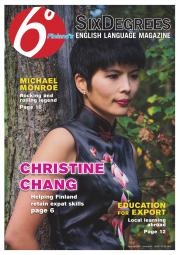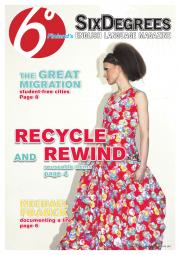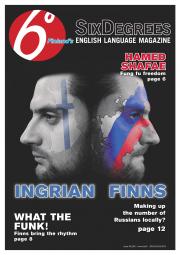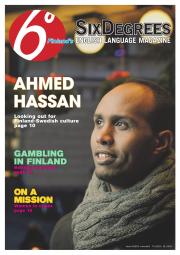


Finland's ENGLISH LANGUAGE MAGAZINE
SixDegreeS
VUOSAARI
Su b u rb fo r eve r yo ne page 12
COMMUNES
T h e soc i a l a l t e rnat ive page 10
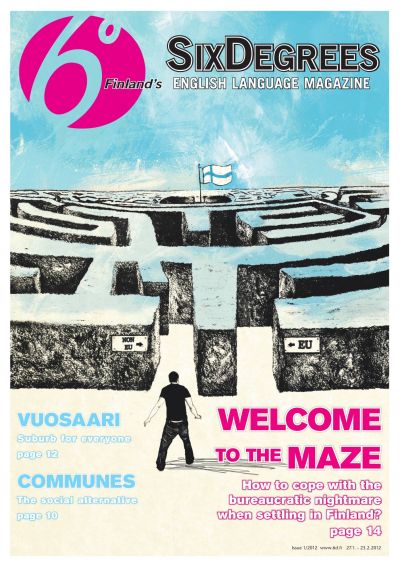
WELCOME TO THE MAZE
How to cope with the bureaucratic nightmare when settling in Finland? page 14
Issue 1/2012 www.6d.fi 27.1. - 23.2.2012
Close Encounters
Helsinki-St. Petersburg
1.2 at 7 pm, tickets 7/5 International music festival with a generation of new musicians played out in two cities simultaneously.
Helsinki's
Anna aikaa 2012
m -Volunteer Match
2.2 at 3 pm, free entrance Give a moment of your time for a better world.
aking
200
th
Evening with
Russian poetry
4.2 at 6 pm, free entrance Contemporary Russian poems combined with music by Sergej Sokolov.
and music
anniversary as Finland's capital
New Suryan
Music Station
18.2 at 8 pm, tickets Concert and club night with Sakari Kukko & HUM'BALAX.
Panel discussion
24.2 at 6 pm, free entrance The role of arts in integration and bringing people from different backgrounds together.
THIS year sees celebrations underway marking 200 years since Helsinki became the nation's focal point, becoming the capital of the Finnish Grand Duchy in 1812. Joining a wide variety of street events, exhibitions and lectures, the bicentennial jubilee also sees a number of restaurants around town changing their menu to incorporate dishes served during particular decades of Helsinki's years as capital. Marking the so-called Union Line, stretching from Observatory Hill to Kallio Church, Unioninkatu will be a major focus of the year's celebrations. A Blue Line laser beam will be projected from one end to the other in the autumn, linking this more affluent suburb with the traditional working class area. "Everybody's welcome to celebrate," states Hilkka Hytönen, producer of the bicentennial celebrations. "It's for the inhabitants of Helsinki, those who come to visit Helsinki from other parts of Finland, for visitors coming from abroad and for immigrant groups here. All have had an impact on the cultural life in Helsinki." The celebrations will also incorporate a number of other significant anniversaries in 2012 including the first railway connection between Helsinki and Hämeenlinna. Furthermore, Kallio Church and Helsinki playgrounds and kindergartens pass the milestone of 100 years and the Finnish Guard Battalion celebrates its 200th anniversary.
25.2. at 5 pm, free entrance Literature and culture of Colombia with author Gustavo Consuegra.
ture Literaevening
Women's
International Living Room
27.2 at 4 pm, free entrance Indonesia meets Finland. Guest speakers Evita Haapavaara and Cyntia Mäkipää. Registrations to oge.eneh@hel.fi.
International
Women's Day
8.3 at 1 pm , free entrance Workshops and a panel discussion on topic Women as Designers Diversity vs. Gender.
International Cultural Centre Mikonkatu 17 C, www.caisa.fi
www.helsinki200.fi/en
Further information can be found at:
HELSINKI TIMES
26 JANUARY 1 FEBRUARY 2012
11
Travel peace declared in Helsinki region
HSL and its partners in cooperation challenge passengers to work together to make 2012 a year of travel peace.
Public transport is meant to be just that something that is for everyone. It is a democratic, sustainable mode of transport in our rapidly expanding metropolitan area. At its best, public transport is easy, affordable, reliable and safe. Safety and the sense of safety are essential to good public transport service. HSL has worked closely with various bodies in order to improve the safety of public transport. As a result of the work, a safety strategy has been created. The key principle is that everyone has the right to travel or work in peace on a train, bus, Metro, tram, or ferry without fear of physical or verbal abuse. Any bad behavior and violation of human dignity are not acceptable on public transport. Make your own wish Our most important partner in cooperation in improving safety are the passengers. When the users of public transport respect fellow passengers and public transport workers and help each other in various situations, it has an immense impact on the atmosphere on public transport vehicles. We need tolerance and helping each other, not indifference. Helsinki Region Transport, Helsinki City Transport, VR, Eläköön. fi traffic safety campaign and Veolia Transport Finland are challenging the residents of Helsinki region to make 2012 a year of travel peace. All public transport passengers are invited to sign the travel peace declaration at Matkarauhaa.fi, and to share their own wishes at the website (the website is in Finnish only, but you are welcome to write in English). All those who submit their own wishes at the website, participate in a prize draw for five HSL season tickets for one year loaded on a personal Travel Card.
The Culture Tram now offers even more
The Culture Tram still operates on the 7B route. But now the schedule has changed, offering on-track culture on Wednesdays, Thursdays, and Fridays. Live performances start each day at 5.14 pm when the tram begins its journey from the Töölö Hall stop on Mannerheimintie. During every month of 2012 the festivals taking place in Helsinki will also make an appearance on the Culture Tram. The programme includes the Flow Festival, Pixeliähky, Cirko, Stage, and Helsinki Design Week. In addition to the live performances, Photo Raw magazine will have four photography exhibitions on the tram throughout the year, one for each season. Cooperation with the artist's association AV-arkki, the Distribution Centre for Finnish Media Art, continues in 2012 also. The Culture Tram is a joint initiative of Helsinki Region Transport, Helsinki City Transport, and Korjaamo Culture Factory, the latter of which produces the content.
Art Meets Ice at Korkeasaari Zoo
The international ice sculpture competition Art Meets Ice gets underway this year in the first two weekends of February. This year professional artists from 14 countries are taking part. On the weekends of the competition, and also after it until 19 February, Korkeasaari Zoo is open from 10 am to 7 pm. The number 11 bus will get you there additional services on the route run for the duration of the Art Meets Ice competition, and afterwards until 19 February. Buses run every half hour on weekends, and every hour on weekdays. The last bus towards the city centre leaves every day at 7.15 pm from near the zoo, at Mustikkamaa.
How to get there?
HSL's online Journey Planner (www.reittiopas.fi/en/) can tell you the way to go even when you don't know the exact address of your destination. In addition to streets, the Journey Planner service recognises the city districts throughout the capital region, and also thousands of destinations such as hotels, chopping centres, schools, churches, museums, and galleries. An alphabetically ordered list of the different destinations can be accessed from the Directory link. Alternatively, you can also select your destination from the map. Clicking on any part of the map displays the street address at that point.
Vocational Qualification in Business and Administration
LOOKING FOR A DREAM JOB?
Central Ostrobothnia University of Applied Sciences is the right place for you if: ·youwanttostudyinaninternationalenvironment ·youwanttoobtainahighereducationdegreewith realhand-onexperiences ·youwanttobenefitfromtheexcellentconnections wehavewiththeworkinglife ·youarelookingforatownthatquicklyfeelslikehome ·youaredreamingofastudyexchangeperiodin oneofour130partneruniversitiesaroundtheworld ·BusinessManagement ·Nursing ·IndustrialManagement ·InformationTechnology ·HospitalityManagement Application period 9.1.-14.2.2012
Helsinki Business College offers an international vocational business program, which is taught entirely in English language. This program is for students with upper-secondary certificate. The program leads to the Vocational Qualification in Business and Administration (QBA). · specialised vocational studies: Customer Services and Sales · duration 2 years Application period: 16.1.9.3.2012 The application form is on our website www.businesscollege.fi Entrance examination: 12.4.2012 Starting date: August 2012 For further information on the program, please visit www.businesscollege.fi or contact Program Manager Ali Daher, ali.daher@businesscollege.fi, tel. +358 50 573 5861. For further information on the application process, please visit www.businesscollege.fi or contact Student Affairs Office, info@businesscollege.fi, tel +358 9 1489 0200 (ask for Student Affairs Office)
Bachelor-level programmes:
Master-level programme
BusinessManagement Application period 9.1.-30.3.2012
www.cou.fi/applications
Further information: admissions@cou.fi p. 040 808 6604
Helsinki Business College Business Campus (Pasila) Rautatieläisenkatu 5 FI-00520 Helsinki
"SAMK HAS ADVANCED TEACHING METHODS AND FACILITIES WHICH PROVIDE A GOOD STUDY ENVIRONMENT" ZHAO YING, STUDENT
APPLY
9.1.14.2.2012
WINDOW TO THE WORLD
STUDY IN ENGLISH
BACHELOR'S DEGREES Environmental Engineering | Pori International Business and Marketing Logistics | Rauma Physiotherapy | Pori Apply now! Studies start in August 2012. Read more: www.samk.fi/apply
Satakunnan ammattikorkeakoulu | Satakunta University of Applied Sciences admissions@samk.fi | Tel. +358 (0)2 620 3033
6
Issue 1 2012
Starters
Top 5
things on our mind this month...
Presidential elections
After months of waiting and speculating, Finns finally got the chance to vote for the country's next president. Into the second round go the National Coalition's Sauli Niinistö and Pekka Haavisto of the Greens. This time last year, many feared that the country was being overcome by intolerance and xenophobia. Now, Finland may very well have the world's first gay president. Incredible stuff!
Let's get
PUMPING!
Seeking fitness? Choose from a multitude of options.
Beth Morton
Guggenheim foundation gives Helsinki the thumbs up
One key justification the City of Helsinki has given for the project is increased tourism revenue. Personally, I'd prefer it if people didn't come here who choose their holidaying destination based on whether somewhere has a franchise of a foreign chain.
Snow
It came at last, yippee! When will it start getting hotter, though why do Finnish winters have to last sooooo long etc.?
Baltic Sea receives its biggest single load of phosphorous pollution
"What's the point in us Finns using phosphorousfree cleaning products if the Russians pollute the Baltic Sea whenever they please?!" was no doubt muttered in (too) many households around the country in the wake of news of this incident breaking.
Homophobia, plain ignorance or both?
According to a recent EU-funded report, Finland's been returning gay asylum seekers to countries where they face the death penalty. The last week of election campaigning even saw one candidate, the Centre's Paavo Väyrynen, throw a large dose of homophobia into one of his TV ads when he claimed that a house the presidential castle needs both a lord and a lady, despite one of his opponents being homosexual. We are living in a Western European country in the 21st century, right? Compiled by Allan Bain.
AFTER the dreaded Christmas hangover period wallowing in the guilt of overindulgence has been prolonged due to the difficulties in convincing yourself to step outside into temperatures more suited to the inside of your freezer, now is as a good time as any to step up and make good on your New Year's resolution to get in shape. The fashionable thing to do these days is ditch the traditional gym equipment and try some sort of vigorous body training. So fashionable, in fact, that there is an abundance of varied training classes to choose from at the gym. But where to start? Among the most popular crazes at the moment are Zumba, a Latin dance fitness regime that will tone you senseless and Spinning which, contradictory to how it sounds, will see you cycling indoors to music with a group of other people and following a routine led by an instructor. If dance or cycling aren't your thing then fear not because anywhere you turn you will find many, very trendy, Les Mills training classes. From Body Attack and Body Balance to Body Jam, Body Step and, the most recognised, Body Pump, all are slightly different but set to make you sweat. Or maybe you're after more of a combat work out like Body Combat, Kickboxing, or Boxercise. No? How about Piloxing then to burn that fat and sculpt your muscles in this cross between Pilates and Boxing? Or you could try the aptly named Kettlebell, which involves a routine requiring you to swing around a kitchen kettle-like apparatus. Phew! I'm exhausted just trying to pick which one to punish myself with, so I might just stick to the relatively relaxing balance, strength and toning workout that Yoga so less brutally proposes.
Take a deep breath, resist that tasty pulla and check out what's on offer at your local gym!
to... How
avoid cabin fever during the long Finnish winter?
"Go south for a week at some point. This year we spent a week in Dubai and it did wonders to recharge the batteries. Otherwise, revel in the awesome winter sports available in Finland through either exotic locations like Ivalo, or more approachable areas like Himos or Ruka." Will Cardwell, head of Aalto Center for Entrepreneurship Be a musician! You will be so used to being imprisoned in a cabin that you will not even notice if there's wonderful weather outside or if it's storming, dark and cold. You're bound to be inside anyway practising your precious instrument. Then, when you go shopping for milk, you feel like you are traveling around the world. Mervi Myllyoja, musician Make snow angels and pretend you're a kid. Life is sometimes easier that way. Niklas Smith, journalist
Fast
Teemu Henriksson
descent
LASKIAINEN (Shrove Tuesday or Mardi Gras) is one of those peculiar days that just about everybody acknowledges, in one way or the other, even if few can explain what it
really stands for. In short, Laskiainen can be defined as a mishmash of religious (Catholic, Lutheran, pagan...) elements and ancient habits that mark the cycle of seasons. Even the r e a s o n b e h i n d the name, Lask iainen (roughly "the descent"), is unclear, the most common explanation (and that by the Finnish Lutheran
church) being that the day marks the "descent" to preEaster fasting. Nowadays, though, the name resonates with a more concrete meaning for descendi ng: on Lask ia inen, the custom for both the young and old is to go sledding. It is the local equivalent for carnivals that mark the day in
some Catholic countries. For example around Helsinki, there will be many possibilities for sledding both on the Sunday before Laskiainen as well as on the actual day, Tuesday 21 February. The other thing that goes inseparably together with the day is laskiaispulla, shrove bun, which are more or less the common pulla but filled with whipped cream and jam or almond paste delicious, and just the thing to have after gliding down the slopes!
Laskiainen is celebrated on Tuesday 21 February.
FINNISH AFTER DARK
Learning the Finnish they don't teach in school
David Brown and Mimmu Takalo
Suomeksi: Kaappi & Haba English equivalent: Cupboard & Muscles, biceps
While being a cupboard might not seem like much of a compliment, being strong and powerful probably does, particularly if the man in question also has massive biceps. Similar to the English phrase `a big unit', being a kaappi is more positive than negative, referring more to the body capacity than the brain capacity. · · · · · · Toiportsarionkaameekaappi! Joo,katonyttotahabaaki. Munmakuunliianiso... Thatdoormanisabigunit! Yeah,checkoutthosebiceps. He'sactuallymaybeabitbigformytaste...
Starters
7
SixDegrees
Tell me about your city...
< Katy Suutari
beck! Lü
No Valentine on Valentine's Day?
Teemu Henriksson
IN FINLAND, Valentine's Day is a relatively discreet occasion. Unlike its Anglo-Saxon cousin, the Finnish ystävänpäivä is more generally about celebrating friendships, rather than being a day just for lovers. Nevertheless, the overabundance of pink hearts and factory-made confessions of love (in the form of Valentine's Day cards) that go
with the original V-Day are enough to turn off just about anyone. The saccharine mood associated with the day is not the only reason some people protest against it. Isn't the day, really, a wholly commercial affair, many ask. And what about single people, who inevitably are left out? If these questions strike a chord, the internet offers plentifully anti-Valentine's Day
t-shirts and other paraphernalia, and you can also send online anti-Valentine's Day cards. Also "Singles Awareness Day" (yes, its acronym is SAD) has become an increasingly popular alternative. SAD is an opportunity for single people to celebrate being single, and serves as a reminder that one doesn't need to be in a romantic relationship to enjoy and celebrate life. SAD parties can also be an opportunity to hook
up with other singletons. So, if you find yourself alone this Valentine's Day, it's no reason to be forlorn. Remember that just like all those lovers, you're allowed to be self-indulgent and treat yourself well, or even organise a party in honour of your single life. You know you won't be alone.
Valentine's Day is celebrated, by some, on 14 February.
Me, a news
Aleksi Teivainen
"IF you were to advise a good friend on what to see while visiting your hometown during a weekend escape, what would you tell them?" That is the question I asked Jan Klüver, a German gentleman who lives in Helsinki where he runs a pleasant bakery/cafe named Crustum. And so the Lübeck tour began. Hamburg's little sister, as Jan said smiling, gets some of it's charm for being surrounded by water, but what really makes it special and interesting are the many passages one can find in the old town. These "gänge" might take you to secret yards hidden by small houses built in 1453, in which you might even find a flat to rent for your holidays. Delightful isn't it? To fully enjoy your stay in the characterful northern German city, our local guide insists that you should get some fresh bread in the morning from one of the many bakeries to be found. As for places to eat, his favourite is Alte Mühle, where he would definitely order a Maultaschen (sort of big ravioli), but he named Miera the number one place to go for quality food and wine at reasonable prices. Nightlife scenes Kandinsky, Paulaner's or Que Pasa were mentioned for having a nice atmosphere. Regarding the architecture, the Schiffergesellschaft, Schabbelhaus, the churches and the Holstentor (the city's old gate) deserve to be seen. In summer, Lübeck is lovely and fun thanks to the nearby Hansa-Park, and in December the whole city turns into a charming Christmas market. Pick your date!
Who knows your hometown better than you do! Share with us the best things to see and do there for this new series in each issue of 6D. Send a brief email with some info about yourself and your hometown to: james@6d.fi
photographer?
Get paid for taking photos with your smartphone.
RE-DEFINING photojournalism by employing crowdsourcing such is the promise of Scoopshot. The brainchild of Helsinki-based P2S Media Group Inc., here amateur and freelance photographers, or "scoopshooters", can send photographs taken with their smartphone to the Scoopshot photo stream, which are monitored by members of the media, and also set a price for the publishing rights of the photo. In addition, media members can post tasks to scoopshooters. These tasks can be restricted, for example, to freelancers or a certain geographical area. For genuine scoops, exclusive publishing rights of photos are available for additional costs. When all you need is a smartphone (the app is currently available for iOS and Android) to become a scoopshooter, the number of scoopshooters, and thus the coverage provided by Scoopshoot, is potentially staggering. Indeed, user-generated content in media has increased with the prevalence of smartphones, and is used especially in reports from sites of accidents and catastrophes, or, as the Arab Spring demonstrated, areas inaccessible to journalists. However, shortcomings,
HOW WELL DO YOU KNOW THE FINNISH WINTER?
chief ly poor quality and lack of reliability, also exist. To ensure a certain level of authenticity, Scoopshot automatically includes location data and a timestamp to photos. To improve the quality of photography, pointers are available on the website. In Finland, Scoopshot has already been embraced by
several major members of the media. Internationally, the recent announcement of a co-operation with Metro International is certainly a solid start. As of 23 January 131,680 photos have been sent to Scoopshot, earning 125,922.
www.scoopshot.com
History made in presidential election's first round
Allan Bain
1. Downhill skiing 2. Snow 3. Sub zero
4. Skate 5. Sledge 6. Sleet
ON 22 January, Finns went to the polls in the first round of voting for the country's next president. Sauli Niinistö of the conservative National Coalition and the Greens' candidate, Pekka Haavisto, emerged victorious and will face each other on 5 February
in the second round. Niinistö led opinion polls for months prior to the election and was almost guaranteed a place in the next round. Who would join him was, however, impossible to tell right up until the votes were counted, although in the last week of campaigning Haavisto and the Centre's
Paavo Väyrynen seemed to be moving ahead of the other five candidates. In the end, Niinistö secured 37 per cent of the vote, less than what some opinion polls predicated he'd receive, while Haavisto defeated Väyrynen by the narrowest of margins, 18.8 per cent to 17.5 per cent.
Whoever wins, for the first time in 30 years Finland won't have a Social Democratic president. More noteworthy, if Haavisto wins, he will become the world's first president from a Green party.
The 2nd round of voting to decide Finland's next president will be held on 5 February.
Test your knowledge of Finnish vocabulary by using the local equivalent.
Puzzle by Marjo Matilainen
8
Issue 1 2012
We Met
Profitable
RISK
Supporting entrepreneurs to realise their dreams.
We Met
9
SixDegrees
Photos Tomas Whitehouse
David J. Cord
"W
THERE are few people in Finland with broader experience in start-up companies than American Will Cardwell. Since 1998, he has invested in them either independently or as a venture capitalist with Eqvitec Partners and Conor Venture Partners. He has advised them from the board of directors, and also led one, Valimo Wireless, as CEO. He has helped them begin their business life from his position as head of Technopolis Ventures, Finland's largest technology incubator. He has researched and lectured about them in the Aalto School of Economics and Aalto University of Technology. Now Cardwell is the head of the Aalto Center for Entrepreneurship, which offers growth entrepreneurship education, research, innovation services and start-up services to people associated with Aalto University. As he is intimately involved with the vanguard of Finland's economic growth strategy, he has a great deal of influence on the nation's long-term economic success.
Like "trickle-down" economics? Well, partially. When people say `trickle-down' they think of wealth in one segment of society trickling down through the entirety. Yes, growth companies provide wealth that is redeployed, but they also provide the financial infrastructure and the supply chain that is used by all entrepreneurs. Jobs and revenue accrue across all segments of society. This is why there is such a political discussion about incentives for growth companies. But this has gotten mired down in definitions. What is an `angel investor'? What is a `growth company'? What should be done to support entrepreneurship? A great entrepreneurial economy has three things: unfair advantages, extreme work and agility. We have an oversupply of unfair advantages. Our infrastructure and primary education are among the best in the world, and this has led to fantastic know-how in many sectors. Everyone knows about our strengths in mobile technology and gaming, but we have advantages in other industries, like water management, for instance. There are challenges with the other two issues. Extreme work means enabling and supporting the 24/7 work that the best entrepreneurs do. People have to work efficiently, and they have to work very long hours. We must allow them to benefit from that work. This idea that we should penalise financial success annoys me, because we are shooting ourselves in the foot if there are no benefits from hard work. Agility means that when the window opens for innovation, whether it is earlier or later than planned, the entrepreneur must be able to move fast. Sometimes a company has to wait until they have sufficient conditions. The way external funders behave has a tremendous impact on agility. They must allow the entrepreneur to move quickly in a previously unplanned direction, and not be stuck on a longer-term plan. Entrepreneurs should not spend too much time on their business plan, by the way, because the future will be different from what they foresee. Do we have any challenges specific to Finland? There has been no initial public offering in the second half of the decade. Many of the Finnish companies that have listed have struggled to keep a reasonable market value and liquidity. It is certain that there will be no serious and sustainable venture capital market in Finland until either a local tech IPO market emerges, or we find good channels to Sweden, the UK or the US. Trade sales are fine, but the pricing of the deals cannot reach their potential unless there is a credible threat for companies to go public. Unfortunately there is a negative perception about selling to foreign companies. What is your philosophy on teaching entrepreneurship? To start, yes, I believe that you can teach entrepreneurship. I disagree with the statement that "entrepreneurs are born, not made." Historically, entrepreneurship has been in the domain of the business school. Entrepreneurship is gaining visibility and importance as a discipline of its own. Engineering and Business Schools both want to claim it, and both are organising courses around it. We believe it is a multidisciplinary activity, with engineering, industrial design, with all the different schools and departments. Also, we believe that teaching entrepreneurship should include a mix of academics and practitioners. Stanford has done a great job in getting Silicon Valley entrepreneurs to be adjunct professors. We hope to enable this approach in Finland as well.
It seems that you take a lot of inspiration from abroad. Certainly. For example, Israel is an important model for Finland. Their high-tech firms go international very early, and they are very good at raising private money. Here in Finland much of the early-stage funding is public money. Interestingly, what kicked me into this business was the study I did comparing Finland and Israel in 1997, which was published by SITRA, the Finnish Innovation Fund. What is your biggest professional accomplishment? I will say being involved in all phases of the development of Valimo Wireless. I started with them as a board member and investor through Eqvitec Partners. I became chairman in 2003, leading several rounds of financing. In 2006 I became CEO, buying a portion of the shares from the founders and having an equal share with them. I led the company through three interesting and complex years, and then when I saw that there were better CEOs out there than me, I stepped aside and moved back to the board. Finally, we were able to sell the company to Gemalto. I cannot express how much I learned from that sojourn, other than to see I will forever be affected by the roller coaster ride. I see so many things that could have been done differently, but overall I am a better person due to the experiences and the many friends and colleagues I worked with during those days. I'm proud that although I've had to do some really difficult, and sometimes harsh, things in my career, I think that in general I have not created many enemies or acted unethically, although there certainly have been many opportunities. Being involved in start-ups is by definition a huge number of tradeoffs that you have to balance constantly, and the right decision is rarely obvious. What does the future look like? Helsinki will compete to act as the start-up hub of the Baltic Rim region. In my opinion, this is the only way that we can achieve economic prosperity in the future. Immigration policy needs to anticipate this, so we encourage highly skilled people to come here. We are working hard on this concept at Aalto, largely following the model being led by our students at the Aalto Entrepreneurship Society who have set a big and bold vision. Our Startup Sauna start-up development program is becoming well known throughout the region, and the Aalto Venture Garage is a worldclass co-working space for entrepreneurs. We need to ingrain entrepreneurship in education, not only in university, but in all schools. One fun thing at the Venture Garage is the growing number of high school students that are joining our events. There is the challenge of turning innovative ideas into marketable products and reaping the value created. This is a Europe-wide problem. Many of the entrenched global problems that keep us awake at night already have solutions in the lab and in pilot cases. This is both encouraging and frightening to me on the one hand, the solutions are out there, but on the other hand, we are terrible at implementing them. I think the problem is that in most universities technology transfer is still regarded as an arcane legal process rather than a streamlined commercial one. There is a growing group of top scientists who realise that being smart about intellectual property will allow financial upside and more research money. These guys are potentially the heroes who will contribute to solving problems like global warming, clean water scarcity or malnutrition. We need to encourage risk-taking and tolerate failure. My argument is that due to different public instruments and relatively low ambition levels, our typical failure rate in Finland is far too low. We had a great National Fail Day celebration on 13 October. What a great idea only in a funny way. Again we failed because Fail Day was so successful!
e need to encourage
risk-taking and tolerate failure."
Why did you originally come to Finland? I married my wife Jaana in Winston-Salem, North Carolina in 1987. I was working for AIG and decided to get my MBA in 1990. I made a last-minute decision to go to the Helsinki School of Economics. I was in Finland for a year and a half, and then we went back to North Carolina, University of North Carolina Chapel Hill, to work on my PhD in finance. I did almost four years of work, and then got a call from Veikko Jääskeläinen, the former dean of the Helsinki School of Economics. We came back in July 1996 for good. Why did you go to the Aalto Center for Entrepreneurship? It was a good place to consolidate the work I have done on the various sides of start-up and venture capital. I wanted to start at the beginning, by which I mean that I wanted to help young entrepreneurs build companies for the first time, as well as act as a driver for the entrepreneurial side of the economy. Why is this important? Stanford's Steve Blank says that there are six types of entrepreneurs: lifestyle, small business, buyable, large company, social and growth. A growth entrepreneur, like in Google or Facebook, has from day one the vision to change the world. Studies have shown that we will need 250,000 new jobs in Finland within the next several years. Growth companies alone are not going to create 250,000 jobs. But we have to think on a global scale. An owner of a pizza joint would be a small business entrepreneur. But pizza joints don't happen without growth entrepreneurs. All of the types depend upon growth companies, because they generate the wealth. They are the locomotives.
Will Cardwell
Born: Lynchburg, Virginia in 1963. Education: BS Math Davidson College, MBA Aalto School of Economics, and four years of PhD work in Finance at UNCChapel Hill that I may complete someday. Family: Wife Jaana, son Aleks is 22, daughter Amanda is 21, and daughter Amelia is 14.
When I was a child I wanted to be... either a basketball, baseball or football player. In the future I hope...to change the world somehow for the better. The one thing that would most improve the world would be... to realise that many of the world's technological problems are solved in a lab somewhere, but humans have not figured out how to get them into the market. This is perhaps the core problem we are trying to solve at ACE. I admire... Linus Torvalds. He had a thought that might change the world, and he made it happen.
10
Issue 1 2012
Lifestyle
REVIVING TOGETHERNESS
Community-centred living is becoming increasingly popular in today's Finland, with people more aware of the prevalence of social reclusion.
Jenni Toriseva
RATHER than being an exception relegated to a rare few, living alone in a studio flat in your early 20s is more accurately described as the norm when it comes to student accommodation in Finland. Given that such living standards are seen as a luxury in most other countries, many foreigners fresh to Finnish culture are found to be flabbergasted upon hearing about it. Even though bigger cities are showing a clear shortage of studio apartments, students and other young people still prefer to search for their own private-but-costly nest, leaving the possibility of sharing a flat as a second-rate option. Be the reason for this independence-seeking leap of financial or cultural origin (or probably a combination of both), the fact remains that alarmingly many Finns of all ages are suffering from social reclusion and loneliness. About 6 per cent of people here suffer from depression, while a staggering 15 per cent suffer from personality disorders. Although suicide rates are slowly decreasing leaving Finland at 15th place worldwide it is safe to say we are still not the most mentally stable bunch. A healthy alternative With funds being continuously poured into mental health care institutions, some have been quicker to embrace a simpler and cheaper way to avoid such problems. This could be described as a (re-)turn to the primordial way of life that we still have coded somewhere in our genes: the way we used to and few still do live in close-knit communities that forego genetic ties.
One of them is Titiu Nylund, who was brought up in a rather different way. She grew up in her father's guesthouse that hosted a vibrant social atmosphere, with new people, Finnish and foreign, coming and going all the time. She would always find company when she felt like it, but could retreat to her own room when in need of some peace. Instead of having only a few people to take care of her, she would instead have an extended amount of people watching out for her. Now a 29-year-old UI designer, Nylund has lived in three different communes (kommuuni in Finnish), two of which she set up by herself. After having some experience in the first commune, which comprised of four people, she was eager to set up her own together with her boyfriend of the time. Being the leader of the new commune, she could create a home that reflected her own personality, and choose flatmates that were best aligned with the couple's interests and character traits. Nylund ended up renting a 204m2 flat with seven bedrooms, a kitchen, hall, two toilets, a bathroom, laundry room and a balcony. "We were really lucky to find it. It was a flat above a church on Iso-Roobertinkatu [in Helsinki], and the owner had difficulties in selling it because of some legal restrictions. It was also quite a bargain as rents would vary from as little as 80 euros/ month for a 7m2 room to 380 euros/month for a spacious 35m2 room," Nylund says, pointing out that such modest prices were from eight years ago. She still remembers the feeling of being able to provide a safe nest for young teenagers living away from home for the first time: "It was immensely rewarding to be able to give a safe home for someone so new to life over here. They'd get a readymade social
network and a safe place to live in. I was really proud about that." And when it comes to that independence Finns are so used to cherishing, Nylund believes that living in a commune was not by any means an obstacle to becoming independent. "On the contrary, I think in a commune you are better equipped to become a balanced person, because you have to learn how to deal with people of different kinds, and get used to all the different problems people tend to get entangled in with each other." Naturally life in a commune was not always a bunch of roses. "There would always be that last toilet roll waiting, while the previous few had been snitched to peoples' respective hiding places; it would never be super clean, and there was always someone who did more than others," Nylund says. But enduring all of this, she believes, has taught her an important lesson: "It's useless to try to have everything polished up to perfection, and that there will always be something that's not quite how like you'd have it, so instead of grinding yourself about it you should rather learn to accept it," she says, referring to all aspects of life. Togetherness in different forms In Finland not all forms of living that include many non-related people co-habiting an apartment can be classified as a "commune". Another such type is what Finns call "cell-living" (soluasuminen), which is usually organised by entities like HOAS, the student housing foundation in the Helsinki metropolitan area. However, 31-year-old facilitation consultant Tanja Korvenmaa, who lives with seven other professionals in Tampere, does not see strict definitions separating different living forms as important. "I'm not even sure is meant by the word `commune'," she states.
Lifestyle
Tanja Korvenmaa
11
SixDegrees
Tanja Korvenmaa
I N T E G R AT I O N
In many cases the kitchen is the heart of the commune.
Food is always an excellent reason to spend some quality time together.
Are you lost in the Finnish bureaucracy? Do you need help in nding a job, a place to study or a language course? We o er assistance and advice!
Welcome to visit our service point on Mondays and Wednesdays 11-16 or call or send us an e-mail with questions concerning integration.
"N
everagaindoI wanttolivealone orjustwithmy boyfriend!"
that it is rather a more ancient way of living that has simply been renamed. "We all had our own home, family, money, and then we had a communal building that hosted the local kindergarten," Korvenmaa reminisces, describing her childhood home. "We also had a communal sauna and laundry facilities in the middle of the garden. It was a great place especially for families with young children, as the garden was a safe place to play in, and there were adults everywhere, easing the mother's job tremendously." Cohousing communities are often set up to gather people that share the same life situation, be they families that prefer to have their children grow socially more aware and have help from other families
"People would even call the cohousing community I grew up in a commune." So what is a cohousing community then? The bare rudiments of what cohousing (yhteisöasuminen in Finnish) is, composes of an intentionally gathered community that lives in private homes and share certain facilities that vary according to the residents' needs. The community-based life comes from the shared activities that take place in common areas, including everyday chores such as childcare, gardening and cooking. Cohousing communities are often built from scratch, whereby the future residents plan their own apartments and joint facilities together with the architect. "Alternatively they can renovate old housing suitable for their community," Korvenmaa is quick to add. Korvenmaa's childhood was similar to Nylund's, growing up surrounded by people from different walks of life. The cohousing community she grew up in composed mainly of families, totalling up to 100 people at its peak. The community, named Tuulenkylä in Jyväskylä, was structured in the form of a circle, the heart of which was taken up by a big central garden and a communal sauna. The surrounding terraced houses formed a barrier around the garden, leaving it as a secure place for the children to play in. People would enter their houses from the inner garden, allowing neighbours to socialise more often. Even though cohousing is said to have started in Denmark in the 1960s, Korvenmaa believes
with sharing turns babysitting, or senior citizens, who want to keep their social life flourishing. "I think I learnt very early on that cultural differences prevailed in different families. By realising that `oh, things here work differently from our home, that's ok', I guess I learnt to become very tolerant of other peoples' habits that differed from ours." As it often plays out in communes, cohousing communities usually consist of a group of like-minded people that share similar values and lifestyle. One popular type of cohousing is an ecovillage, which is based on the simple idea of living sustainably. It is up to the community itself in which way, and to what extent, this is materialised. Korvenmaa spent a fair share of her 20s living alone or with a boyfriend, and is now sure about one thing: "I could never go and live completely on my own again, not even just with my boyfriend or husband," she says, considering a close-knit community as a natural part of life. Curiously, Nylund also has the exact same thoughts.
"Never again do I want to live alone or just with my boyfriend! No offence to him, but I just need more human interaction around me!" she says, considering a cohousingtype of community as the next likely step.
6 March at 15-17 Writing a CV for a job in Finland Is your CV up to date? During the lecture you will get advice on how to write a CV for the Finnish job market. Lecturer: Tony Eichholz. Register by 2 March. 24 March at 10-16 Hygiene training and pro ciency test (30 ) The training course covers all the subject areas of the test. The training is followed by the hygiene prociency test. Lecturer: Marja Laukkanen. Venue: the Swedish Adult Education Centre, Arbis, Dagmarinkatu 3, Helsinki. More information: www.luckan. /bridge. 26 March at 15-17 Preparing for a job interview What should you think about when preparing for a job interview? During the lecture we will discuss how to prepare for and what typically happens during a job interview in Finland. Lecturer: Tony Eichholz. Register by 23 March. 6 February at 17-20 Baking Runeberg's cupcakes Learn how to bake the famous cupcakes named after the Finnish national poet Johan Ludvig Runeberg. The evening will begin with a light meal and a presentation of J.L. Runeberg by Henrik Litonius. Venue: Martha Association, Lönnrotinkatu 3 A. Register by 2 February. All registrations to bridge@luckan. Until 13 April, Tuesdays and Fridays at 9.30-12 Intensive Swedish for parents and children (20 ) The Swedish Adult Education Institute, Arbis, o ers an Intensive Swedish course for parents staying at home with children. Free childcare provided during the course. Venue: rooms 11 and 33 (childcare), Arbis, Dagmarinkatu 3, Helsinki. Enrolments: Arbis tel. 09 310 494 94 or alexandra.ramsay@arbis.hel. . More info: www.hel. /arbis or www.luckan. /bridge.
Get your job hunting started with our courses!
Titiu & Tanja's
tips for commune living
· Keepakitty(sharedmoney) forcommunalexpenses. ·Avoidaccumulatingstuffin common areas, especially inthekitchen. ·Everyonehastheirstrengths andweaknesses,makeuse ofthestrengths. ·Conflicts are useful not only will you practise your human relations skills, but theyarealsoagreatwayto get to know one another in adeeperway. ·Theflatwillneverspic-andspamclean,thesooneryou realisethis,thebetter!
Get to know Finland through culture!
Learn Swedish
The ABC of Finnish Bureaucracy for foreigners 1.- 29.3.2012
Do you want to get information about housing possibilities in Helsinki? Are you aware of your rights as tenant? Do you want to know more about working life in Finland or welfare services you are entitled to? The Finnish society can surprise even a resident of many years. If so, join the course at Kalliola and discuss and learn more about Finnish society and welfare system. The course will be held in English and it is free of charge. Location: Kalliolan kansalaisopisto, Sturenkatu 11, 00510 Helsinki Time: 1 - 29.3.2012, Thursdays 17.00-20.00 Information and enrolling: By 27.2. info@ne-ra.fi, tel. 046 850 9282 Organised by Kalliola Adult Learning Centre and Counselling Centre Ne-Rå www.ne-ra.fi - www.kalliolankansalaisopisto.fi
LUCKAN Simonkatu 8, 00100 Helsinki Contact: bridge@luckan. / 040 485 9636 / www.luckan. /bridge
12
Issue 1 2012
Society
Column
David Brown is a language consultant and journalist, regularly covering stories in Africa, Asia & the Middle East. He has lived in Finland for 10 years.
Piggy in the middle
David Brown
WHEN I first came across a story about the terrible conditions Finnish pigs are farmed in I was tempted to dismiss it as either being the rantings of extremists, or as an isolated example. In any farming country there will be examples of poor farm practice, and a few blurry pictures do not provide enough evidence to condemn an entire industry. BUT the images and video released by activist group Oikeutta Eläimille (Justice for Animals) are truly shocking. They not only show pigs being held in absolutely appalling conditions, but claim the farm in question is owned by the head of the Finnish Pig Farmers Association. The release follows photos and video released from different farms in 2007 and 2009, and shown on the website of both Oikeutta Eläimille and Sika Tehtaat (Pig Factory). EVEN if they are not typical of pig farming practice in Finland, they raise some extremely difficult questions for the entire pork industry.
"E
ven if recent videos are not typical of pig farming practice in Finland, they raise some extremely difficult questions for the entire pork industry."
HOME 4 ALL
Helsinki suburb Vuosaari is emerging as a dynamic and international centre in its own right.
Mika Oksanen
THE videos show pigs held in tiny containers, some so small that they are unable to turn around. In others we see pigs scarred with sores, cuts and bites, in some cases riddled with what appear to be maggots. One pig has a hernia so large that it has become bloody from rubbing against the ground. I EAT pork, I buy pork and I cook it. I have no intention of not buying pork, but as a consumer I'm absolutely shocked that animals in Finland could be treated so cruelly, and am bitterly opposed to an industry that apparently condones it. I HAVE no ethical problem with animals being farmed for food, but I expect those animals to be treated with dignity and provided as pleasant a life as they can have while on this earth. I think we can assume most consumers feel the same way. AS an amateur chef, I can also say that organic and free range pork tastes better and is better value for money than standard pork. Although Finland recently banned the use of sow stalls (in which 300 kilo pregnant pigs are held in containers 60 cms wide), doubts remain about both how strictly the law is being observed, and about conditions for the animals overall. THERE is also the reaction of pig farmers to be considered when the videos were released, their reaction was not to apologise, but to sue the activists. ETHICALLY produced pork is available in Finland, through the kauppahalli and occasionally elsewhere. But of the half million pigs raised in Finland each year, only 2,000 (0.004 per cent) are raised organically, with a similar number enjoying free range conditions. PIG farmers in Finland need to do better much better. At the very least, they must introduce a code of ethical conduct and stand by it. They need to police their own industry, and be ready to close farms which do not meet ethical standards. If they don't it is they who are the true pigs here.
www.sikatehtaat.fi/english
"WHAT makes Vuosaari interesting and special as an area is that it comes across as a fascinating, modern and urban city district that pulsates with life." This is what Aku Louhimies, one of Finland's front-line film directors, said in an interview about a year ago. His new film Vuosaari, a collection of contemporary love stories, is hitting cinemas on 3 February. "I chose Vuosaari as the setting, because it allowed the different stories in the film to be naturally intertwined, owing to its essence as an East Helsinki suburb by the sea, with a large port, the eastern terminus of the metro train, absolutely exquisite residences as well as a good number of council estates," he explains in January 2012. "In short: a broad variety of people and stories. I have been somewhat inspired by films with a strong milieu presence, including Heat (1995) and Short Cuts (1993) that show the city of Los Angeles from original standpoints." In topographical terms, you can easily appreciate the diversity when you look at a map of Vuosaari. There is a large residential and commercial area, east of which there is the port and a bustling industrial area including the coffee roasting plant, sandwiched against a golf course. All these border the Baltic sea to the south, with marinas and the boat club, and are interspersed elsewhere with forest patches of varying sizes highlighted by splendid recreational areas on the shoreline. Overlooking it all is Cirrus, a high rise that stands as Finland's tallest residential building. But what about the people living there and the international angle? To get an idea, SixDegrees spoke with a couple of local residents. This is just like Europe! The above perception of Aurinkolahti, an area of Vuosaari, comes from Yonas Tadesse Hagos, of Ethiopian origin, who moved to Vuosaari from abroad with his wife Johanna Leppänen, a native Finn. "We needed a place rather quickly, and the first good flat we found was in Vuosaari," Leppänen recounts. "East Helsinki was in fact our first choice, because there are more people of international origin there." "Vuosaari is peaceful, not too crowded," Hagos observes, when asked how he likes living there. "This is a great place for families, also foreign ones," Leppänen explains. "We have other foreign neighbours, so being a foreigner here does not arise similar attention as it may somewhere else." According to Leppänen, a variety of services are well within proximity. "They are all near us: the shops, the health centre, the public library, the swimming hall," she explains. "Everything is easily accessed, with prams as well. The metro is also very practical for pram pushers, making Itäkeskus readily available." "Even though there are a lot of foreigners and you read in the papers about the problems, we must say that we have many international neighbours, but the only discomfort we have experienced has stemmed from some born-and-bread local people who seem to habitually take to the drink slightly in excess of what would be good for them." More international than its counterparts in Helsinki East Helsinki, including Vuosaari, does have an above-average proportion of immigrants. But how much so, in actual fact? "Looking at the official stats, you can see that there is a difference, but to me the difference seems quite small," says Ilkka Laine,
SixDegrees
13
SixDegrees
VUOSA ARI
· · · · · · · · · ·
AdynamicandinternationaldistrictineasternHelsinki,with 36,000residents. BoastsAurinkolahti,anewelegantresidentialdevelopment bythesea. Featuresalargeshoppingcentreatthemetrotrainterminus. Large natural recreational areas at Kallahti, Uutela and Mustavuori. Maritimefeaturesincludemarinas,aboatclubandtheport. The port is the most modern cargo port by the Baltic Sea andthelargestinFinlandintermsofcargovolume. 16% of Vuosaari residents are immigrants (10% in all of Helsinki,2.5%inLänsi-Pakilaand2.7%inallofFinland). Ofthese,thelargestgroupsbynationoforiginareEstonians, RussiansandSomalis. The top year for foreign language-speakers immigrating/ relocatingtoVuosaariwas2008. The film Vuosaari by Aku Louhimies is released on 3 February.Itisaco-productionbetweenFinland,Germany, RussiaandAustria.
Statisticalsource:CityofHelsinkiUrbanFacts
"T
hisisagreat placefor families,also foreignones."
architect with the City of Helsinki, having accumulated a decade's worth of experience with the city planning department where Vuosaari fell under his sphere of responsibilities. "In the entire district of Vuosaari, the share of people whose first language is not Finnish or Swedish exceeds 16 per cent, compared with an average of 10 per cent in all of Helsinki." So is the talk about Vuosaari becoming another sink estate just an urban legend? "One explanation as to why people may have felt that way is that there are indeed differences between the various areas of Vuosaari, which is a large district soon numbering 40,000 people," Laine explains. "In some limited areas, the proportion of immigrant residents is in fact clearly above the average, and this is something that the city does pay constant attention to, so as to avoid the development spiralling into the wrong direction with negative effects."
Vuosaari is no sink estate Nevertheless, one can hardly compare Vuosaari with areas such as Rinkeby in Stockholm, Sweden. As of 2007, 89.1 per cent of Rinkeby's population had a first or second generation immigrant background. But the situation here will not come to that, right? "I would find it extremely hard to believe that such unilateral development could ever take place in Vuosaari," Laine replies. "I've hosted visiting parties of city planners from abroad on trips to Vuosaari, and they have mostly chuckled at the notion of, say, Meri-Rastila being locally considered somewhat of a problem area they have basically seen it as an attractive suburb." One finds this difference in viewpoint easy to understand, after riding in broad daylight through some Stateside areas such as the South Side of Chicago and North Philadelphia, which in their own stark way surely make Rinkeby seem more like the posh part of Westend in Espoo. Those familiar with, say, some of the sink estates in major French cities will probably nod their heads in agreement. But what has brought immigrants to Vuosaari? "During the big Finnish recession of the 1990s, the development of proprietary housing for consumers was very slow," Laine says, "and in Helsinki, a lot of new residential construction naturally took place where the city had free space." Vuosaari, originally the conceptual "forest city" of the 1960s, was one such area, growing since the beginning of the `90s at a rate of about 1,000 new residents per annum. Around the same time, immigration to Finland, then a new phenomenon, started in earnest, and newcomers to Helsinki found their homes in the expanding areas, including Vuosaari. After 20 years of busy housing construction, the growth of Vuosaari as a residential area is now slowing down naturally, as there is less free space available.
Enjoying in permanence and transience The above experiences were the result of more or less permanent relationships with Vuosaari, but the district can be enjoyed equally well on shorter visits. In view of tips for sojourns and cameo appearances, let's spend a final minute virtually in wondrous Vuosaari with our interviewees. "The nature of Vuosaari, particularly in the shoreline areas, is simply magnificent," says Laine. "Circling the district for work purposes, I often find myself in awe of some beautiful or pleasant spot, such as the newer developments of Aurinkoranta and the Uutela recreational canal, which features a waterfall in Aurinkolahti," he continues. Filmmaker Louhimies feels much the same. "The cape of Kallahti appeals with its natural beauty and the sights from atop Cirrus really unravel it all for you. If you see my film, you may see Vuosaari in a new light," he concludes. And then, when you visit Vuosaari, you may be enlightened yet anew.
Vuosaari is released on 3 February. The film's English title is The Naked Harbour.
Aku Louhimies lines up a shot.
14
Issue 1 2012
Feature
A Tale of
Text Dave Dunne, Illustration Marco Bevilacqua
Two Citizens
Does your status as an EU citizen lessen the bureaucratic nightmare faced when moving to Finland?
SixDegrees
C
URRENTLY in Finland there are just over 60,000 non-Finnish citizens employed in the country. This works out at around 2.6 per cent of the working population. With the numbers of foreigners altogether in the country running at around 3.2 per cent, this shows a healthy representation of foreigners' contribution to the nation. Many foreign workers arrive to Finland with a contract already some 43,000 foreigners are employed in the private sector, with large numbers with Nokia, Kone, Neste Oil, ABB, Stora Enso and the other big-hitters in Finnish industry. For them the move is relatively easy Nokia and Kone can order qualified workers from wherever they need them, and often everything down to accommodation is sorted out by the employer. There are however a great number of foreigners in the country who are highly qualified, willing and yet frustratingly unable to work. A common complaint of those who arrive to the country without a job waiting for them is endless bureaucratic red tape and Catch-22 scenarios of residence permits and municipality of residence. Here SixDegrees tries to cut through the maze of government departments one should visit, what forms you need to fill, as well as talking to two people whose stories tell of the frustration so many feel in their attempt to gain employment. The journeys people taken to reach their goal of living, and most importantly working in Finland are often very different. EU citizenship plays a big role, as we see. A recurring factor is the confusion over which government body handles each aspect of immigration. Integration plans are not always available to some of those who wish to wish to learn the language whilst actively seeking work. Finland has one of the lowest percentages of foreign nationals of all EU countries and immigration is still, relatively speaking, a new thing here. Do the authorities need to simplify and clarify the process, to get non-nationals contributing to a society that is still cautious about foreigners? Integration is a myth
Karl is a highly-qualified professional who craves to work and contribute to Finnish society. As a non-EU citizen he's found that harder to achieve than it sounds.
15
SixDegrees
"I can't understand why the government here in Finland doesn't invest a little more time and money in highly-qualified people, to get them into the labour market. A few thousand euros and some months of language training and within a year they have repaid that investment in tax alone," says Karl, a qualified physiotherapist from Australia. He asked that his real name not be used. Karl qualified with a BSc in physiotherapy from Australia in July 1997 and worked there for some months before moving to the United States in January 1998 on a student visa, to continue his studies and then to practice as a physiotherapist. "I received my license to practice in March 1998 and was studying for an MBA in Hospital Management and Healthcare Administration. Then I moved to Michigan from Oklahoma City and spent ten years there working as a physiotherapist having got my work visa in October life was good and the money was great," explains Karl It was in Michigan that Karl met his future wife and they were married in August 2007. "My wife is from Russia and we thought about where we'd like to start a family and raise our children we decided on Finland. My brother was working in Finland and married to a Finnish woman. Also Finland is closer to my wife's home country," "I sold my house and took my savings to move to Finland. I came here at first on a visitor visa, with the intention of investing in my brother's restaurant and availing of the entrepreneur's visa. I came in January
2008, but had been already investing in the business since its starting up 4 months earlier," "When we arrived to Finland the immigration authorities explained there is was point to try for the entrepreneur's visa, as you need to invest 100,000 euros and I had only 80,000 to invest. We were told to apply for visa on the basis of being employed in the restaurant, but the salary was deemed insufficient," says Karl. In May 2008 Karl's wife gave birth to their baby boy and he felt he needed to stabilise the situation. "I decided to study Environmental Planning and Management in Tammisaari at that time even just give me breathing space to let me figure out how to settle in Finland. I scored 2nd best in entrance exam from 78 people around the world." While on a student visa, a student who is studying for at least two years must have private insurance which covers the cost of medical treatment up to 30,000 euros. Also, 6,000 euros must be shown in the bank at all times for each family member in Karl's case 18,000 euros. During that time a student is limited to the amount of hours they can work making a reasonable income next to impossible. "My wife and I had applied for a residence permit, which takes a long time, and when our son was born we had to add his name to the application. He may be born in Finland, but he's not allowed to stay in Finland. So for him to apply for residency he needed a passport. You can't apply for a Russian passport until a child is six months old, so we got an Australian passport for my son which was much easier," says Karl. "Four years on from first arriving in Finland and I've finished my studies now. My wife and child have had to return to Russia as they could not remain on my study visa which has expired the only way my wife and child can remain in the country is for me to prove earnings of 1,800 euros a month. At the moment I work two jobs and do more 60 hours a week, making studying the Finnish language extremely difficult." Under the terms of Karl's temporary work visa he must work in the area in which he qualified which is the healthcare sector. Environment planning work is not allowed as there must be a single speciality field, and more profitable jobs, such as taxi-driving, are off limits. "My main occupation now is care-assistant, and though it's worthwhile work it's not what I'm trained to do. No disrespect intended, but I'm basically working as a maid now. When I was in the US I was making over six-figures a year. I'd love a chance to practise my profession as I did in America, but the government is more concerned about making you jump through hoops than helping you to contribute in a real way both financially and to Finnish society," "My main struggle now is to get my wife and child to Finland. A distance of 2,000 km is too far to watch your son grow up." Having a job opened doors
Colm is an electrical engineer who has finally found light at the end of the tunnel in Finland. As an Irish and EU citizen his journey was eased somewhat along the way.
"I realised quickly that having a work contract would open previously locked doors. As if by magic I was told that any issues with the immigration service, immigration police, residency permits, Kela, social security number and bank account would be rapidly solved," says Colm from Ireland. Having qualified as an electrical engineer from University College Cork in 2006, Colm went on to do his master's in 2008. He decided to move to Finland last year to be with his Finnish girlfriend of several years. "I initially arrived over in September of 2011 and within the first day or so went
to the EURES (European Employment Services) offices at Kluuvi in Helsinki. There was a very helpful lady there who explained that I may be entitled to help from the Irish social welfare system, were I registered as unemployed there," explains Colm. There is an agreement between EU states that if an individual is registered as unemployed for four weeks in their home country they may apply for a U2 (or E303) form. This form authorises you to keep claiming your old unemployment benefit in the new country for a period of three months. It is important to register as available for work with the local employment service in the new country within 7 days of arriving to avoid losing any benefit. "I returned to Ireland and registered as a job-seeker and applied for the form. After the four weeks I returned to Finland with my U2 form and presented myself at the EURES offices. There was no problem claiming the allowance for three months in fact the Irish welfare system paid this, so it's not a concern to Kela but when I asked about a residence permit I was given the usual line of needing to have means to support myself and address etc," says Colm. "It was a frustrating time, being unemployed, and frankly the job-seeking assistance in Finland seems to amount to a fruitless monthly appointment where you basically `sign-on'. I'd heard great things about integration plans and state-run language courses, but these were only available to me if I was employed. I figured that now that I was unemployed it might be a good time to become integrated and not later on when I would hopefully be busy with work." An unemployed immigrant who has a home municipality in Finland and comes within the sphere of a labour market subsidy and/or social assistance is entitled to be in an integration plan and to receive assistance. In an integration plan agreement is reached on how immigrants will become familiar with their new country of residence, learn the country's language, supplement their occupational skills and acquire information and skills. To have home municipality one must go through the asylum seeker/refugee process, be married to a Finn or have a work contract for at least one year. Maistraatti decides on this and as a job-seeking EU citizen Colm could not avail of the integration plan. "I had a number of job interviews and was feeling increasingly confident that I would get a job, but felt frustrated that I could be learning Finnish, or even Swedish, when I had time on my hands. For the moment I still had job-seekers' allowance from Ireland, but it's not a whole lot and language courses seem quite expensive." "There was, however, a course run by Ne-Rå called ABC of Finnish Bureaucracy which was really helpful. One particular evening at the course the main speaker was a man who was quite high up in the immigration services. He had apparently lost his notes and for the next two hours faced a barrage of questions from frustrated individuals that he seemed to have little answers for. Not the Finnish efficiency we all hear about." "Just recently though I've got a job with VTT Technical Research Centre of Finland. I returned to the employment office, VTT contract in hand, expecting to be finally given some integration plan or Finnish courses and was told, `Sorry, this is only for unemployed immigrants with residence permits.' So, in real terms, it seems to get assistance I need to come, get a job and lose it again." "I've signed my 12-month contract this week and next week I meet somebody from KPMG who will sort out my paperwork. Everything from residency permit, bank account, Kela number to immigration police and maistraatti. It was like somebody waved a magic wand," jokes Colm. "But I'm certainly glad I'm not still stuck in the bureaucratic maze frustrating is the best word I can use."
EU citizens
Citizens of the European Union, Liechtenstein and Switzerland all have the right to live and work in Finland without any permit, provided they stay no longer than three months. For longer stays, EU citizens must register their right to reside in Finland with the Immigration Police and apply for a residence permit. Citizens of the Nordic countries are registered at a Register Office. EU citizens may stay in Finland for longer than three months if they are actively seeking employment and have a "real chance of finding employment," as judged by the Finnish Immigration Service. Once an EU citizen has resided in Finland for five years, he may apply for a permanent right of residence. Right of permanent residence or municipality of residence is decided on by the Maistraatti and can be based on residing in Finland for five years, marriage to a Finnish citizen or having a work contract that is for 12 months or more. There seems to be a grey area in decisions made by the Maistraatti and this leads to a lot of frustration. Technically without permanent residence one cannot get a library card or avail of the municipal travel pass for public transport. Many foreigners who have lived and worked in the country for 3 or 4 years on short-term contracts (unfortunately the norm in Finland these days) feel angered at what they perceive as being treated as second class citizens. There is a case to argue that after years of living here and paying taxes, how can a person not even be entitled to a library card?
Non-EU citizens
A non-EU citizen seeking to work and live in Finland must apply for a residence permit to engage in any lucrative activities. This ruling applies regardless of whether an individual is employed or selfemployed. To apply for the permit, an individual must complete an application form, pay a processing fee and have a potential employer in Finland, who presents additional information on the terms of work. Applications may be submitted to Finnish embassies or consulates abroad or to police departments within major Finnish cities. However, in most cases, non-EU citizens must wait for the permit to be awarded while abroad. Residence permits for self-employed applicants must contain a business plan, as well as details regarding the business's operation and size. According to these guidelines a non-EU citizen cannot enter the country as a job-seeker, or for reasons other than study, or refugee or asylum seeker status.
List of useful websites:
www.ne-ra.fi Based at the Kalliola Settlement in Helsinki - Ne-Rå is financed by RAY (raha-automaattiyhdistys) and works in conjunction with universities and universities of applied sciences. Offers counselling on social services and benefits, a place to discuss your concerns, assistance with filling in forms, support in dealing with authorities and is open for everyone. Ne-Rå functions outside the realm of governmental and municipal services, and promises professional confidentiality. Ne-Rå's services are free and it aims for the prevention of exclusion and the promotion of inclusion. www.luckan.fi Website info in a number of different languages. Luckan's Bridge is a Finland-Swedish integration service in the capital region and provides information and help to immigrants to find a job, study place, volunteer work or services. Runs educational events such as writing a CV for a job in Finland, preparing for an interview to the hygiene and training proficiency programme, which is necessary for bar and restaurant work. Website offers excellent links to job hunting sites and a clear `Action Plan to get started in Finland'. www.infopankki.fi The pages of Info Bank contain important basic information for immigrants on the functioning of society and opportunities in Finland. Website in a number of different languages. It is also possible to call to infopankki's office and discuss your situation. www.poliisi.fi The Immigration Police are responsible for handling licence and investigation issues related to immigration administration in the Helsinki area. The Immigration Unit deals with processing of residence permits (including workers), EU-citizens right to reside in Finland, visa extensions and re-entry visas, passports and travel documents for aliens, nationality issues and identity card issues for aliens. In Finnish, Swedish and English. www.maistraatti.fi The local register office maintains a national Population Information System and decides on municipality of residence. www.migri.fi This site gives you information on immigration principles and practices applied in Finland. Contains useful flowcharts on the route employed and self-employed people must take on arriving to the country. The FAQ section is also very useful.
24 30 NOVEMBER 2011
17
Do you really know what Islam is?
Subscribe to Salaam magazine and get informative, accurate and up to date information about Islam in Finland 4 times a year.
Salaam magazine is published by Resalat ry. A non-profit organization registered in Finland. Yearly subscription costs 12 . The magazine can also be purchased from the Academic bookstore for 4.20.
ree! Deg
ww
Advisory Board on Immigration and Integration declares an application process for The grant FOR IMMIGRANT ASSOCIATIONS' capacity building
d Your Fin
n w! Apply woaurea.fi/en .l
The associations can apply for grant in order to purchase trainings, consultations and services for the following purposes: Training the staff, the board members and/or the volunteers · on voluntary work, organizational democracy or developing participation skills · on development of the association's working methods and strategy · on development of communications and working with media. The grant can be applied for by an association with more than a half (50%) of its members of immigrant background. The association should be registrated and by definition, should promote active citizenship More information on the grant and the application form: www.hel.fi/heke/maahanmuutto > Avustus järjestöille > Information in English. Enquiries: Immigration division's planning officer Miriam Attias, tel. 09 310 37982. Application period and submitting applications: Applications with necessary attachments in English, Finnish or Swedish should be submitted by 2.5.2011 at 16:00 to the following address: Registry of the City of Helsinki, Personnel centre, P.O. Box 10, 00099 CITY OF HELSINKI. Street address: City Hall, Pohjoisesplanadi 11-13.
For more info and subscription go to: www.resalat.fi. Or send an email to: salam@resalat.fi. The world Salaam means peace and is used as a greeting in most of the Muslim world.
Tastebuds
17
SixDegrees
Bar Llamas
A Finn-Mex fiesta
The walls, floor and ceiling of Bar Llamas are decorated with all kinds of fascinating cultural memorabilia from Latin America.
tly in the background as I take my first bite. Not bad, though it's perhaps lacking somewhat in the spicy department. Something to drink? Now, the idea of moonshine is something I've always confined to the backwaters of the USA, with a toothless hillbilly decked out in overalls cackling to himself as he swigs from a bottle containing something closely resembling gasoline. Not so here. With flavours such as goji berry, or chilli mixed with orange, cinnamon and vanilla, Llamas' own moonshine, made with vodka, is available for only 4 euros. Furthermore, aside from the plethora of Salitos (6 euros) that are sold, there is a wide range of tequilas available. At 4.50 euros for 12 cl, red wine is also a very popular choice among revellers. And if you fancy something to accompany your beverage, make sure you keep topped up with the complementary popcorn, along with nachos (5 euros) on offer to keep the munchies at bay. After all of the talk about drinks on offer, our conversation soon drifts to that of Bar Bhangra, the IndianBollywood-cocktail mash up in Töölö that is also under the leadership of the same owner. Smaller in size, Bhangra boasts a colourful kaleidoscope of Bollywood imagery and music, with tyre swings and curry-flavoured shots to keep punters entertained. Again, like Llamas, Bhangra takes a cultural theme and expands upon it, using it to create a décor, rather than trying to replicate a note-perfect Indian experience. But, with an empty plate in front of me, it's time for me to leave. I down the last dregs of my beer and gather my things. Walking towards the door I notice that every table is now full, and the inebriated woman is nowhere to be seen. Siesta is over, it's time for Llamas to kick it up a gear. Olé!
Reader Recommends
Restaurant SiipiWeikot
Karen Witt Olsen
Bar Llamas
Mon-Fri 09:30-02:00 Sat-Sun 15:00-02:00 Iso Roobertinkatu 14, Helsinki tel. 045 323 0504 www.barllamas.fi
Petra and Jari Ajola have found Tampere's tastiest wings. "It sells chicken wings only but they are really good! Every time we go, we challenge ourselves a little to try a bit stronger sauce. SiipiWeikot also has beer in frozen mugs and is very popular with local ice hockey players and actors."
Text and photos James O'Sullivan
SOME time before dark and its transformation into a hip scene of lively bars and pubs, Iso Roobertinkatu strikes a very different tone early on a Tuesday afternoon. Stripped of its hipster sheen, what remains is a relatively plain pedestrian mall, populated by a smattering of shoppers, tourists and suits. A glance to my left and a group of men to are working on the underground piping. Well, not all of them. Two of their colleagues nonchalantly smoke cigarettes, leaning against the makeshift fence that cordons off the cavity torn out of the ground. It's only when I look behind them that I realise that I have arrived to my destination: the Latin American-themed bar, Bar Llamas. Renowned for drawing in crowds for serious bouts of drinking and good times, it comes as a surprise to be greeted by a more muted tone when I step inside. A handful of people are spread out in the post luncheon calm that has descended. A period of siesta, if you will. The walls are draped with all manner of artefacts, souvenirs and sombreros. A row of swings hangs in front of the bar. As I wait for the manager
to join me, I survey the decoration, with a clutter of skulls, bank notes, flowers, guitars and all manner of cultural memorabilia battling for my attention. A drunk seated in the corner of the room eyes me off as I wander around taking photos of the cavernous interior. Mex and more Soon I am seated across from Maaret Launis, and am sipping on a Salitos, a piece of lime wedged firmly down its neck. Having accepted her offer of a drink, and asking for something popular, I was initially puzzled by her choice: a Salitos. Being as I'm surrounded by Latin American inspired décor, it came as a surprise to discover that there are in fact no Mexican beers on offer at Llamas, not even the ubiquitous Corona. A few sips of the tasty German beer later, and all is forgotten, however. So, what is Llamas all about? "It's a Mexican, Latin American theme bar," Launis states. "But it is not a place where people sing Spanish songs all the time. We have a Helsinki urban vibe." Having opened a couple of years ago, Launis took over the manager's position at Llamas a few months back. Originally
a DJ here before stepping out from behind the decks, she talks excitedly about busy evenings full of hair being let down in light of the variety of grooves blasting from the speakers. "During night time it's indie, R`n'B, rock, soul, old Finn hits," she enthuses. "It's very versatile. It's a weird combination that you can hear Finnish songs in this environment." But all of this is quite a distant thought in the light of day, when a drunken woman interrupts our conversation with a mix of slurred words and misdirected aggression. "It's pretty quiet here from 14:00 to 16:00," Launis observes with a smile, when the drunk finally shuffles off to the bar to top up her dazed state. And with that I turn to face the huge portion of baked potato that now sits on the table in front of me. Taking a sip of beer, I survey the full plate, searching for a good entry point. The potato lies hidden under a mound of smoked ham, spinach, feta cheese and salad. Throw in a juice or soda and a coffee for 8 euros, for a lunchtime special it's pretty good value. Other options include sandwiches (4.5 euros) and a variety of tapas (3/6 euros). Chilled reggae beats hum gen-
SiipiWeikot Aleksanterinkatu 26 Tampere www.hotwings.fi In this new series, 6D readers tell about their local favourite place to grab a coffee, sip on a beer or enjoy a bite to eat. Send a brief email to james@6d.fi, and let us know what you recommend!
What Finns are eating this month
Pea soup (hernekeitto)
While Thursday each week is traditionally reserved as the time to eat this thick concoction of split peas and ham year-round, rejoice at another excuse to eat it this month, with Laskiainen also a time when Finns slurp down a bowlful. Love it? Hate it? Can't deny it! Don't forget the dollop of mustard on top for good measure!
18
Issue 1 2012
Cultitude
Jenni Toriseva
CARELIAN-born Cossack Viktor Klimenko has garnered fame in the Gospel music scene, but has now gathered together a varied group of talented artists to save a culture that is slowly withering away: the music of the Russian pre-communist era brought over by fleeing emigrants that is renowned for its gripping gypsy songs with a twist of romance. On his side Viktor has an accomplished violinist, Mervi Myllyoja, who embellishes the musical profile of the project and leads a team of Russian musicians who skilfully play the balalaika, the accordion and everything in between. Similar to the Buena Vista Social Club, their trick is to combine the old and the new, to produce a renewed version of the lingering Russian emigrant culture, which is seemingly in dire need of swift resuscitation. Their project will be launched in a concert at Caisa on 8 February. Six Degrees sat down with Viktor and Mervi to understand what exactly Russian emigrant culture is about, and how their endeavour got started. Where did you get the idea for a production on Russian emigrant music? Viktor: In a way, it's a trauma of my own. I don't think it `got started' from anything in particular. My family moved to Finland in the third emigration wave from communist Russia. Because of the timing, we were sort of `in-betweeners" among other Russian emigrants. The ones already in Finland saw us as communists, although we had just fled from communism! It was terrible to be in such a twilight zone. Being an emigrant, I've spent a lot of time in search of my roots, which in a way gives vigour to my life. I've had to build my identity from bits and pieces, beginning from a picture of my grandfather, standing proud in his Cossack uniform. I just thought that there must be a story behind this! Millions of people fled from Russia, and the emigrants built their own culture, which is quite unique in itself. One of its strongest traits is the strong nostalgia, and the belief
Reviving
"B
eing an emigrant, I've spent a lot of time in search of my roots."
revolution, all old artists were thrown in the bin, where they stayed until an American guy came to dig around and ended up finding real stars in the rubble. He revived an old culture, which later on became a brand. The music brought over by Russians who emigrated before the communist era is a dying culture, a real treat that needs to be saved before it becomes extinct. I did brand myself quite strongly in the Gospel-side, but because of my roots, and for being somewhat a legend myself, of course I'd love to bring the authentic feeling of Russian Romances and Gypsy songs for the audiences, since when I'm gone, there won't be any more [Russian] emigrant artists left [in Finland]. Anyone can start singing old gypsy romance songs but it needs to be anchored to some-
a dying culture
Russian romance is a part of an endangered musical genre that is about to be brought back to life.
thing, to a legend, who will tell the story. Mervi: I had actually been systematically looking for this particular type of programme since the year 2000. It had become a real passion for me after a long search for a genre that could become `my own'. Luckily I then found Viktor! How is the Russian emigrant culture doing in other parts of the world? Viktor: In France the emigrant culture used to be strong. There were Russian schools, and a lot of Russian artists that had escaped communism. But now it seems to be slowly withering away. All the former nests of Russian emigrant culture have been assimilated to the local culture, or converted into discotheques. It's this global culture where things are jumbled up together, to create something `ethnic'. Personally I'm quite disgusted by that. But I guess it's a good marketing gimmick. Did you compose any of your own music for the production? Viktor: No, I don't think that would count as culture anymore! Mervi: The material that we intend to use is mostly of the folkloric kind, which has been passed down through generations without a written form. They originate mainly from the gypsy camps in Russia in the 1700s. What does gypsy music have to do with the Russian emigrant culture? Viktor: It's a musical genre within the emigrant culture. Cossacks, like my grandfather, and the rest of the tsar's court used to go to the gypsies when they were looking for musical entertainment. Gypsies fled as well when communism took over, becoming a part of the Russian emigrant wave. So all the music will be a reproduction of the folklore? Viktor: I don't think culture is very healthy if it is copied exactly as it is. When a tradition is taken forward it should also evolve. New traditions are born all the time. Mervi: And the concert will show what the new is...
Viktor Klimenko, Mervi Myllyoja - The Legend of Russian Romance 8 February 19:00 Caisa Vuorikatu 14, Helsinki Tickets 7/10 www.caisa.fi
that one day we'll go back, which is well portrayed in its music. People would just wait for communism to fall, but eventually it all slowly started dying away. Had the project been brewing in your mind for long? Viktor: I got an additional kick of strength when I saw the Buena Vista Social Club. When Cuba went through its
Viva la fiesta!
The spirit of flamenco
Beth Morton
FESTIVAL Flamenco de Helsinki will be dancing us into the new year with its annual return in February. The mesmerising art of this Andalucian gypsy culture promises to bring the music, song and dance of all things flamenco to the city.
Founded in 1993, the Helsi n k i F la menco Association is dedicated to uniting flamenco enthusiasts and promoting awareness of the art form. Since their first festival in 1997 and the swelling interest in the events and courses on offer at their premises `peña', the HFA has continually grown
in popularity, now boasting over 300 members from all over Finland and Estonia. Along with some top flamenco performers to get you warmed up, there will also be plenty of exhibitions and concerts to keep spectators happy. But why let it stop there? The variety of song, dance and guitar courses available will help you find your inner flamenco and become part of the festival
yourself, as you join the hoards of aficionados gathering in Helsinki.
Festival Flamenco de Helsinki 3-11 February www.flamenco.fi
Cultitude
Lukás Morávek
19
SixDegrees
Woman on a mission
Tania Anderson
CZECH-born Lucie Niemelä quit her office-job in Helsinki in full-time pursuit of her hobby: music. Throwing caution to the wind, she spent 2010 cultivating her sound, style and technique and poured all her savings and energy into creating a great demo record. Twelve months later, she signed with German record label ZeitART. Her debut album Doses is being released internationally in February 2012. Growing up in the '80s in a rough mining region as a solid Queen fan, Niemelä began composing songs and singing in English at the age of 11. Her natural aptitude for languages led her to Jyväskylä to improve upon her self-taught Finnish and she eventually made Finland her home in 2004. Looking back over her years spent in Jyväskylä, dabbling in different music genres to keep up her musical side, Niemelä feels that those years of experimenting with jazz and R`n'B
led her away from traditional music genres. "If `melodiousph i lo s oph ic a l- c r a z y-p op' would be a genre, that's how I'd label my music," she jokes. Don't let Niemelä's harmonious melodies and accomplished piano playing fool you into an easy-listening mode, for the meat of her music, the lyrics, reveal dark content. With a flair for story telling, Niemelä draws upon personal experiences and that of friends, to explore sore themes such as drug-abuse, cultural misunderstandings and heartache. Her haunting first single Miners tells of domestic abuse. But why such an unusual choice of subject matters? "We get life experience in doses: small and big doses of love, of excitement, of sadness," she explains. "We need to learn how to handle those doses so we don't go crazy!" Hence the name of her album. Keep an eye open for this rising star. Niemelä's a woman on a mission to use her powerful voice to touch her audience's heart. As the rocket-speed start to her career has shown, nothing can keep her from achieving her goal.
Doses is being released internationally in February 2012. www.lucieniemela.com
photo
Music to your ears
Discovering Helsinki's live music hotspots.
Nicklas Smith
HARDROCK, punk, electro, indie, pop in Helsinki you can find a rich live scene offering all genres. But what kind of music is where? And what is the background of the venues and what music is their signature? SixDegrees took a closer look at some of what's on offer. Nosturi Located in Punavuori, Nosturi takes its name from a crane located close by the concert hall. It's operated by the Live Music Association and enjoys a large spectrum of uses, from organising concerts to providing rehearsal spaces for bands. Look out for performances by UK bands Angel Witch (4.2) and Lamb (12.2). Tavastia The oldest venue in Helsinki built for the Tavastian nation back in 1931. In the '70s it changed its name to Tavastia klubi and began to organise a lot of concerts with bigger bands from abroad like Tom Waits and Wigwam. Years of success followed with both national and international bands performing, and in 1994 Tavastia opened a smaller club called Semifinal in their basement. Concerts to check out: Reggae Snowsplash 2012 (4.2) and Amon Amarth (22.2). Savoy Theatre Famous for bringing world music to Helsinki. The Blanks (30.1) from the USA are performing on stage at the end of January and Henry Rollins spoken word (8.2) are two examples for what's on the upcoming schedule. Bar Loose When you want to meet some famous Finnish media types and musicians, Bar Loose is your choice. Located on Annankatu, close to Kamppi, Bar Loose is a trendy place for people involved in the music scene, with very mixed music pumping from the speakers. The club is open all year round and is an alternative for those who want something else then ordinary Christmas or Midsummer parties. Upcoming concerts of note are the garage-punkblues of Black Magic Six (28.1) and the punk rock band Leatherface from the UK (16.2).
A RARE
Aleksi Teivainen
TREAT
KYLESA will retaliate with style after the cancellation of the show originally scheduled for August last year. Joined by their fellow Savannahians Circle Takes the Square and kindred spirits KEN mode from Canada, the band return to Finland for a three-show tour hitting Tampere, Helsinki and Jyväskylä 2-4 February. Undeservedly shadowed by the heavyweight bands also out of Savannah, Mastodon and Baroness, according to many, Kylesa have nevertheless gradually matured into a beast
Design Museo
of a metal band typically defined by "crust" or "sludge". Particularly, the praised 2009 release Static Tensions was a ruthless display of musical wit. Having mastered the use of two drummers and the vocals of Laura Pleasants to ensure a wide range of dynamics, the quartet now, indeed, seem ready to bask in sunlight. Circle Takes the Square virtually disappeared a few years after the release of the brilliant As the Roots Undo (2004). Now finally resurrected, and the release of the anticipated Decompositions: Volume I looming, the band will offset
the brutality of their colleagues with arbitraryish, chaotic and emotional output. KEN mode, meanwhile, proves a fitting name for the intense Canadian trio KEN being an acronym for Kill Everyone Now. The group combines whimsical complexities and sheer momentum to conjure devastating metallic hardcore. The Finnish metal-heads will be left panting, bruised, and wanting more.
KYLESA, Circle Takes the Square, KEN mode 2-4 February Tampere, Helsinki, Jyväskylä
Live Nation
Another world
James O'Sullivan
TAKING a wide look at international contemporary design, DesignWorld at Helsinki's Design Museum seeks to present objects that embrace ecological and sustainable design and safety and comfort, accompanied by a wide range of workshops and lectures. A rollable water carrier for use in developing countries, a stylish prosthetic limb suitable for evening wear, a low-cost infant warmer designed for the developing world [above] and a backpack that is attached to a hood in order to slip over your head, to name a few these and many more innovations are on display until 6 May.
DesignWorld Until 6 May Design Museum Korkeavuorenkatu 23, Helsinki
Geoff L Johnson
Regarding Henry
James O'Sullivan
FANCY a rant by a human pit bull? Not known for keeping his opinions to himself, Henry Rollins, the legendary former frontman of Black Flag and The Rollins Band returns to Finland to kick start the year with an avalanche of social observation, anecdotes and daunting stage presence. Having hung up his microphone as a singer, for the time being, Rollins has embraced his career as a spoken word performer, having amassed 17 different spoken word releases, a number up there with his musical output. Amusing, provocative, entertaining and entirely needed, Rollins performs at Savoy Theatre on 8 February.
Henry Rollins Spoken Word - The Long March 2012 8 February, 19:00 Savoy Theatre Kasarmikatu 46-48, Helsinki
Korjaamo Korjaamo Culture Factory provides Helsinki with theatre, music and art. Over 300 cultural events every year and over 135,000 guests visiting Korjaamo in 2011 sounds like success. This year the goal for the Töölö venue is over 700 events and with a fresh mix of wide music, there seems to be something for everyone. Check out performances from local acts Yona & Orkesteri Liikkuvat Pilvet (28.1) and Johanna Iivanainen & 1N (9.2) Storyville If you like jazz, then Storyville, located next to Parliament House, is the choice for you. Open from Wednesday to Saturday with a rich mix of jazz, swing and R&B. There is also some food and drinks so no one has to listen to the tunes of trumpets on an empty stomach. Artists like Spyders (27.1), Dirty Robbers (27.1) and Evergreen Swingers feat. Kari Fall (28.1) are performing on the Storyville stage soon.
20
Issue 1 2012
SixDegrees
pply a ow! n
Are you pondering upon your future? Now is the right time to open the door of your choice to the future.
wings Roots and
Study BuSineSS in engliSh at tampere College
Vocational Qualification in Business and Administration, Customer Service and Sales, 3 years
Tampere College is offering vocational upper secondary Business education for those who have completed basic education (9 years). This program, which is entirely in English starts in August 2012. This is your chance to develop your vocational skills and expertise in International Business. Applicants with a good command of English and who have completed basic education are eligible to apply. Application period: 30.1.16.3.2012 Pre-assignment and entrance examination See applicant's guide and application e-form on Tampere College's web site: tao.tampere.fi Interested? For further information please contact: Merja Helin, merja.helin@tampere.fi
JOINT APPLICATION 2012
Choose an institute of higher education in the friendly Finnish cities of Kemi and Tornio, in southern Lapland, right on the border with Sweden. The duration of studies in an international Bachelor's degree programme is 3.5 - 4 years. The language of teaching is English. Kemi-Tornio University of Applied Sciences is adequately sized - not too big, not too small. · BIT - Business Information Technology, Bachelor of Business Administration/BBA, Tornio Each year six most motivated IT students get to study in the USA and Germany without tuition fee. · Nursing, Bachelor of Health Care, Kemi Studying in a multicultural environment is awarding and gives abilities and skills to work in an international context. Application dates for Spring 2012 9 January - 14 February 2012 at www.admissions.fi Additional information at www.tokem.fi or tel. +358 (0)40 592 4003, admissions@tokem.fi
PL 217, 33101 Tampere
Visual and Media Arts · Business & ICT Health Care and Social Services · Technology