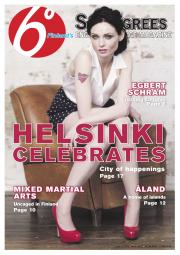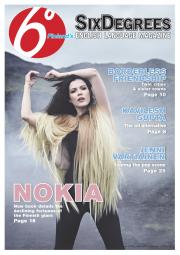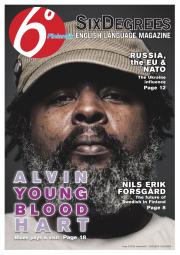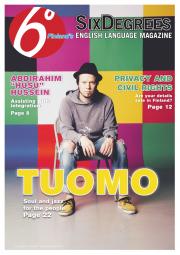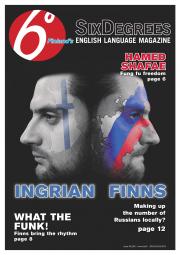


• Finland's english language magazine SixDegreeS Japanophilia keith hall keeping the rhythm page 8 Japan comes to finland page 10 free press Changes on the street page 14 Issue 7/2012 www.6d.fi 31.8. - 28.9.2012
  • Lo oking fnotrs! new tale Register Are you ready!? If you love to sing and perform - Join Ourvision 2013 Singing Contest! Ourvision is a singing contest for immigrants, people of immigrant origins and foreigners living in Finland. The winner receives 7 000 and possibly a record deal! For registration and more information, please visit www.caisa.fi/ourvision now! Music African Pots African food festival and music Enjoy food culture from Uganda, Somalia, Senegal, Ethiopia, Nigeria, Cameroon and Gambia. Fri 28.9 at 8-11 pm, 10 includes the food Slavic gypsy music and a hint of tango with Zingaroos Trio and Tango Duo. Sat 8.9 at 8 pm - 2 am , 5 Station Concert and Club-night 25 August to 21 September 2012 Today's Topic! Northern Uganda and Joseph Kony. Wed 19.9 at 5-7 pm. Free entrance. ORGANIZERS PARTNERS Moon Festival Come and celebrate the autumn harvest and the full moon! Ikebana workshop. See details at www.caisa.fi Sat 29.9 at 6-9 pm Asian International Cultural Centre Mikonkatu 17 C, www.caisa.fi facebook.com/caisa.kulttuurikeskus
  • 6 30 AUGUST ­ 5 SEPTEMBER 2012 HELSINKI TIMES Students travel more cheaply The autumn term is starting in capital area schools. Students receive a 50% discount on the Travel Card's season and value tickets when certain conditions are fulfilled. The student must live permanently in the HSL area ­ in Helsinki, Espoo, Kauniainen, Vantaa, Kerava, Kirkkonummi or Sipoo. The student must be at least 17 years old, and be studying in Finland on a full-time basis. The studies must lead to a qualification or degree, and their duration must be at least one academic year. The discounted student ticket for public transport can also be granted to foreign exchange students living in the region temporarily. There are some restrictions for student discounts for over 30-yearolds. Postgraduate students do not receive a discount. Alternatively, certain student cards bearing the stamp of the starting academic year are accepted as sufficient proof of studies. Further information and necessary forms: www.hsl.fi/EN > Tickets and Fares > Discount Groups > Students. The discount group needs to be updated You can travel in public transport at a discounted price for as long as the student discount is valid on the Travel Card. It must be updated at the beginning of every academic year. Updating requires your own Travel Card and either a valid HSL student discount ticket application, or a valid student card. In addition to HSL service points, until 7 September the Travel Card can also be updated at the University of Helsinki main building, Viikki campus and Aalto University in Otaniemi. In Vantaa and Espoo, the updating can also be done at a Citizen's Office. Getting a student Travel Card You can get a student Travel Card from HSL service points, which are situated in Rautatientori, Itäkeskus and Pasila. You must provide both an official identification document and an HSL student discount ticket application approved by the educational institution. Changes to early morning bus services The early morning bus services have had a number of changes since the autumn timetable took effect in mid-August. The early morning services operate on the nights between Friday and Saturday and Saturday and Sunday, as well as on particular holidays. The Helsinki internal early morning bus services Withdrawn services 05N 06N 08N 09N 100N 130N 140N 210N 220N 05N, 06N, 08N and 09N were terminated. The regional services to Espoo 100N, 130N, 140N, 210N and 220N were also withdrawn. The terminated services have been replaced by extending the late night operating hours of other bus services, and adding new N-services. Replacement services Night buses to Espoo leave from the Kamppi terminal The early morning buses to Espoo depart from the Kamppi terminal after 2:30. Services 195N, 231N and 270N will continue to depart from Elielinaukio. During the early morning service hours after 2:00, passage to the Espoo terminal is through the long distance transport terminal entrance in Narinkkatori. HSL recommends that the ticket be bought with value loaded onto the Travel Card to ensure minimal delays. The ticket can also be purchased from the ticket machine next to the entrance. The tickets are inspected at the terminal entrance. Further information: www.hsl.fi/EN. Make an autumn trip to Suomenlinna! You can admire a historical view and refresh yourself in Suomenlinna in the early autumn as well. Thanks to HSL ferry service, this popular sight is only 15 minutes of seafaring away from Kauppatori. The Suomenlinna ferries run on summer schedule for longer than in previous years, until the 16th of September. Other HSL services are already running autumn schedules. Accepted on the ferry are Helsinki internal tickets, regional tickets and the Suomenlinna ticket, which is valid for 12 hours. A Suomenlinna ticket costs 5 euros for adults and 2.50 euros for children. The Suomenlinna ticket is only valid on the ferry. Suomenlinna tickets can be bought at the ticket machines at the ferry terminals, and several sales and service points in the capital region. The ferry itself has no ticket sales. a new route 76N and 71 to Pihlajamäki a new route 72N, 64N and 65N to Koskela and Oulunkylä routes 68 and 71 a new route 67N and 64N to Käpylä and Oulunkylä 106, 109N, 110, 132N and 195N 109N, 110, 132N, 154N and 195N 147N, 150N, 154N and 195N 106, 154N, 231N and 270N 106, 109N, 110, 231N and 270N
  • SContents ixDegrees 5 SixDegrees in this issue September 10 Japanophilia From youngsters dressing up as their favourite manga characters, to shops stocking culturalitemsandavarietyof culinarydelightsonoffer,the appealofJapanesecultureis widerthaneverinFinland. 6 17 Starters Tastebuds We sample some authentic Ethiopiancusine,discoverwhat Finns are eating this month andalsoenjoyadecksidebeer inHelsinki. 18 Cultitude Cécil Orblin, Midnight Run Helsinki, LARU 12, Helsinki Street:MoreTowardsNothing, Placebo, World of Tango Festival,MickHarveyandLove andAnarchyreturns.Also,find out what's on at the cinema overthenextcoupleofmonths and the latest games, DVDs andCDsreviewed. 26 Out & See Where to go and what to see in Helsinki, Tampere, Turku, JyväskyläandOulu. 8 Keith Hall Arriving to Finland some 22 years ago armed with a pair of drumsticks and a sense of humour, this London-born gent opensupabouttherhythmthat hastakenhimaroundtheworld onnumerousoccasions. 12 Political tours Travellingtheworldhasnever been more accessible. But whataboutthosewhowishto discover destinations off the commontouristtrack;places that have been scarred by warandextremeevents? 14 Free press Anumberoffreepublications have fallen by the wayside in recent times. Just what does it take to sustain street press these days and what are the factors that force the switchingoffofpresses? The SixDegrees Team Editor-in-chiefAlexisKouros SubeditorJamesO'Sullivan Advertising & Marketing BobGraham,AimanKaddoura, +358968967422 Emailsintheform:firstname@6d.fi Out&SeeHelsinkiandcapitalarea outsee@6d.fi Out&SeeTampere outseetampere@6d.fi Out&SeeTurkuoutseeturku@6d.fi Out&SeeOuluoutseeoulu@6d.fi Out&SeeJyväskylä outseejkyla@6d.fi Layout & Graphic Design KirbyWilson MooseDesign&Photography Writers and contributors in this issue Feven Chane Abagaz, Nick Barlow, David Brown, Hans Eiskonen, Rasmus Hetemäki, Marko Kainulainen, AnnaMaija Lappi, Beth Morton, James O'Sullivan, Mika Oksanen, Leonard Pearl,AnnikaRautakoura,GarethRice, Mimmu Takalo, Aleksi Teivainen, Jutta Vetter,TomasWhitehouse. Proofreading JamesO'Sullivan Print houseI-PrintSeinäjoki Circulation50,000pieces PublisherDreamCatcher Productionswww.dreamcatcher.fi 6°DreamCatcher Vilhonvuorenkatu11B 00500Helsinki tel.+358968967420 fax.+358968967421 info@6d.fiwww.6d.fi ISSN1459-5680 Allarticles,picturesandgraphics aresubjecttocopyright. Noreproductionorreprintingis allowedwithoutpermissionfrom DreamCatcherInc.©DreamCatcher Nextissueisouton 28September2012. SixDegreescanalsoberead atwww.lehtiluukku.fi ReadmoreabouttheJapanophiliain Finlandonpage14.
  • 6 Issue 7 2012 Starters Top 5 things on our mind this month... the Olympics Well, that was fun wasn't it? A veritable feast of people running, jumping, throwing stuff and kicking each other in the head. We've had so much of it in the news it seems the rest of the world was put on hold for two weeks, which was nice! the Olympics: Finland win at sucking Oh, come on - with fewer medals than Uzbekistan and being lower in the final table than Mongolia, Uganda and Latvia it's our worst position in Olympic history! That takes some beating, so well done Team Finland. And thank goodness for windsurfing, eh? Summer's here! As a result of which people who have gone back to work after spending July getting wet in their summer cottages are now sitting in their offices and cursing their luck. Sages say a cold winter is in the offing. Finland maybe blows up the Eurozone Erkki tuomioja, Finland's foreign minister, vaguely suggests the euro might one day collapse leading newspapers to lick their lips, the Finnish government to go `WTF?', timo Soini to say he told us so, and the rest of Europe exclaiming, `Oh no he didn't!?!' Also, a German industrialist compares the crisis to 1945 and Spain holds 164.4 billion euros in bad debts. Is the single currency about to go pear-shaped? We don't know, and neither does anyone else! Pussy Riot In a fantastically ineptly-handled trial, a Moscow judge handed down a two year sentence (in a labour camp) to three members of the Pussy Riot collective for singing a bad song in a church. Despite lots of celebs booing the decision, it hasn't helped so far; in Madonna's case, it might even have made it worse. Nick Barlow Record fairs back in the groove Collecting vinyl continues amidst the digital revolution. Finland and Sweden, and the whole bustle seems to manifest a grass-roots rebellion against the digital age of music, its predictability and disposability. In general, the fairs appeal to people of all ages, but the ripples of the vinyl's lost decade are still tangible. "There is no music for people in their twenties," Sundsten bemoans, referring to the limited availability, and consequent high prices, of the vinyl pressings of, for instance, Tigermilk by Belle & Sebastian, Mellon Collie and the Infinite Sadness by The Smashing Pumpkins and Division Bell by Pink Floyd. "After all, not everyone wants to live my youth," he exclaims. While you may stumble on some rarities, the record fair is not an arena for the likes of the 1977 Sex Pistols' single God Save the Queen single on A&M Records or the 1963 The Beatles' début album, Please Please Me on Parlophone ­ ranked as the two most collectable records by the Record Collector magazine. Such gems are sold at the Sotheby's auction or on eBay, where the fifth copy of the WhiteAlbum by The Beatles (presumably Yko Ono's, Sundsten notes) recently fetched 19,201 pounds. "The fairs are by no means annual gatherings of record collectors," Sundsten promises. "The majority of customers are regular folk, looking for, let's say, the best of Sinatra their local music shop did not have. You can always find something for a couple of euros." the next record fairs are organised on Saturday 15 September in turku's Kåren and on Sunday 16 September in Helsinki's tavastia. For more information visit www.levymessut.com I Aleksi Teivainen to... How make the most of aUtUmn? By storing up as many memories as possible of a warm summer to keep me going through the dark deep freeze of winter. I perform at the Ruska Swing festival in Lapland every autumn and that is always a beautiful way to enjoy the autumnal colours. Keith Hall, drummer t is hardly news that vinyl is making a comeback: old collections are dusted off, manufacturing is re-vitalised and many ­ including Harry Wallop, the consumer affairs editor of the Telegraph ­ regard vinyl as a worthy alternative investment target alongside wine, stamps and art. Whether you are looking to (re-)acquaint yourself with the format, to invest or simply to add to your collection, a record fair is not a bad place to start. Jacke Sundsten, the proprietor of JS Records in Turku, organised his first record fair roughly 20 years ago. Through what has been a tumultuous age for the music industry, the fairs have somehow persevered ­ although not exactly unscathed. "Back in the day, 1,400 people flocked to the volunteer fire department for a record fair," Sundsten recalls. "Our budget was five-fold and the entrance fee was eight euros. But with the downfall of the CD, half of the customers disappeared." Today, a few hundred people pay the three-euro entrance fee to flick through boxes of product set up by the sellers from Finnish AFter DArk Learning the Finnish they don't teach in school David Brown and Mimmu Takalo Take in the brisk air and beautiful scenery while walking in a park or sitting on a bench. Remember to dress warmly! annika Rautakoura, journalist Suomeksi: Rotunainen English equivalent: Pedigree women (literal), Uptown Girl When Billy Joel sung about his "Uptown Girl", you sensed he met a model from Manhattan, complete with a Mercedes and a platinum Amex card. Here in Finland the same concept exists, and although she likely lives in Espoo and rides the bus, she at least dresses beautifully and will make your friends sick with envy. Though the word "rotu" needs to be used carefully in any environment but a dog show, dating a woman of a fine pedigree is a noble pursuit ­ unless you have to buy her drinks. · · · · · · Kukasenainenolieilensielläkonsertissa?Setumma. Yksmuntyökaveri,Meeri. Vau!Siinävastarotunainen.Sanoterkkuja Whowasthatwomanattheconcertyesterday?Thebrunette. Thatwasmyworkmate,Meeri. Wow!She'sreallyapedigreewoman.Sayhifromme! There is an Icelandic saying: "Hástid er timi ástarinnar" that means "autumn is the time of love". That would be my number one survival strategy for darkening evenings. Cécile Orblin, actress
  • Starters 7 SixDegrees a warm welcome Welcome Weeks offers a multitude of opportunities for the international community here. MarianSigler James O'Sullivan tell me about your city... < a day without Fender-benderS and partiCle perilS? Mika Oksanen iF you drive to work but sometimes think about the environmental impacts of it, you might want to be a small part of the solution on 22 September by following the lead of the Leave Your Car at Home Day, an international theme day that brings attention to the problems caused by increasing traffic volumes and the development of public transport. This year the City of Helsinki will add a fun twist by providing a series of events on the day and the following day in the spirit of the 19th-century. The Finnish capital's historic centre and its buildings will be the setting for horse carriage rides, lectures, live music and bustling markets. Keeping to the theme, the City encourages visitors to take public transport or to pedal their bikes, whether to the events or otherwise during that day. Helsinki and other main cities in Finland have rather good public transport systems in place. Check out the Helsinki Regional Transport (HSL) website to surprise yourself with how extensive they actu- ally are in the capital region. However, those eagerly anticipating the reappearance of city bikes in Helsinki available for public use will have to wait a little while longer than 22 September. "The city bike system, linked with other public transport, is intended to make travel within the city easier than by car," says Artturi Lähdetie, Project Manager for Helsinki City Transport (HKL). "The former bikes suffered from vandalism and poor mechanical quality, but those of the future will provide the same quality level as other forms of city transport. Basically, our system would be disassembled for the winter and rebuilt in the spring due to bike technology and road maintenance constraints, and would involve very low user costs for short use and slightly higher costs for longer use. We strive to follow international developments to make our system state-of-theart. We are hoping to set up the system for the next summer, once we can resolve a number of remaining technology, cost and provider issues." leave your car at home day is on 22 September. reaCHing out to the 95,000 international folks living in the Helsinki region, the third annual Welcome Weeks is being held until 21 September. Utilising a large number of organisations, institutions, and public offices the event seeks to make it easier for foreigners to integrate and become included in their local communities here by highlighting all of the options available to them. "We are succeeding in creating a lot of new connections between all those actors in the region working for internationals and internationalisation," explains Project Coordinator Søren Berg Rasmussen. "This in turn, enables us to pool the resources and expertise of all these people to provide a very inclusive and encompassing programme. Welcome Weeks is for everyone, made by everyone." One of the more eagerly anticipated events is that of the Talent Factory on 17 September. The event provides access to the Finnish labour market through discussion, information, practical help and networking for both companies and international talents. Elsewhere sees the Engage Yourself event arranged in cooperation between Luckan and Sello Library. Here a range of free time activities the region has to offer such as sports and hobbies, volunteering and political engagement are explored. Furthermore, other events are also on offer, such as Find a flat, Mate!, Hidden City Race, Entrepreneurship 101 and Learn the Local Lingo seeking to ease your integration pathway. Welcome Weeks 25 august to 21 September www.welcomeweeks.fi addis ababa Mihai Petre Feven Chane Abagaz back for the Time to study for all ages. Future Click and play What's caught our attention online recently. www.dearblankpleaseblank.com Here some heartfelt, amusing and touching submissions are compiled for your entertainment. Gasp incredulously and laugh heartily in a short space of time. All material is submitted by fans of the site, with the team running the site sidestepping as much responsibility as possible stating that, "If you see us on the street, please don't shoot, stab, or punch us". Great stuff. www.guardian.co.uk/sport/ series/brick-by-brick If you're still coming down after experiencing a dose of Olympic fever, take a glance at The Guardian's highly entertaining Lego recap of some of the more notable events. Once again soak up Usain Bolt's dominant 100m, Michael Phelps's record breaking performance in the pool and US gold in the women's beach volleyball. aFter enjoying the modestly warm summer months, by the time this issue is on stands schools around the country will have flung their doors open once again to hordes of knowledge-hungry youngsters. However, a number of students are quite literally heading back to school for the first time in a considerable while, with adult education offering the opportunity for more mature students to achieve their academic needs. "The truth is without a qualification in Finland you are at a disadvantage," explains viceprincipal of Eiran Aikuislukio Leslie Hyde. "There's the strong idea in Finland that when autumn comes it's time to study, to renew." One of the largest adult institutions in the country, Helsinki's Eira boasts 1,600 full time students ­ a third of which are immigrants returning to studies for the first time after a break. A number of the student body is also made up of Finns that have been living abroad and seek to have the same qualification as their peers. "Generally when they come back to Finland they tend to settle in to their studies pretty well," Hyde explains. "Also, many foreigners realise the importance of learning Finnish, as do their family. As they begin to learn things, they soon become the ones in the family who can take care of things." While such a transformation can only be of benefit to their immediate family, the goals of many adult students remain personal. "The idea of coming to a new country, you can learn Finnish, you can build a secondary education and become a new person. It's creating a new vision for yourself." School is now in! CoSmopolitan Addis Ababa has been growing with an astonishing speed since it was founded more than a century ago by the charismatic and highly cherished Emperor Menelik in 1887. Many blame the city's varied architectural design on the recent arrival of urban planning, however, the tall office buildings, elegant villas, fashionable hotels, muddy houses, functional bungalows and flats together reflect its unstructured evolution, simply growing in a natural way. Chilling in cafés and restaurant dining are customary in Addis. I suggest visiting one of the Kaldi's coffee houses to have a real taste of Ethiopian coffee, Arabica. Though there are exotic cuisines in the city, the best way to enjoy the culinary taste is to go local ­ a diet of spicy, meaty dishes and fresh organic vegetarian foods. Get ready you're going to use your hand to eat with, not a fork! For a night out, bars and clubs can be found in abundance offering the best music of all type, but you might need to be with a knowledgeable friend. To enjoy a glimpse of Addis Ababa's enriching history, I advise a walk to the national museum where numerous antiquities, historical relics and pale ontological objects jointly dictate Ethiopia as a cradle of mankind. If you drive further north up to Mount Entoto, you will have a panoramic view of the city and surrounding countryside. I recommend also a visit to the national pride Trinity Cathedral, where many patriots of the war against the Italian invaders are buried. The often called largest open-air market in Africa, Merkato, is also a must see. Here you can find virtually anything that money can buy. Finally, the year-round bracing atmosphere of a highland summer resort in Addis is an ideal climate to escape to from the cold European winter months. let us know about your city: james@6d.fi HoW Well do you knoW FinniSH Summer? 1 2 3 4 5 6 7 8 Feeling under the 9 weather? Yep, that's about it for the warm weather here. Time to begrudgingly pack away the summer equipment and get down to the reality that we have a little while to go before the sun's heat is behind us again. But, don't despair as there will be a few pleasant days to come. In fact, an Indian summer is not completely out of the question. What you can expect over the coming month. September averages (°C) Helsinki 14.6/8.7 turku 14.9/7.2 tampere 14/5.9 Jyväskylä 13/4.7 oulu 12.5/5.4 1. classroom 6. lesson 7. pen 2. study desk 3. teacher 4. 8. alarm clock break (during school day) 9. physical education 5. rubber test your knowledge of Finnish vocabulary by using the local equivalent. Puzzle by Rasmus Hetemäki. Solutions on page 26.
  • 8 Issue 7 2012 We Met Moving to his own beat Drumming has taken Keith Hall to many stages around the world. Date and place of birth: 24 April 1951, Wembley, London, UK. Education: C of E Primary school, Grammar school education. Family: Wife Titvi, Mum Evelyn (90 and still going strong) and elder, but younger looking, sister Shirley. My favourite word in Finnish is... I have several: aprikoida, to muse over; terveisia perseesta is another. The hardest thing about drumming is... lugging the drums around. I miss having roadies. My most memorable gig was... after 58 countries and TV appearances in over 30, it's a toss-up between Wembley Arena and Madison Square Garden. Wembley wins, I guess, as it's my home town. Tomas Whitehouse
  • We Met 9 SixDegrees S ITTING with Keith Hall is an exercise in keeping up with the multitude of jokes and anecdotes filling the air. A drummer since he was nine years old, London-born Hall enjoyed success early on in his career with the popular group Pickettywitch in the early `70s. Going on to join one the most famous outfits of all time, Gerry and the Pacemakers, Hall was soon touring the globe once again. Following his time with the band, Hall went on to work with an impressive number of internationally known musicians over the years including a stint in Terry Lightfoot´s Jazz Band continuing an illustrious line of previous drummers that includes Ginger Baker. In time, his musical interests brought him here to Finland where he eventually settled in 1990. A member of the Antti Sarpila Swing Band for 20 years, he has worked with some of the biggest names in music here, has hosted his own radio programme Playback and has appeared many times on Finnish television. SixDegrees caught up with Hall one afternoon in a downtown Helsinki pub to hear more about his life and career, and learn just what to say when chatting with Tarja Halonen. some little village somewhere who's doing something amazing rhythmically, and you are like, `What the hell was that?!'. It is a question of variety. For me, playing lots of different kinds of music has been a huge bonus. I've never said that I'm just a rock drummer, or a jazz drummer or anything. I've done theatre work, I've worked in London's West End and I've done a lot of studio work. I've played with a classical orchestra. All of these experiences are extra tools that you put in your toolkit and bring them out when you want to use them. It's very handy, a musical palette if you will. It's like if a painter had only one brush, he'd do a pretty good job; if he was Michelangelo he would do a great job! But if he had a few more brushes he'd have more variety of strokes, more colours and so on. That's how I look at it. A lot of jazz musicians don't get it; they say I played in a rock band. To me I don't see any harm in that ­ it's all music, why specialise in only one thing. I don't get it. If it's well played, it's great. In fact many of today's leading jazz drummers started out playing rock. Are you comfortable getting up on stage? Absolutely. I am more comfortable getting up on stage than I am sitting here talking to you. It's my home, the office. I've been lucky enough to perform at Wembley Arena and Madison Square Garden in addition to thousands of clubs, concert halls and theatres. Those legendary venues you don't forget those in a hurry. It's amazing. The excitement and joy of playing music; the travelling is tough sometimes. Relationships within bands are like marriages, mostly loving and supportive, but sometimes cranky or bitter. The aim is, hopefully, to grow as a person as well as a musician. I was a bit of a bastard when I was a young guy. Hopefully I've gotten a bit more laid back and a bit more reasonable. It was only because I was striving to be where I wanted to be musically. probably never going to be a real Finn, I absolutely hate Finnish tango! This is the Lederhosen tango capital of the world. Tango, for me, should be Argentinian, romantic and sexy. The Finnish version is too rigid and sung with this terrible false vibrato! I have a fantastic group of Finnish friends here, both men and women. They are some of the most beautiful people that I have ever met and have kept me sane and smiling for most of the time! What struck you about Finland when you settled down? It was a bit of a time warp actually, I have to say. Not quite as bad as New Zealand where you set the watches back 200 years. The first time I went to New Zealand with Gerry and the Pacemakers we were on the front page of the newspaper as they had opened up a club that closed at 1:30 in the morning. It was scandalous. There's a small town mentality here in Finland that I find most annoying. They boast about the smallest things: the Finnish guy who came 12th in some competition somewhere in South America. It's extraordinary. But many countries with small populations and short histories have this rather inflated national pride. The one thing that does work extremely well here is the rubbish collection. Going back to London now it's a total nightmare. This rubbish goes out on one day, that on another and your recycled stuff on another. The water is brilliant here; the tap water is out of this world. The public transport too. There's a lot of stuff that's great. But there are only five million people in a country the size of the UK. The needs are different; there's space for everybody. When I first came here it was still in a bit dark, DDR period, still shaking off the Russian influence. It wasn't long before I arrived that women weren't allowed to be in a restaurant on their own. You couldn't just go in and have a drink, you had to order food. Those cultural shocks were a bit of an eye opener, including the politics concerning alcohol. The Finns always make the excuse through shyness, but they ­ the men mainly ­ are socially constipated. There is very little eye contact. Of course, once they have a few drinks they are off. This head down thing is very strange to me. There is a lovely story of that goes `How do you know when you have made a new Finnish friend? He stops looking at his shoes and starts to look at yours!' I know that we Brits use it sometimes too much, but a little small talk makes the world go around. In the 22 years I've been here, places like Helsinki have definitely become more international. Many places are open to four in the morning. Try and find that in London without knowing some private numbers. I think Helsinki is a great city in which to live and the only place where I could live in Finland. Having wonderful places like Seurasaari and Suomenlinna on my doorstep is a real privilege, and the sea of course has a big influence. So it's a good thing that it's becoming more international? Of course it is. It has to. It can't shut itself away. Finland needs to come out of the closet. They have tended to put all of their eggs into one basket. They are very proud of their achievements, like Nokia, Marimekko, KONE. They tend to publicise those to the exclusion of smaller companies that need support to rise up. In order to have a future you can't just invest in the same old companies. What about promoting new designers? Now, when the golden goose Nokia is going through some deep problems it's a bit embarrassing. I hope they pull through, I just hope that they haven't left it too late. Competition is fairly new here. It's always been Finnish companies competing against the rest of the world. In many instances they have performed extremely well. When it is competitive within their own boundaries it's another thing. There is a lot that still needs to be done to improve the quality of customer service here in Finland. If you arrived to Finland now, would it be any easier? Would you do it any differently? The reason I came here to live was for love, so in that sense no. I don't regret it. It's a high price to pay, missing family and friends in the UK. I miss them terribly and of course the language and the humour. On the other hand, I talk to people over there and they say that it's good that I got out when I did. The grass is always greener. If you come to live as a foreign musician in Finland you have to bring something that they don't have. There's certainly some jealousy here. Normally with musicians I love it if someone is a great player. When musicians knock you out with their playing, I go over and tell them. Here there's quite a bit of talking behind the back. Is it a cultural thing? Maybe so, I don't know. Jealousy is something I've never felt. Maybe when I had my first girlfriend and she talked with someone else. That was the only time I felt jealous, when I was nine or ten. I don't envy anybody, I don't give a damn if you're rich or poor, what type of house you live in. I don't judge people by their worldly possessions; maybe that's why I have known many of my friends for over 50 years. You were the first foreign musician to be asked to perform at the esteemed Linnan juhla. What is it really like? Before being invited to perform there, I had always thought it was so boring; I said to my wife that this is the world's longest queue. I have to admit, when you are actually there, it's a lot of fun. I did it twice, the first time for President Ahtisaari in 1999 and the second for President Halonen in 2009 . Actually, I screwed up one time a few years ago at Pori Jazz with Tarja Halonen. She came to an outdoor concert we were doing and called me over when I was leaving. She said, `Thank you very much for your wonderful drum solo', so I said, `Thank you very much Mrs President, you have excellent taste' [laughs]. I got that Queen Victoria `we are not amused' look! So, what is your best drummer joke? What's the last thing a drummer says in a band? `Hey, what about we try one of my songs?' How did you start playing music? When I was nine years old I built a drum kit. I had a tea chest as a bass drum; I bought a second-hand pedal. I didn't have a high-hat. The cymbal was the end of a water heater; it sounded crap, but I developed strong wrists. That's how it started. I had no plans to do this as a career. I was reasonably good at art, and was interested in theatre, lighting and set design. My art teacher suggested doing that as a career, and mapped out a plan. But in my heart I didn't think I was that good. Anyway, when I was 15-and-a-half the band I was playing with were offered to turn professional. They were all much older than I was. They were 18 and I was 11 when I started playing with them. It was very difficult to get out of a grammar school then; you were supposed to be in school until you were 18 and then go to university. I had to get special permission to leave. The band lasted a couple of months but I had a taste of it; I had been in a recording studio and realised I loved it and this is what I want to do. I started auditioning for other bands. I played with Ian Gillan in a band called Episode Six before he formed Deep Purple. I auditioned for his band and almost got the job but I was too young. They were off to the Middle East to do a gig and I needed to be 18 and I was 15-and-a-half. I often wonder if I would have gotten [Deep Purple drummer Ian Paice's] gig if I had stayed with them. While I continued to audition and realised that I was getting very favourable reports from my playing when doing them. One leading London jazz drummer said that, `You are a great player, but you are so young'. I could see my age becoming an obstacle. I didn't know what to do. I kept on auditioning, and kept on playing when I had the chance. The organ player of my next band was South African, when the band folded he was going back to South Africa and mentioned that he had a contract in a hotel as a duo with drums and Hammond organ, and was I interested. Well, I had to ask my parents first as I was just 16. How did they react to all of this? They were fantastic really; cautious but very supportive. My father agreed to pay my passage out there on the condition that I paid for my passage home. I thought that I would use this time down there to practice, get more life experience and that I would be a little bit older when I came back. Getting a work permit to work abroad because I was so young was beginning to be a problem. I was going to go for three months as a student but I ended up staying for a year. I got to study hard every day to get my technique together and got to work with some great people. It was the height of the dreadful apartheid era, so it was a cultural shock to run into separate bridges, benches, taxis and restaurants for the blacks. It was awful; it was like stepping into the American south during the times of slavery. I managed to work with some of the great South African musicians. The club I was working in Cape Town was called `Spurs' and was run by gangsters. Tooled up guys. I was like their mascot, this little guy. They loved me and I loved them. They really looked after me. They had another club that they paid the cops off where they had black musicians playing, Japanese, Chinese all kinds of people in the club. It was a huge cellar called The Catacombs. A fantastic place. How do you absorb all of this as such a young bloke? I went out there as a schoolboy and came back a man. I started smoking out there which was another thing, learning how to drink a bit and a few Durban Poisons. I learned how to do all of that shit, but I realised very quickly that thank God I couldn't play anything when intoxicated. What you thought was great when you recorded it, when I heard it back I realised it was not for me. I managed to keep well away from the hard stuff, which has ruined so many musician's careers. It was a very exciting time. Incredibly long hours but it was fabulous. I never thought then or even nowadays, `Oh shit I have to go to work'. I mean, I have worked very hard to improve and I'm still learning. I'm the eternal student. Nobody knows everything in this world. Even the best drummers in the world are pretty humble guys. There's always some unknown guy in "F or me, playing lots of different kinds of music has been a huge bonus." There's this belief in Finland that you need to have a degree to really achieve success. How does this relate to playing music? There weren't those kinds of opportunities when I was growing up. I studied privately. Is it necessary to study? Yes it is. It helps you understand the history of what has gone before and how to utilise your talents in the most beneficial way. In the end you have to be your own man, your own player. Reading music is another tool to have. But are we in danger of becoming robotic metronomic clones all playing the same style then? I hope not, even though lot of stuff nowadays is done with click tracks and loops. The danger [with music schools] is that the teachers have fairly strong musical opinions ­ not always correct ­ which influence playing style and even holding the sticks in a certain manner. This tends to permeate down through all the students. I'm not saying that this is wrong, it's produced some very fine players, but it's not the be all and end all, you are not getting the whole picture. There's a lot more to just that. Life is the best schooling; understand different cultures and understand that we are pretty much the same, with the same hopes, dreams and fears as everybody else. So, what eventually brought you here to Finland? I came by accident. I had a very good friend who was a bass player in England. He called me and said there is a lady from Chicago called June Harris who is working currently in Norway and she's had some problems with the band and she's moving on to Finland. Would I be interested in doing it as a trio? When I was with Gerry and the Pacemakers the first gigs I did with them were in Scandinavia, but we never came to Finland. I thought it would be fun. It was May 1987. We had a great time and came back again in 1988; it was a very good trio. Through that I met who is now my wife Titvi Ikäheimo, a wonderful fashion designer. She came to check her display case in the foyer of the venue. She heard the music, came up to thank us, and over a period of time we got to know each other. Then it got to be serious. We got engaged in 1989 and I decided to move here in 1990. The same evening when I first came here to live we went out to eat with some friends. We were talking in English for the first hour and then they started talking in Finnish. Of course I was sitting in the corner thinking that, `Shit, if this is what it's like. I'm not actually going to stand this'. A couple of days later, I enrolled at Helsinki University. I studied Finnish language for two years because I could not stand being out of the loop, not knowing what's going on. Now I'm a Finnish citizen, with dual citizenship. But I'm
  • 10 Issue 7 2012 Lifestyle T he H Tom a .I. / nd /A Hyju Local Japanese culture Japan is not that far away, at least not for those who know where to look. have vending machines with panties and sex museums. The culture is just so utterly out of the ordinary." The highly eclectic nature of current Japanese fashion is something to admire, yet not easily emulated. Street fashion is prominent in Japan, and it combines Western trends with local and subculture features. The feminine streak of the Lolita style, a common feature in Japan though originating in the US and Britain, is not uncommon among Finnish youth. The cupcake-shaped skirts and petticoats inspired by Victorian and Rococo-era Britain have been reinvented to suit punk, gothic traditional Japanese needs in the widespread Lolita style. The outfits are often completed with knee high stocks or stockings, blouses and headdresses. Cosplay, short for costume play, is an important yet rather bizarre aspect of being a fan of Japanese culture and clothes. Dressing up in Japanese manga and anime style costumes is an extreme way of conveying devotion to these imaginative sub-cultures. This is a worldwide phenomenon; an annual World Cosplay Summit takes place in Japan, in which Finland also takes part. So what is it about manga and Japanese animation that is so awe-inspiring? What fans mostly talk about is the diversity and exotic nature of these genres. Nothing seems to go according to rules in these mystical stories that nevertheless often portray features of Japanese hierarchy and traditions. Ninjas and the warrior culture dating back to feudal Japan provide mysterious, even romantic tales on screen and in books. The anime craze in Finland increased greatly when The Spiriting Away of Sen and Chihiro by the highly acclaimed anime director and manga artist Hayao Miazaki hit movie theaters in 2002. A steady influx of anime films has ever Hosomi W Annika Rautakoura hiLe Japanese culture might initially seem to appear somewhat of a distant concept in Finland, it has in fact a widespread network of supporters and events devoted to its wonderfully quirky aspects. In many cases the term Japanophilia can be applied: a strong interest in the country, culture or people of Japan. For many it is even not a case of interest, but lifestyle. Did you know that Finland is in fact the third largest market area for Japanese rock in Europe according to JmusicEuropa, a European online poll about Japanese music? Finland also has its own Anime Union, which collaborates with many local Finnish anime organisations, of which surprisingly many do function in the country. While local organisations are independent, the Anime Union oversees common interests, such as organising larger events and campaigns. Japanophilia encompasses different aspects of Japanese culture: anime, manga, language, clothes and music, to mention a few. Needless to say, these are aspects rather divergent from Western and Nordic cultures and hold a strong interest in their supporters due to their extremely foreign nature. since adorned the offerings of Finnish cinema. It was around the beginning of the 21st century that the different aspects of the Japanese culture landed permanently among sections of the Finnish people. Several anime TV shows, such as Dragon Ball Z, Silver Fang and Pokémon have also made their way here. Some of these are not considered "pure" anime by hardcore fans, but rather children's versions. These can be purchased rather widely in stores in Finland, yet those seeking lesser known works must often buy things from online shops, such as fantasiapelit.com. Manga comics are often part of comic book store collections, yet collectors' items may be hard to find. The supernatural Japanese streak extends to all forms of art, and speaks to people around the world, not least in literature. Four of Haruki Murakami's works have been translated into Finnish. His universal themes of alienation and loneliness merge into surrealistic Japanese elements in these wildly successful works. Kafka on the Shore made it to number 9 in the list of most bought translated books in February 2009. This year the Finnish version of Norwegian Wood made the list in February and March. A place to gather Manga Café in Kaisaniemi is a haven for hardcore Japan fans, especially those who love their animation and manga. Milla Sainio, owner of the establishment says they have a lot of regular customers. "Most of the visitors are adolescents or young adults. About 80 per cent are females, who are into the Japanese culture, read manga, watch anime, cosplay, listen to Jpop and so forth." Their display of products is something to behold: Japanese beverages and treats, as well as the obvious collection of comic books, complete Something out of the ordinary Laura Lindeman, 24, who makes clothes herself, is an avid follower of Japanese culture and fashion. "I like the garish nature of the clothes culture of the Japanese," she says. "They dare to be bold and different there. I also like that the people often manufacture their own clothes there. The contrasts are also quirky: the Japanese are rather conventional, yet they with vending machines. "We have Japanese soda Ramune, it's a funny glass bottle where a ball is popped inside," Sainio describes. "We have different flavours on sale. We also have Pokka ice tea, a Japanese brand. Then we have these Pocky chocolate biscuit sticks, which are very popular in Japan." Not to be outdone, there are plenty more items on offer. "We have different Japanese figures, all sorts of merchandise imaginable from different TV shows. Of course comic books are also available, Japanese ones." The café has been in operation for over three years. It moved to the new premises a few months back, and business seems to be going rather well. Sainio says it's a popular get together location for groups especially during the weekend. 16-year-old Erika Jensen-Eriksen, also known as Rika is a frequent visitor at Manga Café. Her style is made up of dark Lolita elements, completed by an umbrella. Rika likes to draw and play videogames. She is a fan of Japanese manga and anime, but not exclusively. "I had friends who were into it, and they encouraged me to check out some things. This was around when I was in fifth grade. It has since subsided a little, now I enjoy also Western comics, but I do manga and anime." The Espoo native visits Manga Café quite often. "I go to upper secondary here in Helsinki, so I may come here after school," she says. "I usually have friends here, and I'm friends with the owners as well." Rika has not been to Japan herself, but would like to visit there. "It's not a must anymore, but it would definitely be nice." Rock attraction Japanese rock music is referred to as Jrock around the world. Finland's JrockSuomi community is an organiser of fan meetings and
  • Lifestyle 11 SixDegrees Kyuu Eturautti Annika Rautakoura Rika is a fan of Japanese manga and anime. offers expertise knowledge on the genre to the press and everyone eager to dwell into the world of Japanese rock. The community collaborates with other associations around Europe. The first visual kei gig in Finland in Turku in 2005 was sold out two months before the concert. The visual kei movement, marked by elaborate outfits, makeup and often androgynous elements, essentially makes up the image of the ubiquitous Japanese quirkiness: it's bold, eccentric and embraced warmly by the Finnish community. For those wishing to familiarise themselves with the culinary features of the Japanese culture, Tokyokan on Annankatu provides rare imported delicacies, along with cooking supplies and books, kimonos, Japanese magazines. Even SUZUMO sushi robots are available and ready for use. The shop was established as early as 1987 and features native Japanese visitors as well as Finnish people and fans of Japanese food. Also Luca Kiosk on Mannerheimintie has a comprehensive selection of Japanese snacks, beverages, herb tea, stationeries, accessories, bags and cosplay and animation related merchandise. According to the kiosk their most popular products are: Totoro products, animation products, Japanese snacks, shopping bags, and fashion magazines. "As we all know, Japanese culture extremely cares about the details," states Luca Kiosk's Oda. "We believe the high-quality products from East Asia bring different feelings to Finnish people, to enjoy up-to-date fashion from the other side of the earth without travelling abroad." It seems like the Japanese culture is here to stay. You can celebrate it by attending the Hanami celebration in the Japanese garden of Roihuvuori in May, study the Japanese language in a number of institutions, or visit one of the hotspots for Japanese fans. Sushi bars are a frequent sight in the city centre these days; they are no longer the oddities that they were ten years ago. The stoic Finns and creative Japanese may in fact have a lot in common. Japan certainly kindles the interest of Northerners. Find Finnish dedication to Japanese culture at: www.cft.fi www.animeunioni.org www.mangacafe.fi www.jrocksuomi.fi www.tokyokan.fi www.fantasiapelit.co www.luca.fi
  • 12 Issue 7 2012 Society Column David Brown is a language consultant and journalist, regularly covering stories in Africa, Asia & the Middle East. He has lived in Finland for 10 years. The sound of silence David Brown The preacher's sermon began at 22:30. The hotel receptionist suggested it might end by midnight, but soon conceded that around 7:00 am was more likely. While evangelical events take place all over the world, in not many countries do they run all night, nor involve such massive speakers that the windows of neighbouring hotels rattle in their frames. With sleep impossible through the din of souls being saved, I lay back and wondered quite why it is that silence means so much to Europeans...and apparently so little to Ghanaians. IT isn't only all-night sermons. In Africa I'm often kept awake by booming downstairs nightclubs that close at 5:00 am, by radios switched on at 5:05 am, by huge arguments and laughter at all hours of the night, not to mention the dogs and chickens. Even on the bus, I have a preacher delivering a sermon from the aisle on one side of me and teenagers playing music (sans headsets) on the other. journeys Potential What if Finland conducted political tours? "P erhaps in Europe we simply worry too much about what is appropriate." here in Finland, we consider such acts unthinkable. To make noise is to intrude into the space of others, and as we know, Finns do not intrude. Finns do not knock on the door if they hear gunshots coming from a neighbour's apartment for fear of breaking the social code of respect, let alone deliver sermons on the bus. I wonder if silence is part of a larger cultural issue. Life in Africa is immediate, joyous, rowdy and without reserve, in all forms of interaction. People touch, kiss, shout and weep without hesitation or shame. Scandinavians represent the polar opposite to this, with all behaviour considered and analysed until it has been found to be logical, polite and most of all ­ appropriate. I value silence, and one of the things I enjoy in Finland is how highly others value it as well. I love the fact that my neighbours turn the music down at a reasonable time of night without my needing to call the police. I find it difficult to write or read or sleep if people are shouting or screaming outside, and like the fact that generally in Finland people don't shout and scream at any time of the day or night. Much as I could live without the sermons (and the nightclubs and radios), I wonder if there isn't also something to admire in Africa's approach. Perhaps in Europe we simply worry too much about what is appropriate. And perhaps if we thought less about the potential embarrassment of hugging people in the street or talking to them on the bus, we would also experience something positive from the people around us. I don'T see a lot of thigh-slapping laughter here, and it does look fun. I dare say most of us might enjoy a bit more laughter, more eye contact and smiles in our lives...and might even like getting to know our neighbours. As long as we could do so without losing our taste for peace and quiet, at least.
  • SixDegrees Gareth Rice 13 SixDegrees When we think of tourism and holidays the following images may come to mind: golden beaches, turquoise seas and sun kissed islands lined with coconut palm trees. Regions that have been rocked by recent experiences of conflict tend to be perceived as less desirable holiday destinations. Enter Political Tours, the British based company that turns on a revolutionary concept for travellers who are passionate about politics and current affairs. It offers the opportunity to visit some of the world's most prominent conflict regions. According to Nicholas Wood, the director of Political Tours, "ultimately these tours are about really getting under the skin of a place, finding out what makes it tick, what have been the key events in its past that have shaped it and how it is changing today". Typical clients include politicians, academics and businesses, as well as the media and people with a professional interest in international or current affairs. So far the portfolio of destinations is focussed on societies that have had very r e c e n t experiences of conflict, controversial elections and ethnic cleansing. Tour titles include: "Turkey Election 2011", "Bosnia: Terminal State?", Kosovo: Europe's Youngest State", "North Korea: Inside the World's Most Isolated State" and "Northern Ireland: The Road to Peace". Wood set up Political Tours in 2009 after ten years experience working as a reporter in the Balkans. Having covered the 1999 refugee crisis in Kosovo, the fall of Milosevic, the 2001 inter-ethnic conflict in Macedonia, the 2004 Kosovo riots and the build up to Kosovo's independence, he is no stranger to conflict. He has also lived and worked in Kosovo between 1999 and 2004, before he moved to Slovenia. In 2009, he returned to live in the UK. What does it takes for a country to become a successful Political Tours destination? "There's no doubt that we are interested in examining issues that are in the news," Wood states. "But we are certainly not restricted to looking exclusively at conflict ­ in fact as we develop we want to look at a whole range of issues like the financial crisis and its impact on the UK or "P ast events, especially the Civil War, have left scars on the landscape and the Finnish psyche." of the first attempt to start serious military training among the Whites with the establishment of a 200-strong "cavalry school" at the Saksanniemi estate. A look at the eastern border A tour could venture further east to the Finnish-Russian border, which has many defensive lines, including Salpa and Mannerheim, built by Finland against the Soviet Union. During World War II Finland fought the Soviet Union twice in the Winter War of 1939-40 and the Continuation War of 194144. Today these lines remain littered with anti-tank obstacles in Miehikkälä and Aholanvaara, and many bunkers, including "Sk 16", are still in place. It is perhaps the Battle of Raate Road, fought during the Winter War, which is still seen today as a symbol of the entire Winter War itself. Finnish research indicates that the Soviets lost somewhere between 7,000 and 9,000 men. The former battlefield, in Suomussalmi, saw only with Sweden and the Soviet Union, and the Finnish Civil and Winter Wars. What then might clients expect to see on a Finnish political tour? What runs through the northwest? Tourists could visit a number of key sites that have fascinating stories attached to them. The Finnish-Swedish border area is believed to be one of the most peaceful in the world, though this wasn't always the case. When the Treaty of Hamina was signed back in 1809 it resulted in significant territorial changes: the separation of Finland from Sweden to become an autonomous part of the Russian Empire. A boundary was drawn along the Torne River, which was an important waterway that combined the Swedish and Finnish settlements along both its shores. Some members of the same families were split by the boundary, which cut through a relatively homogenous cultural region and made interaction difficult. Today, many people still speak fluent Finnish on the Swedish side of the river. This Finnish dialect, "Meänkieli ", has retained the status of an official minority language in Sweden. T h e Treaty is also important because, as the cornerstone of the Grand Duchy of Finland, it paved the way for the eventual revival of Finnish culture, the equal position of the Finnish language, and ultimately Finland's independence in 1917. Civil observation The Suomenlinna military fortress is a UNESCO World Site and one of Finland's most popular tourist attractions. It was a prison camp ­ along with those situated in Lahti, Hämeenlinna, and Tammisaari ­ during the Finnish Civil War, which was fought in 1918 between the "Communist" Reds and "Conservative" Whites. There is a memorial stone at Suomenlinna and an exhibition about the fortress's history. Other civil war sites include Helsinki Workers' House in Hakaniemi, which was the headquarters of the Reds, and today is still decorated with workers' tool motifs that fit with the original purpose of the building. It has a famous table named the "Table of Revolution" around which Lenin, Stalin and some other luminary Bolsheviks nurtured their ideas before 1917. A visit to Porvoo, to the east of Helsinki, would also be worthy of inclusion since it was the site a few minor skirmishes but clients would surely be keen to see The Monument of the Winter War, which includes a field clad with natural stones erected in memory of every soldier that died in the battles around Suomussalmi. According to one destination management company, a Finnish political tour would also bring economic benefits. "All touristic programs can be built based on politics, by giving more in-depth meaning to the product ­ which could be a good way to attract more travel groups that create jobs for bus companies, guides, and for us incoming agencies," states Kuoni. Finland would also be an opportunity to stretch the Political Tours concept a little further, something that Wood is also open to ­ in contrast to the other conflict regions Finland has been at peace since World War II. Clients may be interested to learn about recent Finnish nuclear decisions, Nordic welfare solutions, the success behind Finnish education and PISA, Finland before and after the EU and the rise (and fall?) of the Nokia nation. This would make for a different kind of itinerary and a travel experience that would surely compliment the work of Finland's more mainstream tourist industry. www.politicaltours.co Some potential sights for political tours of Finland · Finnish-Swedish border, along the Torne River. Suomenlinna. helsinki Workers' house in hakaniemi, the headquarters of the Reds during the Civil War. The Saksanniemi estate in Porvoo, the site of the White's 200-strong "cavalry school" during the Civil War. Defensive lines such as Salpa and Mannerheim near the Finnish-Russian border, that were built by Finland when fighting against the Soviet Union during the Winter and Continuation Wars. Also Miehikkälä and Aholanvaara's anti-tank obstacles and many bunkers, including "Sk 16". WWII battlefield at Suomussalmi, and The Monument of the Winter War. · · · · · illus tra H t ion ans Eisk one n. Ireland. We'd like to look at the push for Scottish independence. These are tours we are in the middle of constructing." Local interest Finland is hardly a conflict region but, nonetheless, its position between Sweden and the Soviet Union puts it in a position to make a unique contribution to Political Tours and also to take the concept in new directions. Today, Finland is a peaceful nation, but past events, especially the Civil War, have left scars on the landscape and the Finnish psyche. "I know so little about Finland so I want to understand a lot more about it, its relationship with the rest of Europe, its frontier and ties with Russia, architecture and design," Wood says. "What are the key trends? What worries and interests Finland most? What is surprising?" Tourism experts and researchers have many ideas of what Finland could bring to Political Tours. The most common of these are the history 11.7.­16.9.2012 Nordic desigN Today 2012 / 1.9.­31.10.2012 BMW arT cars / Tue, Thu, fri 11am-6pm, wed 11am-8pm, saT, sun 11am-5pm aherTajanTie 5, Tapiola Tel. +358 (0)9 8165 7512 www.emma.museum buses 106 and 110 from kamppi BMW ag


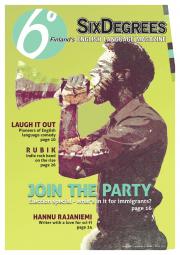
  • 14 Issue 7 2012 Feature Since the paper you are currently holding has already caught your attention, read on to learn how free press has fared in Finland and what different things "free" may mean. i Mika Oksanen N late July this year, the Janton Group, owner of the popular City-lehti, announced that the print version of the paper will be discontinued out of financial reasons. Since then, there has been some talk about a change of ownership and a possibility of continuation, but when we write this, the likelihood is that after a couple of more issues, the print version of City-lehti, one of the biggest free papers ever to appear in Finland, will reach the end of the line, and Finns have one less free paper available. Free papers are great. When you hit the railway station (or other public spot) in the morning, instead of spending your money on a publication, you can buy a cup of coffee and a mini-croissant with what you just saved by picking up this paper. Mmmmm, nice! Do you ever come to think where this "free" stuff comes from? Perhaps the same place where the famous free lunches are served? That's right ­ eventually someone does pay for it, be it advertisers, the publisher, sponsors or a combination of these. From your standpoint, the point is you can grab it for free, or in the case of distributed free papers, simply check your mail to find one. Although free papers have a combining factor in that they are not free in the strict sense, they can also be very different from one another (even when speaking about those within the same cultural reference such as the country of Finland), as they come from all kinds of backgrounds, exist in parallel universes (your spouse at the other end of the table may feast upon one that you wouldn't prod, and the same with tables turned) and sometimes ride the descending economic curves to their death. We delved into a few examples for your edification and delight. City-lehti ­ success and tumult City-lehti is a Finnish semi-monthly magazine. Established in 1986, it rose to an echelon virtually unimaginable for a sharply profiled new paper, with print runs and reader numbers reaching several hundred thousand ­ "that goes to eleven" in the Finnish context. Finland Free press in
  • SixDegrees 15 SixDegrees City-lehti became the voice of urban youth since the late 1980s. It is aimed at 18-35-year-olds, who represent close to two-thirds of the entire readership. And why shouldn't have young Finns grabbed a copy from a stand! The paper's staff and contributors have included a plethora of essential names in the Finnish cultural and business scenes, from multi-gifted whizz kid Sam Inkinen to cutting-edge writers like Timo Harakka and Jari Sarasvuo in the earlier days and Anna Perho and Arno Kotro later on. At some stage, even a bimonthly English edition appeared. "Back in the day, the Finnish media scene was different in the sense that the youth were not really served with a paper of their own, and City-lehti was able to bridge that gap," says Maria Pettersson, the editor-in-chief of City-lehti as from January 2012. "City-lehti emerged a strange bird in that it was not backed up by a big media house; we have always relied on finding our own financing." Pettersson underlines that the word "free" is highly relative for much of the "free press" ­ in their case, the money needed to run the paper comes from advertisements. "As far as I can tell, virtually every professionally made paper in Finland needs income from advertisements, save, perhaps, the weekly news magazine Suomen Kuvalehti," she explains. "We have been able to reach a good number of people, from 300,000 to 500,000, which is sufficient from the advertisers' standpoint and in view of running the paper on a full-time professional basis. Understandably, to attract advertisements substantially you need to have adequate numbers of good sales people alongside the journalistic staff." The major economic recession of the early 1990s nearly killed off the paper at one point, but City-lehti came through after major adjustments. Now, a score of years later, it again faces the possibility of major changes, which may well mean its end. "There has been talk about discontinuing the print version altogether, but also the option of continuing under new ownership has been discussed. We shall have to wait and see," Pettersson says. But City-lehti will continue online as before, with a smaller team than on the print version. "People in our target group are active users of the internet, and free access goes well with that. For example, we can boast reaching a large number of young males that read no other paper beyond City-lehti, and a vast majority of these guys want to enjoy high-quality journalism without paying for it." So going online should be no threshold for their readers. "Once digital tablets become more common, free papers probably need to enter that format as well," she says. Uutislehti 100 ­ a brand assimilated out of sight One of the best-known free papers in Finland was the newspaper Uutislehti 100. Launched in April 1997, it was modelled after Metro magazine in Stockholm, to be made available in public transport vehicles and stations. Just think how perceptive the idea was: someone had observed people waiting for underground trains or sitting in buses, with idle hands hanging in simian style (no, not a Swedish trait per se) and empty gazes on their hanging faces (don't worry about yourself; you're reading this so you're safe), and decided to energise them by giving them something sensible to read. There definitely was room for this innovation ­ but the market soon got crowded. "About two years later, Metro, by then an international force, landed on our shores with pretty much the same concept," says Janne Kaijärvi, Editor-in-Chief of Uutislehti 100 from 2004 when the Sanoma Group acquired it. "In 2006, Metro sold its Finnish operation to Sanoma, which then had two free papers with virtually identical concepts on its hands. The publisher decided two years later to bunch them into one, using the internationally established Metro brand. This spelled the end of Uutislehti 100 as we knew it." Kaijärvi remained with the company as the Editor-in-Chief of the Metro, a position he still holds today. This is more a story of the business than journalism. "The concept of providing public transit users with a compact news package was a splendid innovation from the Swedes in 1995," Kaijärvi recounts. "Traditional Swedish publishers failed to see its vitality then, but today Metro is Sweden's most-read daily paper, and the concept is active in 22 countries, currently achieving growth in South America, for instance." Kaijärvi vacated another editor's seat to assume the one at Uutislehti 100, within one of Finland's most substantial media groups. "You did not need rocket scientist credentials to foresee the plentiful opportunities that opened up in a major media house," Kaijärvi explains. His previous employment, the paper Länsiväylä in Espoo, was owned by the company Janton ­ interestingly, the current owner of City-lehti. "Larger houses have better resources that can be allocated more diversely; small houses are often, though not always, fresher and more flexible," he compares. How does Kaijärvi deem the opportunities for free papers? "In the past, many Finnish advertisers may have had doubts about the status and the potential of a medium that is free for users. But the World Wide Web has changed things and attitudes. Internet users consume a lot of online information that is good and free, and are also involved in the production of information content, and do it for free. This has accelerated development towards a more unbiased assessment between those products that cost something and those that are free. Consumers are today less prone to take something just because it's free; instead, they consider whether they actually want it or need it. Another thing is that to categorise readers strictly as recipients of one-way communication is a thing of the past. We need to have them involved in producing and refining the content to ensure that they consider the content meaningful." Uutislehti 100 is not the only free paper hammered to death by the boardroom gavel, so to speak. Similar courses of destiny were experienced by other free publications in Finland, as the following examples testify. Nöjesguiden is a monthly free paper in Sweden, with a focus on fun, music, cinema and entertainment. Its sister publications were launched in other Scandinavian countries, with varying degrees of success. The Finnish version was started in the mid-2000s, and initially it did reasonably well under Christian Moustgaard and Antti Isokangas, but after a transfer of ownership to the Sanoma group and a subsequent name change to "V", most of the staff left and the new concept turned out a flop, leading to the paper's termination in 2007. The said letter surely worked better for Winston Churchill than Sanoma. Current head of the Swedish People's Party Carl Haglund lead the Swedish-language monthly Papper before making a political splash. Launched in 2006, the paper's online version became home to a lively blog community, where bloggers contributed with film and restaurant reviews and other content, and was acquired in 2008 by the group KSF Media. After the start-up funding from Kulturfonden dried up, the owner decided to stop the print last winter (see the online version of SixDegrees' March 2012 issue for further details). Vaihtopenkki missed by provincial sports fans A collective sigh of dismay could have been heard from the trembling lips of sports fans in provincial Finnish cities of Jyväskylä, Mikkeli, Kuopio and Savonlinna when Vaihtopenkki (meaning the bench where substitute players sit), the rather short-lived sports paper distributed for free in the said regions, announced its termination in late 2011. For example, the Jyväskylä edition always had well-drafted articles of acute local interest, covering everything from professional sports such as ice hockey and football to exotic ones like lacrosse as well as exercise and conditioning-related topics for the benefit of physically minded readers. continues next page
  • 16 Issue 7 2012 SixDegrees SixDegrees What vile paediatric disease could have slain such a well-loved infant at its very cradle? "Basically what happened was that we, a pack of three guys, started and ran the paper with our own funds, and couldn't build up funding through advertisements to an adequate level by the time we no longer were able to finance the paper ourselves," says Vesa Pölönen, the father of Vaihtopenkki. The Savonlinna-based Pölönen started the paper for his love of sports. "In my active floorball playing days, I used to talk with my teammates and other people of how great it would be to have a local sports paper, covering everything that moves us, although I have never studied journalism for one day," he says. City by city, he established contacts with key people to build up a team of contributors, and as reader experiences testify, was able to do this successfully. What proved more challenging for him was finding good and successful salespersons to build up advertisement sales ­ by the way, this is not uncommon in Finnish business circuits. Are Finns too self-conscious, too proud or too scared to get sales done? This one we like to pose as an open question. At best, Vaihtopenkki had a print run in excess of 200,000, and the number of readers per household was in many cases more than one. The makers got almost exclusively good reader feedback, there was extensive talk of expanding to Lahti, and advertisement sales were picking up. "We were close to making it permanently. Had we been able to get 2­3 large customers with advertisements in all our editions, we would have had a basis for building this up further. But we were not able to achieve this," Pölönen laments. "Another deficiency was that our online offering was inadequate for a paper of this sort in this day and age," he adds. It must be said that there are not too many private people like you or me who can run a paper in print with their own money (when leaving out the school paper category). In a small publisher's bedtime prayer, "send me an angel" means a multi-millionaire business angel with ample funds or access thereto. In the initial stage, during which advertisement income is just building up, the paper should have some "fat to burn around the bones" ­ private funds may easily run slim in the process. It is a pleasure to hear that Pölönen is not completely discouraged by the financial setback of Vaihtopenkki. With the necessary funding in place, he could consider launching a new paper. Waiting for this off chance, many-a-reader is left weeping at the previous one's wake. Concordia res parvae crescunt... So starts a Latin proverb that emphasises co-operation in successful build-up of even smaller things. Free papers are no strangers to this. We talked to one, run by a residents' association in the district of Kortepohja, Jyväskylä. The eponymously entitled Kortepohjalainen comes out four times a year and relies on local output in writing, layout, even distribution; only the printing is done elsewhere in another town. Fittingly, the responsible editor Risto Urrio also heads the residents' association. "The paper was started in 1981, with 3,000 copies per issue" Urrio says. "Today, the print run is 6,000, and the paper is read in some neighbouring districts as well." The paper covers articles with local interest, and is mainly funded by local small businesses. "Entrepreneurs in the area have said that every issue of the paper with their ad in it brings 1­2 dozen calls from new customers. They couldn't afford to advertise in the bigger media, and even if they could, they wouldn't have the resources to meet the demand growth." This shows that even a small publication can be big for business, when used in the right dimensions. Understandably, the paper is run on a voluntary basis. "I edit the paper pro bono, and will do so as long as it's fun. The same goes for the contributors. The 5th graders of the local school distribute the paper, and their classes are rewarded a lump sum for school trips and such purposes. The only ones paid are the layout designer and the printing house." While not a money-making machine, Kortepohjalainen brings a lot of joy and benefit to the people and businesses in the district ­ and to Markku Anderson, the Mayor of Jyväskylä, who used to live in Kortepohja, where his daughter currently lives and where he has bought property for his senior years. Anderson visited the district fair this summer, and later gave an in-depth interview to the paper. So a small print run does not inevitably mean small-time. Another bevvy and bun to double the fun? While we may want to watch our calorie intake, the availability of free papers gives us that option. And thanks to the best Swedish innovation this side of Volvo and soured Baltic herrings, we can avert the simian look on the platforms and in the vestibules. Whether individual free papers survive or perish is eventually up to the readers; if they keep on grabbing that paper, the advertisers and other financiers will stay in the game as well. Other past and present free papers in Finland We Are Helsinki The bimonthly appeared from 2006 to April 2012, but was discontinued due to lack of financial resources. Voima As the name implies, this one packs punch ­ and in a critical, socio-cultural way, leaning to the left. Reading this may be one of your best excuses to learn Finnish! Como This entertainment-oriented paper has fared well for 10 years already. It is also a good bait for your Finnish studies. THE BEST ENGLISH EXPERIENCE IN TOWN! OPEN ENGLISH LANGUAGE COURSES Professional native English teachers! · Cambridge exam courses: FCE, CAE, CPE, BEC · IELTS Training · One-to-one lessons · Sound good and be impressive in English! Free level test for evening courses on 5 September Book a time by phone or email (finnbrit@finnbrit.fi). from 10 September Fredrikinkatu 20 A 9, 00120 Helsinki Tel: 687 70 20 E-mail: finnbrit@finnbrit.fi Business English Legal English Technical English Accounting and Business Administration HR English IN-COMPANY TRAINING For more information, contact Harriet at harriet@finnbrit.fi Authorised Cambridge and IELTS test centre. www.finnbrit.fi NEW FOR THIS AUTUMN - FINNISH FOR FOREIGNERS!
  • Tastebuds 17 SixDegrees Keeping it local Home-style ethiopian cooking in Töölö. us ten years to open the restaurant," Yohannes explains. "I want to introduce my authentic culinary culture to Finns. This is an Ethiopian restaurant and it should remain typical." Not only does it smell like home here but it also tastes like it too. not mixing spices, traditions! Eating is a family affair in Ethiopia; people sit around a circular table and eat together from a big plate called teri. Queen Sheba offers such services for those who are familiar with this tradition. This could be one reason why the restaurant's buffet is popular among Finns. The buffet, which mixes vegan and non-vegan foods duly selected by the diners, is well liked for birthday parties, polttarit (bachelor parties) and when a groups of at least 10 people seek the service. Prices vary depending on the selection of foods and number of people in the group. Towards the end of your dining experience, keep in mind that Ethiopian food without a coffee ceremony is almost unheard of. Ethiopian coffee is very strong, similar to the taste of a European espresso. After every meal it's customary to conduct a coffee ceremony that comes in a small pot and cup, along with kolo, a sort of popcorn, and incense burning close to you. Except for the incense, Queen Sheba has it all. I drink the coffee I love and eat the kolo fervently, with the classical music that triggered my homeland sentiment ringing in my ears and keeping me in high spirits on my return journey back to my Finnish home. Ravintola Saba mechelininkatu 8, Helsinki Tue-Thu: 11:00-15.30 & 17.30-22:00 Fri: 11:00-15.30 & 17.30-23.00 Sat: 13:00-23:00 Sun: 13:00-22:00 Reservations required tel. 050 433 4546 www.ravintolasaba.fi mends Recom Relandersgrund Rasmus Hetemäki ader Re Recommended by Sebastian Schauman, Relandersgrund, the boat-café resting near the market square, is a brilliant place to sit and sip on a cold beer while being cooled down by a soothing summer breeze. The surrounding view is also very easy on the eye, with the boats in the marina, the beautiful architecture of the surrounding neighborhoods ­ Kruunuhaka & Katajanokka ­ and the impressive Uspenski Cathedral. Relandersgrund meritullintori Helsinki Text and images Feven Chane Abega. LUncHeon experiences are different for everyone. But when you come face to face with the cooking that you've been missing from home, well, it brings an emotional rollercoaster of both pleasure and melancholy. It's with this food that one can find oneself immersed in an exciting mood reminiscing the good old days where you're able to easily find such delights at home with the comfort of your families and loved ones. I experience these contrasting emotions when I pay a visit to Queen Sheba restaurant, a new Ethiopian restaurant that opened its doors for ethnic food enthusiast in April this year. Owned by Ethiopian chef Helen Yohannes and her husband Samuel Assefa, the restaurant located in Helsinki's Mechelininkatu offers its customers an authentic Ethiopian culinary experience. Elucidating why they choose to name the only Ethiopian restaurant in town, Yohannes states, "The name explains who I am, my identity and religion". As legend has it, the legitimate kings of Ethiopia descended from Queen of Sheba of Ethiopia (500BC) and King Solomon of Israel, thus, the queen has a significant role in Ethiopian history and culture. Designed from head to toe with traditional materials, the restaurant greets its customers with tales of Ethiopian handicrafts and craftsmanship, which use cotton and leather products and marvellous woodcraft, reminding me of the typical cultural restaurant milieu in my hometown Addis Ababa. What's more moving and emblematic is the epic Ethiopian classical music playing all the time. Am I homesick? I don't know but I was totally not feeling like I was in Finland ­ the music consumes my attention for a moment and even makes me forget to order my food. Sheba Special Tibs, definitely a delightful pick! Ethiopian culinary tradition mixes a diet of characteristically spicy, meaty dishes and vegan cooking. Obviously I'm happy to be greeted by a list of my all time favourite foods. The menu covers the most common starters in Ethiopia. The price is reasonable, ranging from 3.50 to 4.90, including such dishes as Dabo: fresh Ethiopian bread served with hot and spicy Awaze dip. Desiring only a main dish, I ask the tall Finnish waiter clad in a white shirt and black pants to bring me Sheba Special Tibs (13.90): lamb seasoned with Sheba's mixture of spices and fried with onion, rosemary and garlic. While the waiters clothes were far more Western than found in restaurants back home, Yohannes informs that they often come out in traditional attire; even at times attempting to represent the different ethnic groups in Ethiopia. It takes ten minutes to bring my favourite fried lamb with injera, a sourdough flatbread made of fermented gluten free teff flour. Injera sounds a bit exotic for people not familiar with Ethiopian cuisine but it's the darling and nucleus of Ethiopian cuisine. Every meal is served with injera and you should tear off bite-sized pieces of it by hand and use it to eat your particular dish with, in place of cutlery. "We encourage our customers to use their hands the Ethiopian way," Yohannes states. "We tell them about our culture, the food and how they can eat using injera. They're happy to try and we're proud everyday." For the less adventurous, however, utensils are also available on the table. Devoted to maintaining authenticity in her restaurant, Yohannes has finished the legal processes to import injera straight from Addis and intends to do so for the local drinks tej and tella, in the future. Right now, the restaurant offers variety of wine and beer. All of the spices are original imports from Ethiopia. Yohannes prepares her own recipes and is determined not to mix with others' spices or traditions. "This is why it took · · In this series, 6D readers tell about their local favourite place to grab a coffee, sip on a beer or enjoy a bite to eat. Send a brief email to james@6d.fi, and let us know what you recommend! What Finns are eating this month Joonasl · · · · · Ethiopian cuisine characteristically consists of spicy vegetables and meat dishes, usually made with wot sauce. Ethiopian cuisine contains many dishes that are vegetarian thanks to numerous fasting seasons per year. This has also led Ethiopian cooks to develop a rich array of cooking oil sources. Besides sesame and safflower, Ethiopian cuisine also uses nug (also spelled noog, known also as niger seed). After every meal a coffee ceremony is enacted and coffee is drunk. Injera, a large sourdough flatbread, which is about 50 centimetres (20 inches) in diameter is made of fermented teff flour. Ethiopians eat with their hands, using pieces of injera to pick up bites of entrées and side dishes. Utensils are rarely used with Ethiopian cuisine. A typical snack would be baked small pieces of bread called dabo kollo or local grains called kollo. Crayfish oRiginaTing from the Finland-Swedes, this time of the year sees the tradition of mountains of hapless crayfish boiled and placed upon pieces of toasted bread. Washed down with schnapps and all manner of singing and festivities, crayfish parties (rapujuhlat) are a highly enjoyable way to see in the commencement of the cooler autumnal months.
  • 18 Issue 7 2012 Cultitude Cécile Orblin Treading the boards across a variety of cultures. Robert Seger F Beth Morton or centuries theatre has been creating worlds and stories to entertain and charm audiences all over the world. A diverse art form with many varied techniques, and a powerful political and social tool; it's no wonder that it remains an attractive profession and, more accurately, a way of life for some. SixDegrees met the highly commendable performer and tri-national mother of one, Cécile Orblin to talk about her multicultural life, her 12-year long career in the dramatic world and what it's like to be an actress. How would you describe your cultural background? I spent the first nine years of my life growing up in a suburb of Stockholm with my French father, my Finnish mother, and my brother. As a result, I am lucky enough to have three native languages and, as my mother was a linguist she knew how to nurture and develop all three. I then moved to Finland with my mother and spent a lot of time with her family, many of who were classical musicians. My grandfather was a composer and I grew up listening to him playing Bach at our summerhouse in Turku. How do you think your multicultural background has influenced you? I think the biggest thing I have inherited from my background is my love of language, but being surrounded by music has also been a great source of inspiration. Honestly, I have this feeling that I'm always a little bit of a stranger, which is much to do with my childhood. For instance, whenever I was in Sweden I could always feel the tie back to Finland and vice versa, so there was a sense that I was never complete. But I think that when I stand on stage for a moment I become who I truly am and become a whole person. What made you want to become an actress? Well, I played the violin until I was 17 and I was a classical singer, so I was very much on that pathway. It was a coincidence that I tried out for theatre school and when I started I had no knowledge of theatre or acting at all. My first stage experience was playing Liesel in The Sound of Music in 1995 and I very much enjoyed it; I then realised I had a passion for the interpretation and performance. I suppose it was just meant to be. Was it difficult to break into a professional acting career after studying? Yes, it very much has to do with whom you meet and whether you share the same vision. You always have to meet people who want to work with you, which is a difficult position to be in and it takes a lot of time. It's always a little bit of an uncertain career, especially at the beginning, and you have to learn to live with that uncertainty. What do you look for in a role? I like the roles that I can make a real link and connection with and these are my favourite kinds. I have a very distinct style, in that I like to play physically and philosophically demanding roles and have sometimes even had parts specifically written for me due to this. I'm thinking, in particular, of my character in The Memory of Maria Andersson, where I played a person who was brain damaged and had lost her ability to speak and walk. It's always challenging to humanise such characters on stage and not make them appear ridiculous or just an image of their condition. I also very much like to break the fourth wall, which means that I also feel restricted when I'm not allowed to make eye contact with the audience. That doesn't mean that I can't carry a fiction and be within a story, but I like to be able to bring the audience into a performance. Is there a coveted role you would like to play? My dream role would be the Mother in Edward Bonds' Great Peace. I've seen that you also have some screen credits. Which medium do you prefer to work in? I don't really know if I'm able to pick ­ I like them both. Working in theatre is second nature to me now and I would say it is where my career has been. I have only scratched the surface of film up to now but I would like to do more and go a little deeper. I think the new Finnish film generation is very interesting and I would hope to be involved with it some day. How do you find juggling family life with such an intense and busy acting career? As a freelancer, I tour a lot and I have already moved to Turku three times with my son when I have been working there. At the moment it is relatively easy but when he starts school in three years it will become more difficult to move around. I don't think that families are meant to be with only one parent ­ it's very difficult ­ but my son likes the theatre and has become very socially talented through coming on tours with me. He leads a very bohemian lifestyle, like me I guess, and he enjoys it. I was quite chaotic before I had my son and I've had to try to now adopt some kind of routine and structure for him, as well as moving around in order to work and earn money for us both. But this has allowed me to also enjoy a less chaotic life too. You have a couple of events coming up. Could you tell us a bit more about them? "W Yes. The first one is Pian Koittaa Aika (Soon Will Be the Time), by Danish writer Line Knutzon. It is a farce that becomes very severe and serious, and reaches a cathartic point. It is a strong and quite shocking play. The second is an extremely physical, larger than life, play and we are bringing it to Helsinki after having already performed it in Turku. This one is Clarice Lispector's Tähden Hetki (The Moment of the Star). What does the future hold for you? Where will you be in five years? I'd like to live a simple life close to nature and have more children, while every now and again Date of birth: Place: Most notable works: hen I stand on stage for a moment I become who I truly am." coming back to the urban world to work with more challenging theatre and film so that I could sustain this secluded lifestyle. I also hope to find love. I'm very fond of writing; maybe in five years I'll have written a play or a book. Cécile orblin's upcoming performances: Pian Koittaa Aika 8 Sep.­1 Nov. (21 performances) riihimäen Teatteri, riihimäki Tähden Hetki 19 Sep. ­ 1 oct. (7 performances) Teatteri Universum, Helsinki Favourite writer: Favourite theatre: Favourite theatre toperform in: Strangest place you have performed: Place of study for acting: 20 July 1977 Danderyd. Stockholm, Sweden Jukka Parkkinen's "Suvi Kinos ja seitsemän enoa" (Suvi Kinos and her Seven Uncles), "Maria Anderssonin muisti" (The Memory of Maria Andersson), Clarice Lispector's"Tähden Hetki", The work with Minna Leino & Company, The work with Juha Hurme. Aleksis Kivi Peter Brooks' Bouffes du Nord (Paris) Åbo Svenska Teater (Turku) The stables in Versailles Theatre Academy of Finland (1996 ­ 2000) resistance is ISMO HEINONEN James O'Sullivan ArT FoCUSING on specific conflicts and choices, the theme of this year's LARU 12 is "Resist". Organised for the seventh occasion, the art exhibition is once again being held at Särkiniemi, in Helsinki's Lauttasaari, and features multi-disciplinary artists and authors from countries such as China, Cuba, Finland, Germany, India, Italy, Scotland, Sweden, Tatarstan and Russia. "There is a diverse cul- tural background within the group of participating artists and therefore a wide lingual understanding of the meaning of Resist," explains communications manager Timo Tuhkane. "What can be expected is a wide, and perhaps surprising, variety on the interpretation of what it is to resist. This theme can carry us easily from the everyday, to the global; from the mundane, to the absolutely essential." The event proposes to Resist during the economic crisis; Resist and oppose to anti- democratic laws; Resist together with the environment to avoid the impoverishment of resources and bio-diversity and to stop Resisting natural emotions and feelings. "In many ways the exhibition is very playful," Tuhkane continues. "There is a very strong communal element in the making of the event, both from the artists, and the audience. Works are made to be in balance with the existing environment, not only the nature, but the people who frequent the exhibition, the local community as well as the general population. Offering visitors the opportunity to experience the exhibition at their own pace, observing and experiencing nature as well as the artwork, people may also participate in several guided tours. LArU 12 1 September-7 october Särkiniemi, Lauttasaari www.laruart.com
  • Cultitude Fullsteam Records 19 SixDegrees Paul Heartfield TAkING IT SoLo James O'Sullivan BeST known for his high profile collaborations with Nick Cave in The Birthday Party and Nick Cave and the Bad Seeds, Australian multiinstrumentalist, composer and producer Mick Harvey is performing a couple of concerts in Finland in September. Growing up in rural Victoria in South Eastern Australia had a lasting effect on Harvey, with the sparse natural landscapes reflected in his often-cinematic approach to constructing an aural canvas. The Birthday Party arrived on the back of the punk movement, sandwiched before the arrival of New Wave at the dawn of the 1980s. Establishing themselves in Berlin, the band burned brightly, before crumbling amidst substance abuse and personality clashes. Nick Cave and the Bad Seeds saw Harvey's prominence as a writer come to the fore, with a string of successive albums establishing themselves at the very forefront of Australian music. Enjoying increasing public favour and tickling the toes of the mainstream audience with such later cuts as Red Right Hand and Into My Arms, the band was constantly anchored by Harvey's dependable musical ear. Known throughout his career primarily as a collaborator, with his intricate detail and atmospherics giving life to Cave's ominous narratives, Harvey's first solo album Sketches from the Book of the Dead arrived last year to often ecstatic reviews, having split from the Bad Seeds after 36 years of collaboration with Cave. Support at Tampere in 18 September comes from Antero Lindgren, with the following night in Helsinki seeing the amusingly monikered Bon Jouni warming things up. mick Harvey 18 September, klubi, Tampere 19 September, Savoytheater, Helsinki Tickets 18-22 Full-throttle TRIo James O'Sullivan Heidi Piiroinen James O'Sullivan Snapshot of the STReeTS Jukka Tarvonen SHoWCASING some of the best photographs published on the Helsinki Street blog as well as a number of works that have never before been seen, Helsinki Street ­ More towards nothing is on display at Laboratory ­ Art Space for Now until 30 September. Turning their gaze to uncover some of the exotic parts of the capital city, the exhibition seeks to bring the focus of local photography back to the streets. Walking towards nothing is the key to this discovery, with aimlessly wandering the streets inevitably unlocking a vivid collection of experiences. The exhibition features some of the most interesting names in Finnish photojournalism and documentary photography, and will be accompanied by discussions, lectures, concerts and other events exploring the worlds of street and documentary photography from a range of different angles and perspectives. As the first Finnish platform created and run by professional photographers and dedicated solely to street photography, the Helsinki Street blog was launched in May 2012 and has proved to be a most popular forum. Helsinki Street: more Towards Nothing Until 30 September Laboratory ­ Art Space for Now erottajankatu 9, Helsinki www.laboratory.fi ARRIVING on the scene in the mid-`90s with jagged riffs androgynous power pop, Placebo immediately made waves with their self-titled debut album spearheaded by the single Nancy Boy. Their fresh approach saw them winning the favour of David Bowie and enjoying a number of onstage collaborations with the musical legend. Sophomore album Without You I'm Nothing broke them through to an even wider audience with a clutch of big singles including Pure Morning. Subsequent albums have sporadically hinted at their earlier impact, with the release of a number of singles that have failed to reach the heights of their earlier releases. Still enjoying a solid fan base around the world, the trio have been in the studio in recent times recording the follow up to 2009's Battle for the Sun. Taking a brief break from recording, they are currently on a European tour that sees them arriving to Helsinki on 14 September. Placebo 14 September Jäähalli Nordenskiöldinkatu 11-13 Helsinki TIme To TANGo IN TAmPeRe James O'Sullivan BASkING in the afterglow of the locally themed summer event held each year in Seinäjoki, Tampere is bringing together lovers of Argentine tango for the annual World of Tango Festival in September. Welcoming all cultures the festival seeks to evoke the roots of the art of tango, as well as creating space for the new expressions of other types of urban folk music, such as chanson, jazz, fado and flamenco. Staged for the sixth occasion, proceedings kick off this year with a number of art exhibitions being staged around town in art galleries, cafes and restaurants. The music programme sets sail on 7 September forming part of a pre-programme series of events that lead up to the main programme which will be held from 14 to 16 September at Pakkahuone concert hall, restaurant Klubi and Telakka. Here the festival kicks into top gear with all manner of dance courses, movies, wine tastings, lectures on tango and poetry performances in addition to the music and art exhibitions. World of Tango Festival 7-16 September Tampere www.maailmantango.net Night on the run JUST in case you find yourself at a loose end at midnight of 1 September, be sure to check out the spectacle occurring around the illuminated streets of Helsinki. Perhaps one of the more entertaining ideas to have emerged from this part of the world, the 2012 edition of Midnight Run Helsinki follows on from the 6,000 participants packing the 10 kilometre route at the witching hour last year. Originating in Stockholm in 1982, the idea has spread over the years to a number of Sweden's neighbouring countries. This year sees even more participants permitted to enter, with the start and finish of the race taking place at The Senate Square, runners are broken up into different groups and released into the night at five-minute inter- midnight Run Helsinki 1 September www.midnattsloppet.com vals. Alongside the thrill of running through the city streets at such an unusual hour, a range of activities are on offer at The Senate Square including the Midnight Run Masquerade, whereby a range of inventive costumes will be on display. Rio Gandara
  • Com e a n d e n j oy learn i n g t h e e a s i e s t langua g e i n t h e wo rl d ! Finnis h fo r Fo re i g n e r s S ee our vast a n d a b s o l u te l y f a b u l o u s cou r s e p ro g ra m m e ! H e l s i n g i n Ai k u i s o p i s t o. f i I nstitute of Ad u l t Ed u c at i o n i n He l s i n k i Tö ölöntull i n k at u 8 , 0 0 2 5 0 He l s i n k i Criminal case? If you are on a low income, you may get free trial Contact: Attorney-At-Law Asianajotoimisto Streng Ky Lapinlahdenkatu 27, 00180 Helsinki Tel (09) 7269 6730, mob 040 565 8146 joonia.streng@icon.fi, www.strenglaki.fi